
.png?w=1368&h=240)
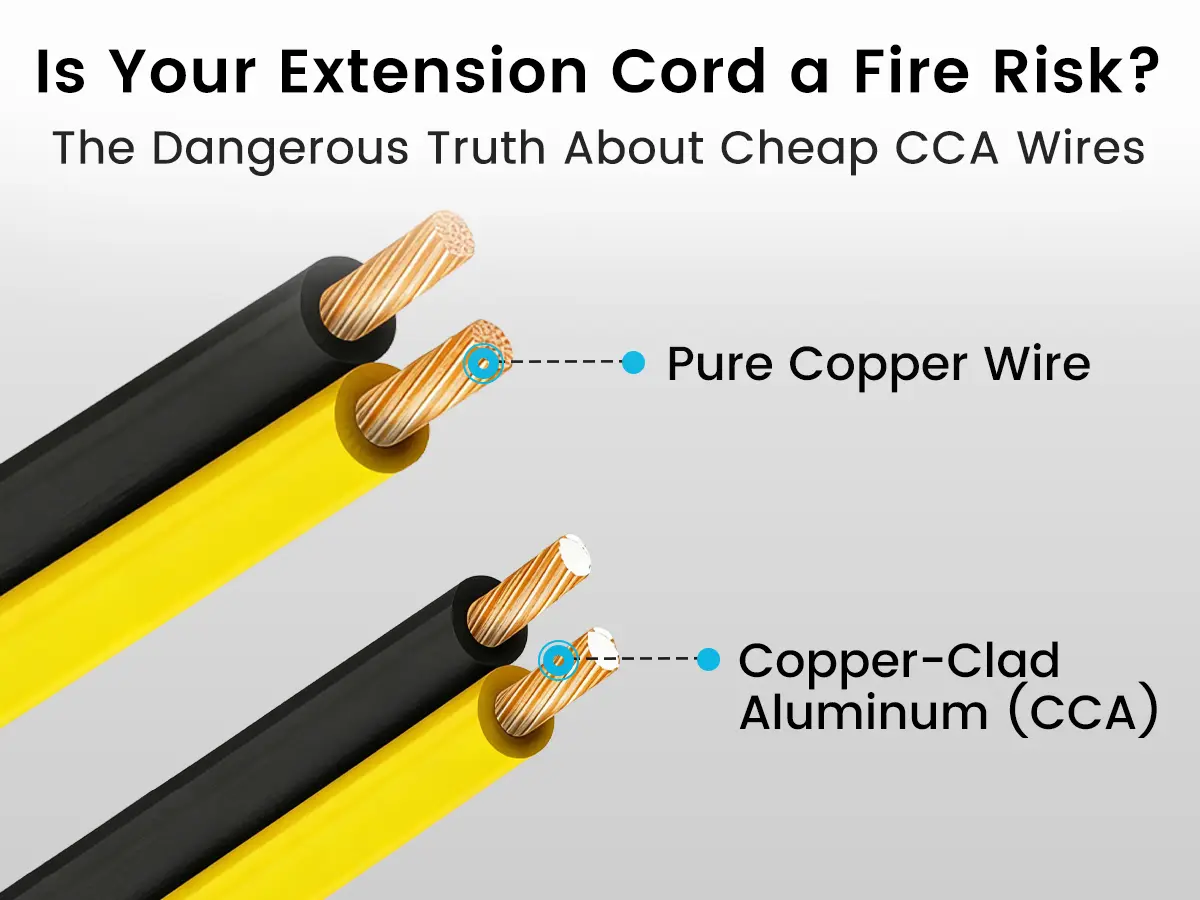
You bought a "heavy-duty" extension cord for your expensive RV or backup generator, thinking you were safe. But inside that colorful plastic jacket, a cheap secret might be overheating as we speak.
Many budget-friendly cords sold online today use Copper-Clad Aluminum (CCA) instead of Pure Copper (BC). While they look identical on the outside, choosing the wrong one is a dangerous compromise that could cost you your appliances—or even your home.
Vantecable Extension Cords
Compare conductor materials, wire gauges and lengths to find the right extension cord for your setup.
1. What is the "Hidden Truth" About CCA?
CCA consists of an aluminum core coated with a thin layer of copper. Manufacturers use it for one reason: to cut costs.
The problem? Aluminum has only about 61% of the conductivity of copper. When you run high-amperage equipment like an RV air conditioner or a space heater, the higher resistance in a CCA wire generates excessive heat. According to Joule’s Law (P = I2R), because CCA has higher resistance (R), it generates significantly more heat (P) under the same current (I). In high-load scenarios like running an RV AC unit, CCA can melt its own insulation, leading to catastrophic electrical fires.
2. The Gold Standard: ETL/UL Certification
Before you trust a cord with your power, look for the ETL/UL Listed Mark.
-
What it means: This certification proves the product has been independently tested by Intertek and meets strict North American safety standards.
-
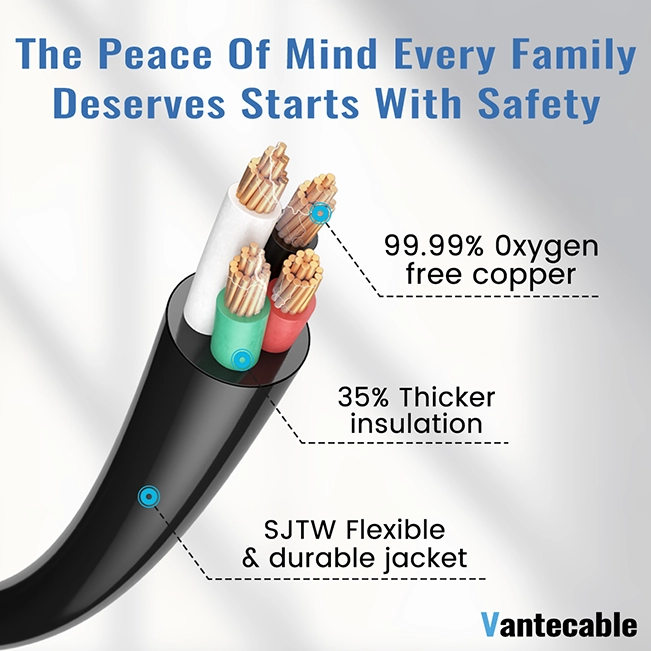
Vantecable’s Promise: All our cords are ETL Listed and built with 100% pure copper to handle the rigorous thermal demands of heavy-duty use.
3. How to Spot a "Fake" Heavy-Duty Cord (The Weight Test)
Copper is nearly 3 times denser than aluminum. If your cord feels suspiciously light, it’s a red flag. Use our standard weight chart below to verify your cord's integrity.
Pure Copper Standard Weight Reference (ETL Certified SJTW/STW)
| Gauge (AWG) | 25 ft (Standard) | 50 ft (Standard) | 100 ft (Standard) |
|---|---|---|---|
| 10 AWG (Super Heavy Duty) | ~7.0 lbs | ~13.0 lbs | ~24.5 lbs |
| 12 AWG (Heavy Duty) | ~4.5 lbs | ~8.0 lbs | ~15.5 lbs |
| 14 AWG (Medium Duty) | ~3.3 lbs | ~6.0 lbs | ~11.5 lbs |
|
16 AWG (Light Duty) |
~2.3 lbs |
~4.2 lbs |
~8.0 lbs |
Pro Tip: If your 100ft "12-gauge" cord weighs only 10-11 lbs, it is 100% CCA. A genuine 12 AWG copper cord must weigh over 15 lbs to safely carry the rated current.
4. Two More Ways to Reveal the Truth
If the weight still leaves you unsure, try these professional tricks:
A. The Scratch Test (The Truth Unveiled)
Take a pocket knife and carefully scrape the surface of one internal wire strand at the plug end:
-
Pure Copper: Remains golden-orange throughout.
-
CCA: Reveals a silver-white aluminum center.
B. The Coil & Flex Test
Pure copper is highly ductile. It feels "supple," lays flat when u
ncoiled, and stays flexible in cold weather. CCA is stiff, "springy," and develops permanent kinks that can eventually snap the internal strands.
5. Summary: Why Vantecable Only Uses Pure Copper
| Feature | 100% Pure Copper (Vantecable) | Copper-Clad Aluminum (CCA) |
|---|---|---|
| Safety | Runs Cool / Fire Safe | High Risk of Overheating |
| Appliance Health | Stable Voltage | Voltage Drops (Damages Motors) |
| Durability | Flexible / Long-lasting | Brittle / Breaks Easily |
| Certification | ETL Listed | Often Missing or Fake |
Conclusion: Don't Trade Safety for a Few Dollars
A cheap extension cord is a high-risk gamble. At Vantecable, we refuse to use CCA. Whether it’s our 10 AWG generator cords or 50 Amp RV extensions, we use only 100% pure copper to give you peace of mind.
Protect your gear. Protect your family. Invest in Copper.
FAQ: Frequently Asked Questions About Extension Cords
Q1: Is it safe to use a CCA extension cord for a space heater or AC?
No. Space heaters and air conditioners draw high current (amperage) continuously. Because CCA has higher resistance, it will heat up much faster than pure copper. This can melt the plug or the cord’s insulation, posing a severe fire hazard. Always use 100% pure copper for high-wattage appliances.
Q2: Why is pure copper more expensive than CCA?
Copper is a semi-precious metal with superior conductivity and durability. Aluminum is much cheaper and more abundant but less efficient at conducting electricity. While a pure copper cord like Vantecable costs more upfront, it is a one-time investment in safety and prevents expensive damage to your RV or generator’s motor.
Q3: Can I tell the difference between Copper and CCA by looking at the jacket?
Generally, no. Both cords use similar plastic jackets (like SJTW or STW). The only way to tell is by checking the ETL/UL markings on the jacket, performing a weight test, or doing a scratch test on the internal wire strands.
Q4: Does a 12 AWG CCA cord perform the same as a 12 AWG copper cord?
Definitely not. A 12 AWG CCA cord only has the power-carrying capacity of roughly a 14 or 16 AWG copper cord. If you use a 12 gauge CCA cord where 12 gauge copper is required, you will experience a significant voltage drop, which can burn out your appliance motors over time.
Q5: Is Vantecable’s extension cord ETL certified?
Yes. All Vantecable heavy-duty extension cords are ETL Listed. This means they have been rigorously tested for safety and material integrity, ensuring they meet the 100% pure copper standards required for North American homes and RVs.