
.png?w=1368&h=240)
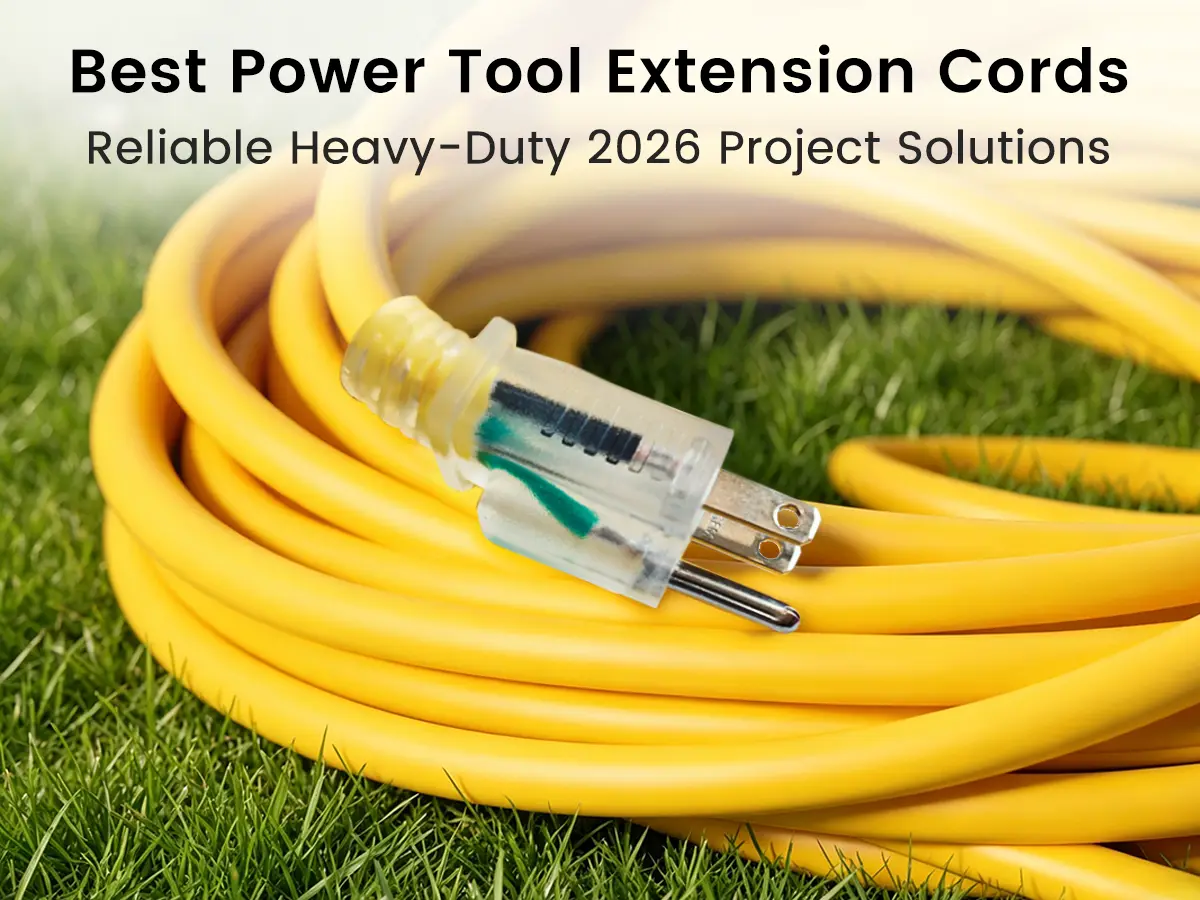
High-performance power tools are the backbone of any serious workshop or construction site. Whether you are running a 15-amp table saw, a high-pressure washer, or a heavy-duty air compressor, the "veins" supplying electricity to these machines are just as critical as the tools themselves. In 2026, as tool motors become more efficient yet sensitive to power fluctuations, choosing a subpar extension cord isn't just a minor inconvenience—it’s a risk to your equipment’s lifespan.
Many DIYers and even some pros fall into the trap of using whatever orange cord is lying around the garage. However, high-amp tools have unique electrical demands. Using the wrong gauge can lead to the dreaded "trip" of your circuit breaker or, worse, a "brownout" condition where your tool’s motor struggles for power, overheats, and eventually burns out. This guide will walk you through the absolute best extension cords for power tools in 2026 and how to match them to your specific gear.
Why High-Amp Tools Require Thicker Copper Cables
When you trigger a high-torque tool, it draws a massive initial surge of current known as "inrush current." If your extension cord is too thin or too long, it creates electrical resistance. This resistance causes a voltage drop, meaning if 120V leaves your wall outlet, only 105V might reach your tool. This loss of energy isn't just gone; it turns into heat inside the cord and the tool's motor, which is the primary cause of premature tool failure.
What is Voltage Drop and How It Affects Your Power Tools
Voltage drop is the decrease in electrical potential as alternating current (AC) flows through the resistance of a conductor—in this case, your extension cord. According to Ohm’s Law (), as the current () or the resistance () increases, the voltage lost () across the cable also increases. Resistance is physically dictated by the cord's material, its cross-sectional area (gauge), and its total length. When an extension cord is too thin for the tool’s amperage, it acts like a bottleneck in a water pipe, restricting the "pressure" (voltage) needed to drive the motor efficiently.
For high-amp power tools, voltage drop is particularly destructive because of the inverse relationship between voltage and heat in induction motors. When a motor receives lower-than-rated voltage, it compensates by drawing even more current to maintain its torque, creating a feedback loop of escalating heat. This thermal stress degrades the winding insulation and can lead to immediate "tripping" of the circuit breaker or long-term catastrophic motor failure. To maintain peak performance and safety, the National Electrical Code (NEC) generally recommends keeping total voltage drop under 3% for branch circuits, which is why upgrading to a thicker 10 or 12 AWG copper cord is a mechanical necessity, not an elective upgrade.
Top Recommendations for 2026: The Heavy-Duty Lineup
1. The "Gold Standard" for Job Sites: 12 AWG Extension Cords
For the majority of professional-grade tools like circular saws, 15-amp miter saws, and mid-sized compressors, a 12-gauge cord is the non-negotiable standard. These cords strike the perfect balance between high conductivity and manageable weight. In 2026, job site safety and visibility have become top priorities, leading pros to move away from generic black cords toward high-visibility, safety-certified solutions.
Our Top Pick:
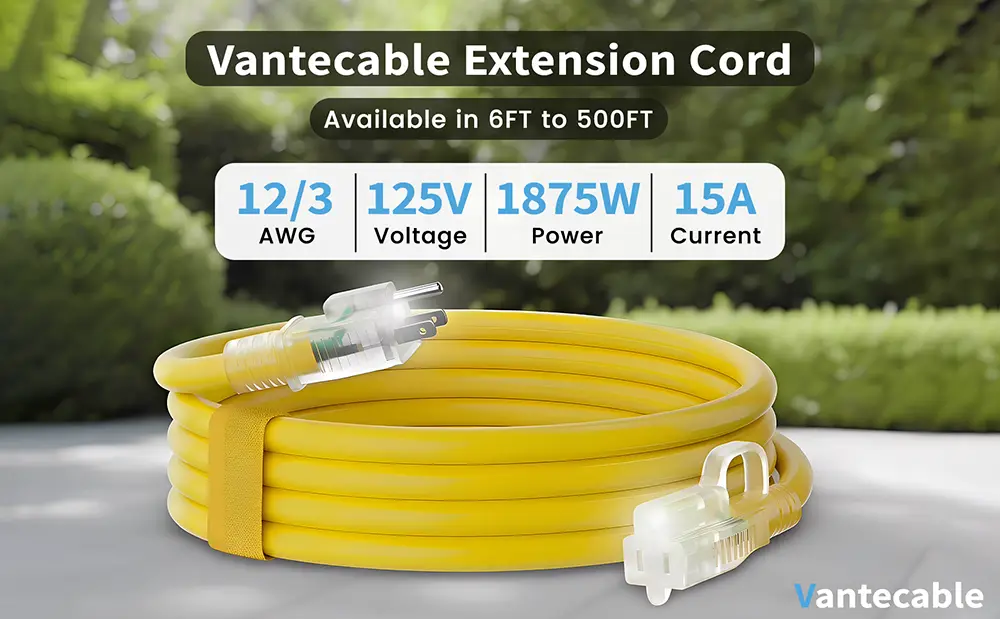
SHOP 12/3 HEAVY DUTY CORD — CHECK PRICE
This cord is specifically engineered for high-demand environments. The high-visibility yellow jacket ensures it won't become a trip hazard in a cluttered workspace, while its ETL listing guarantees it meets rigorous North American safety standards. What sets this model apart is the integrated LED Lighted End, which provides an instant visual confirmation that your tool has power, saving you the frustration of troubleshooting a "dead" tool across a large job site.
2. The "Indestructible" Workhorse: 10 AWG Extra Heavy-Duty Cords
If you are operating a large 5HP air compressor, a commercial-grade pressure washer, or running any high-draw machinery at a distance of 100 feet or more, you need a 10 AWG cord. This is the thickest standard portable cord available—essentially a portable sub-panel in terms of power delivery. It is built to handle 15-amp to 20-amp continuous loads without breaking a sweat, effectively eliminating the voltage drop that kills motors.
Our Top Pick:
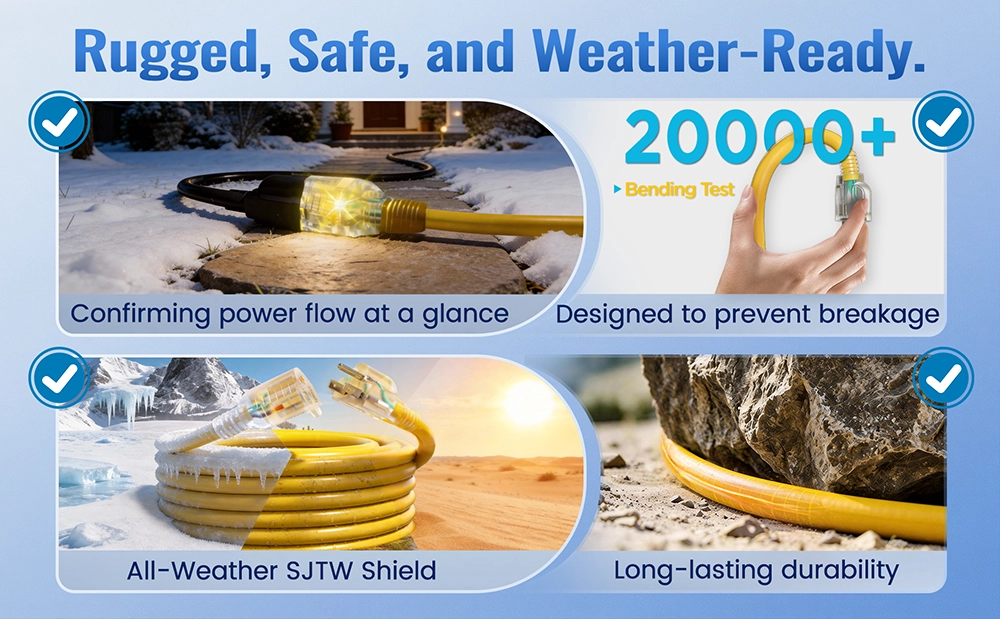
SHOP 10/3 ULTRA HEAVY DUTY CORD → BUY TODAY
When absolute power reliability is the only option, this Ultra Heavy-Duty cord delivers. Built with 100% pure flexible copper, it handles a full 1875W/15A load with zero performance loss. Like its 12 AWG sibling, it features a Waterproof SJTW jacket and an LED Lighted Indicator, but with the added thermal mass of 10-gauge wire to handle massive inrush currents from heavy-duty motors. Whether it's freezing outside or a scorching summer day, this ETL-listed cord stays flexible and provides the "clean" power your most expensive tools demand.
Critical Safety Standards and Certifications
Safety isn't just about the thickness of the wire; it's about the quality of the insulation and the integrity of the connections. When shopping for the best extension cords for power tools, you must look for the ETL or UL certification marks. These logos confirm that the cord has undergone rigorous testing for fire safety, grounding integrity, and sustained load capacity.
Pro Tip: Check the NEMA configuration. Most high-amp tools in the US use a NEMA 5-15P (standard 3-prong) or NEMA 5-20P (with one horizontal blade). Ensure your extension cord matches the amperage of your tool and the outlet you are plugging into. Referring to OSHA’s Electrical Safety Guidelines can provide further technical context on job site compliance.
Furthermore, 2026 has seen a rise in "counterfeit" cords that use copper-clad aluminum (CCA) instead of pure copper. CCA is lighter and cheaper but has significantly higher resistance, making it dangerous for high-amp tools. Always verify that your cord is 100% Pure Oxygen-Free Copper to ensure the lowest possible resistance and the highest safety margins.
Why Your Tools Are Still Tripping
If you’ve bought a high-quality cord and your breaker is still tripping, the issue might be "daisy-chaining." This is the practice of plugging one extension cord into another to reach a further distance. Every connection point introduces a jump in resistance and a potential point of failure. If you need 100 feet of reach, buy a single 100-foot 12 AWG cord rather than connecting two 50-foot cords.
Another common mistake is leaving the cord coiled while in use. When a high current flows through a coiled cable, it creates an electromagnetic field that generates significant heat. This "induction heating" can actually melt the insulation of the cord from the inside out, even if the tool is within the cord's rated amperage. Always uncoil your cord completely before starting a high-demand project.
Comparison Table: Choosing the Right Cord for Your Tool
| Tool Type | Amperage Draw | Recommended AWG (under 50ft) | Recommended AWG (50-100ft) |
|---|---|---|---|
| Table Saws / Miter Saws | 15A | 12 AWG | 10 AWG |
| Electric Pressure Washers | 13A - 15A | 12 AWG | 12 AWG |
| Large Air Compressors | 15A - 20A | 10 AWG | 10 AWG |
| Orbital Sanders / Drills | 5A - 8A | 14 AWG | 12 AWG |
| Angle Grinders | 10A - 12A | 12 AWG | 12 AWG |
Maintenance: Keeping Your Power Clean
An extension cord is a tool, and like any tool, it requires maintenance. Periodically inspect the prongs for oxidation or bending. If a prong is loose, it can create an arc, which generates heat and ruins the outlet. In 2026, many premium cords come with molded "strain relief" boots that prevent the wire from pulling out of the plug head—ensure these are intact.
Additionally, keep your connectors clean. Dirt, sawdust, and moisture in the plug ends can increase resistance. For those working in outdoor or garden environments, using a water-resistant cord seal or a simple "cord lock" box can prevent the connection from pulling apart and protect against short circuits caused by damp ground.
Final Verdict: Invest in Copper, Save Your Tools
Choosing the best extension cord for high-amp power tools in 2026 comes down to one simple rule: Don't undersize. While a 10 AWG cord might feel like an overkill "over-investment" today, it is significantly cheaper than replacing a burned-out motor on a $600 table saw or paying for an electrician to reset a damaged breaker panel.
For the best results, we recommend keeping a high-quality 50ft 12/3 SJTW cord for your daily tasks and a 100ft 10/3 cord for your most demanding, long-reach applications. By prioritizing pure copper, proper gauge, and safety certifications, you ensure that your tools perform at their peak efficiency every time you pull the trigger.
Take Action Today
-
Audit Your Gear: Check your current cords for any signs of heat damage or "softness" in the insulation.
-
Upgrade Your Setup: Visit our Power Solutions Library to find the perfect heavy-duty cord for your specific workshop needs.
-
Stay Safe: Always refer to your tool's manual for specific manufacturer-recommended extension cord lengths and gauges.
Looking for more technical guides? Read our latest article on Understanding Voltage Drop for RV and Generator Power to master your power management.