

What wire size do I need for a 20 amp circuit?
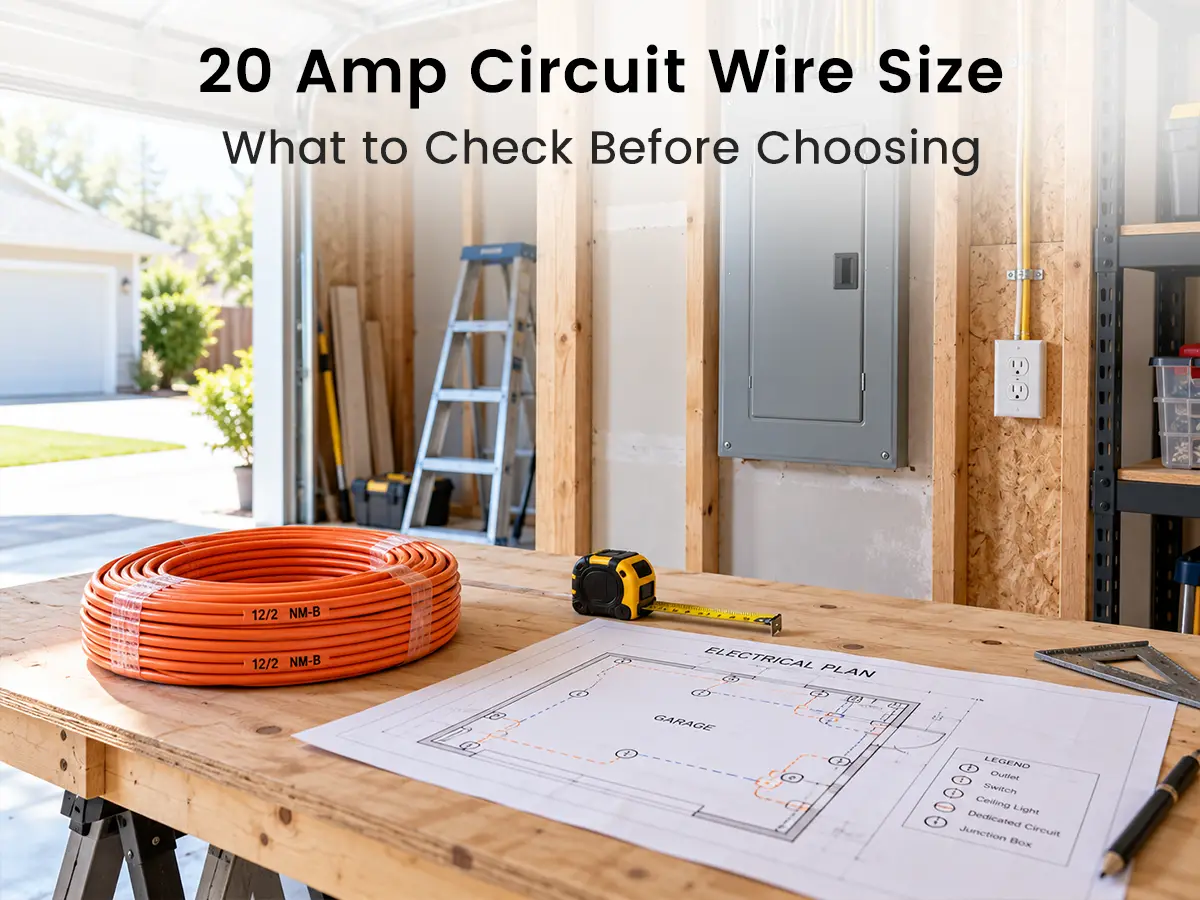
A standard 20-amp, 120-volt residential branch circuit calls for 12 AWG copper. The breaker protects the wire from overheating, so the wire is sized to the breaker: a 20A breaker needs at least 12 AWG, and 14 AWG wire needs a 15A breaker. Check the breaker label and the cable jacket print before you buy or reuse any cable.
The number of outlets does not change the gauge. A 20A circuit needs 12 AWG whether it feeds one receptacle or several, so a plan for more outlets is not a reason to use thinner wire. The gauge is only part of the answer, because the cable type also has to suit the place where it will run.
Electrical Wire
Shop wire and cable for home wiring, landscape lighting, and equipment connections.
Shop Electrical WireCan I use 14 gauge wire on a 20 amp breaker?
No. 14 AWG copper belongs on a 15A circuit, and NEC 240.4(D) limits overcurrent protection for 14 AWG to 15A, so a 20A breaker does not meet that requirement.
The breaker trips only when current passes its own rating. A 14 AWG conductor on a 20A breaker can carry a current that is too high for the wire but too low to trip the breaker, so the wire heats up inside the wall with nothing to stop it.
If you find 14 AWG on a 20A breaker, there are two correct fixes. Replacing the breaker with a 15A one limits the circuit to 1,440 W of continuous load (15A × 120V × 80%). Re-pulling the run with 12 AWG keeps the full 20A and supports 1,920 W of continuous load. Replace every 14 AWG segment on the run, because one remaining segment keeps the whole circuit at 15A. Both fixes involve the panel or in-wall wiring, so call a licensed electrician if you are unsure which applies.
How do I match the breaker, wire and device ratings?
The breaker, the wire and every device terminal on a 20A circuit must each be rated for 20A. The lowest-rated part sets the limit for the whole circuit.
The table pairs standard copper NM-B gauges with breaker sizes and shows the continuous load each pairing supports at 120V.
| Wire Gauge | Breaker Rating | Max Continuous Load at 120V (80%) | Typical Use |
|---|---|---|---|
| 14 AWG copper | 15A | 1,440 W | Lighting circuits, low-draw outlets |
| 12 AWG copper | 20A | 1,920 W | General-purpose room outlets, small appliances |
| 10 AWG copper | 30A | 2,880 W | Dedicated 30A circuits for large equipment |
The 80 percent column applies to loads that run three hours or more, such as a heater or a freezer. Local code and the actual load decide the final choice.
A higher-rated breaker does not upgrade the wiring or devices already in the circuit. A 20A breaker on 14 AWG wire leaves a 15A conductor in place, and a 15A-rated switch or outlet on a 20A circuit can develop a loose or overheating connection over time. Check the rating stamped on each outlet, switch and in-line connector, not just the faceplate, and confirm each one is listed for 12 AWG copper. If one part is mismatched, replace it instead of working around it.
Where can 12/2 NM-B be installed, and how long can the run be?
Location and distance decide whether 12/2 NM-B fits your run. NM-B belongs in dry interior spaces, and a run near 100 feet should be checked for voltage drop. The ampacity rules that govern NM-B cable are set out in NEC Article 334, which you can read in full free on UpCodes.
Can I use NM-B cable in a garage, attic or outdoors?
NM-B is rated for dry interior locations such as wall cavities, ceiling spaces and finished attics, where the cable is protected from moisture and physical damage. It is not rated for outdoors. Wet, damp or exposed locations need a different wiring method entirely. Underground feeder cable, or UF-B cable, is the common alternative for outdoor and direct-burial runs, and installing it is a separate job from choosing NM-B.
A garage depends on its condition. A finished, conditioned garage may qualify as a dry location under your local code, while an unfinished garage with an exposed slab and no climate control may not. Your local authority decides how that is interpreted, so confirm it before you buy material.
Caution: Never install NM-B in a wet or damp location, in conduit buried underground, or in any exposed exterior run. Using it outside its rated environment is a code violation and a fire and shock hazard.
Is 12 AWG still enough on a run of 100 feet or more?
Usually yes for a lightly loaded circuit, but a run near full load needs checking. Every conductor adds resistance as the run gets longer, so devices at the far end receive less than 120 V. At 15A, 12 AWG copper loses about 4% of the voltage over 100 feet, which is above the 3% the NEC recommends for branch circuits, and stepping up to 10 AWG keeps the drop within range.
The actual load decides it, not the breaker rating. A 100-foot garage run feeding a few phone chargers and a work light is usually fine, while one feeding a table saw or compressor near full draw may need 10 AWG. Treat 100 feet as a prompt to calculate, not a hard cutoff, and use our voltage drop calculator guide to run the numbers for your wire size, distance and load.
When should I check local code, permits or call an electrician?
Check with your local building department before you buy, because the code edition and amendments vary by area and most residential branch-circuit work needs a permit and inspection. Call a licensed electrician if the location, the run length or the load calculation is uncertain.
What should I check on a 12/2 NM-B cable label before buying?
Read the printed jacket, not the color or the package photo. A cable that suits a 20A branch circuit shows 12 AWG, NM-B and two insulated conductors plus ground ("12/2") on the sheath itself.
The table lists each marking to check and the sign that the cable is wrong for this circuit.
| Check Item | What to Look For | Red Flag |
|---|---|---|
| Gauge and conductors | "12 AWG" with two insulated conductors (black and white) plus a bare ground | No gauge marking, "14 AWG", or "12/3" when you only need two current-carrying conductors |
| Cable type | "NM-B" printed on the sheath | "UF-B", "THHN" or no type marking |
| Voltage rating | 600 V, the standard NM-B rating | Low-voltage marking such as speaker or alarm wire |
| Conductor material | Copper, because the 20A rating for 12 AWG assumes copper | Aluminum or CCA (copper-clad aluminum), which NEC 240.4(D) limits to 15A at 12 AWG |
| Jacket color | Varies by manufacturer | Relying on color without reading the print |
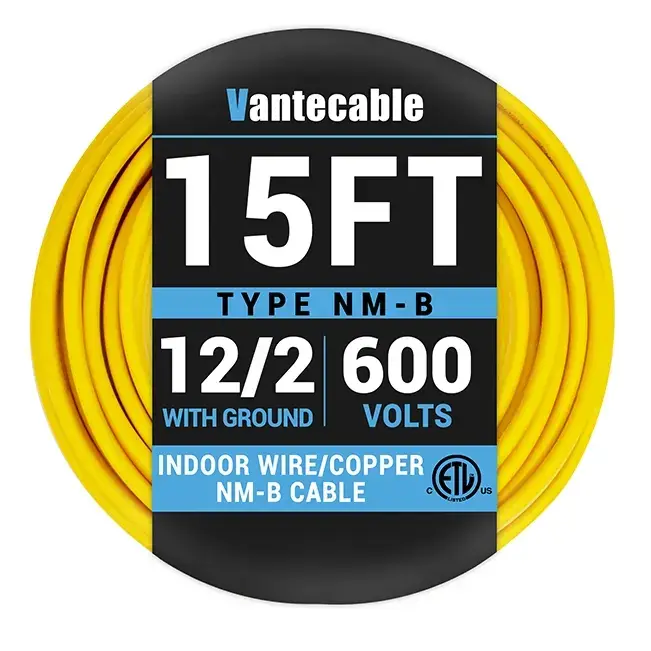
Copper carries current with less resistance and less heat than aluminum at the same gauge, so two wires with the same AWG number do not carry the same load when the metal differs. Our copper vs CCA wire comparison explains the difference. Jacket color is a convenience, not a standard. Vantecable's NM-B line uses orange for 10/2 and yellow for 12/2, but another maker may color its cable differently, so let the print decide.
Vantecable NM-B 12/2 Wire with Ground
Copper NM-B cable with ground for indoor residential wiring. Available in four lengths to fit your home improvement project.
- Wire Gauge
- 12 AWG
- Voltage Rating
- 600V
- Available Lengths
- 15 / 25 / 50 / 100 Ft
- Material
- Copper
Look-alikes are the real purchasing risk. Speaker, alarm and thermostat wire can be sold in similar-looking coils, and 20 AWG stranded conductors are far too small for a 20A breaker. If the label shows "20 AWG" or no NM-B marking, it is the wrong product for this circuit.
Caution: Do not buy cable with a worn, missing or unreadable jacket print, and do not accept a seller's description in place of the marking. If the cable you receive does not match the label you ordered, return it instead of using it on a branch circuit.
Once the print matches, keep the purchase record and a photo of the jacket marking for your permit or inspection.
20 amp wire size FAQ
Can 15 amp outlets go on a 20 amp circuit?
Yes, provided the circuit has two or more receptacles and is wired with 12 AWG copper. A single receptacle on its own circuit must be rated 20A. The breaker still protects the 12 AWG wire at 20A, so confirm the device terminals accept 12 AWG copper and check local code first.
How many outlets should be on a 20 amp circuit?
The NEC does not set a hard maximum for general-use receptacles on a 20A, 120V residential circuit. A common planning figure is 8 to 10 outlets, based on 180 VA per receptacle against the 1,920 W (16A) continuous limit. Add up the loads that run at the same time and keep them under that limit, and ask your electrician or inspector to confirm the count for your circuit.
What is the 2-6-12 rule for electrical outlets?
It is the NEC 210.52(A) layout rule for wall receptacles in rooms such as living rooms, bedrooms and dining rooms. Any wall space 2 feet or wider needs a receptacle, no point along the wall may be more than 6 feet from one, and receptacles may be no more than 12 feet apart. It tells you where outlets go, while the breaker rating still sets the wire gauge.
Conclusion: confirm the whole chain, then buy
A 20-amp circuit needs a 20A breaker, 12 AWG copper conductors, device terminals rated for 20A and a cable type that suits where it will run, and the lowest-rated part sets the limit. 12/2 NM-B fits that chain only in the dry interior spaces its type allows.
Before you order, hold your circuit plan next to the cable's printed jacket and confirm the print agrees with your breaker, your devices and the route the cable will take. Settle long runs and unusual locations with your local code office or a licensed electrician first. When the markings line up, Vantecable electrical wire is available in 10/2, 12/2 and 14/2.
Electrical Wire
Shop wire and cable for home wiring, landscape lighting, and equipment connections.
Shop Electrical Wire