
.png?w=1368&h=240)
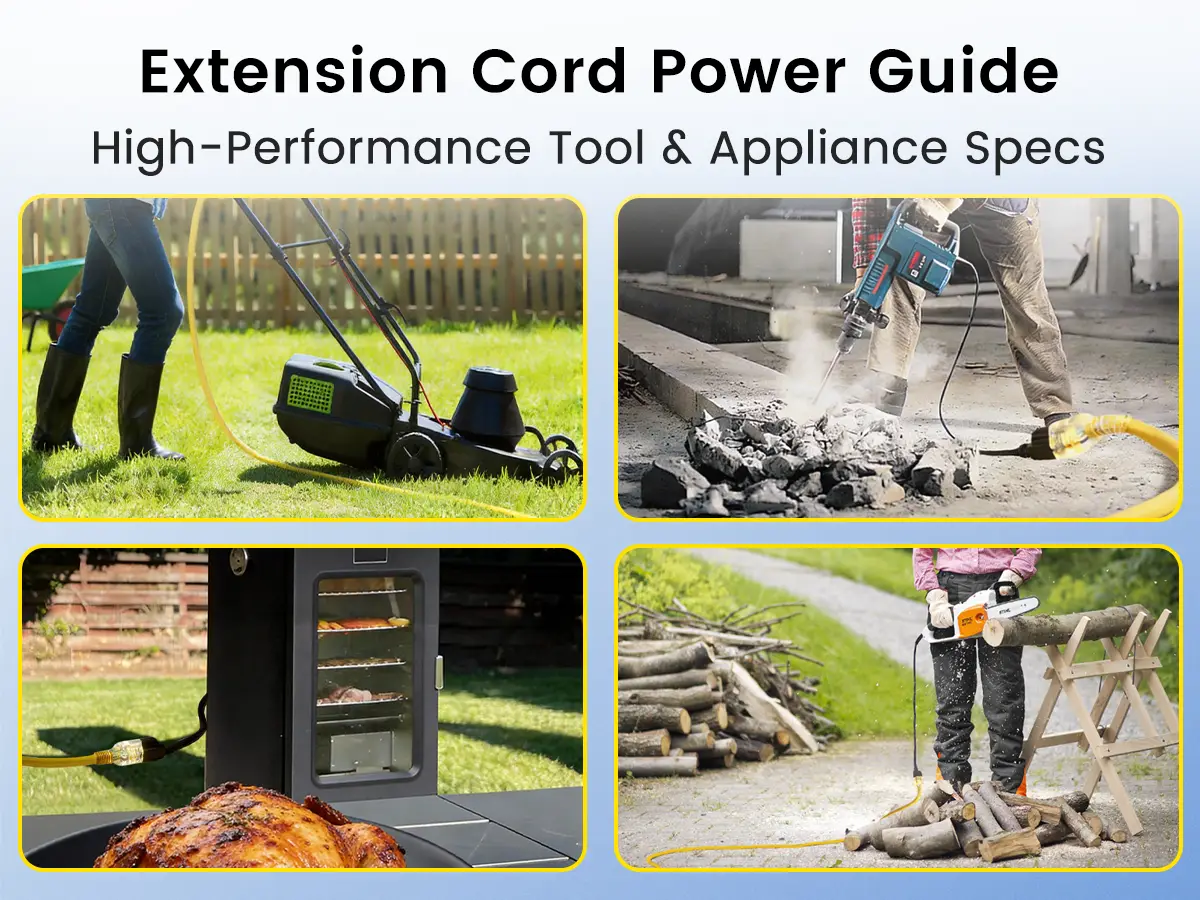
When you’re tackling a DIY project in the backyard, setting up a backup power system for a storm, or simply plugging in a new garage refrigerator, the "humble" extension cord is often the most overlooked piece of equipment. However, in the world of electrical engineering, the cord is not just a wire; it is a critical component of the circuit. Using the wrong cord is more than just a minor inconvenience; it is a significant safety hazard that can lead to permanent motor damage, electrical fires, and voided warranties.
For a high-performance brand like Vantecable, we understand that power is only as reliable as the conduit carrying it. Whether you need a heavy duty extension cord for a professional job site or a specialized connection for a home backup system, understanding the science of Gauge (AWG), Amperage, and Distance is critical. This comprehensive guide will walk you through exactly how to match your cords to your high-demand gear to ensure safety and peak performance.
1. The Core Science: Understanding AWG, Resistance, and Voltage Drop
Before we dive into specific applications, we must address the "Gauge" or AWG (American Wire Gauge). This is the universal standard in North America for measuring the diameter of electrical conductors. The most important rule to remember is counterintuitive: A smaller AWG number means a thicker wire.
Why Wire Thickness Dictates Performance
When electricity travels through a copper wire, it encounters resistance. If the wire is too thin for the amount of current (Amps) being pulled by a motor, that resistance turns into heat. This causes a phenomenon known as "Voltage Drop." In simple terms, if your wall outlet provides 120V but your cord is too thin or too long, your power tool might only receive 105V.
A significant drop in voltage means your tools will run sluggishly, run hotter, and eventually burn out their brushes or capacitors. For sensitive electronics or high-torque motors, this "brownout" effect is the silent killer of equipment. Thick wires (like 10 AWG and 12 AWG) have lower resistance, allowing them to carry more current over longer distances without significant loss.
The Physics of Power Loss
The relationship between current (I), resistance (R), and voltage drop (V) is governed by Ohm’s Law. As the length of your cord increases, the total resistance increases proportionally. This is why a 100-foot cord must always be a thicker gauge than a 25-foot cord used for the same tool. According to the National Electrical Code (NEC), voltage drop should ideally be kept under 3% for optimal performance.
Swipe left to view more →
| Gauge (AWG) | Max Amperage (up to 50ft) | Common Applications |
|---|---|---|
| 16 AWG | 13 Amps | Light duty: Lamps, holiday lights, fans |
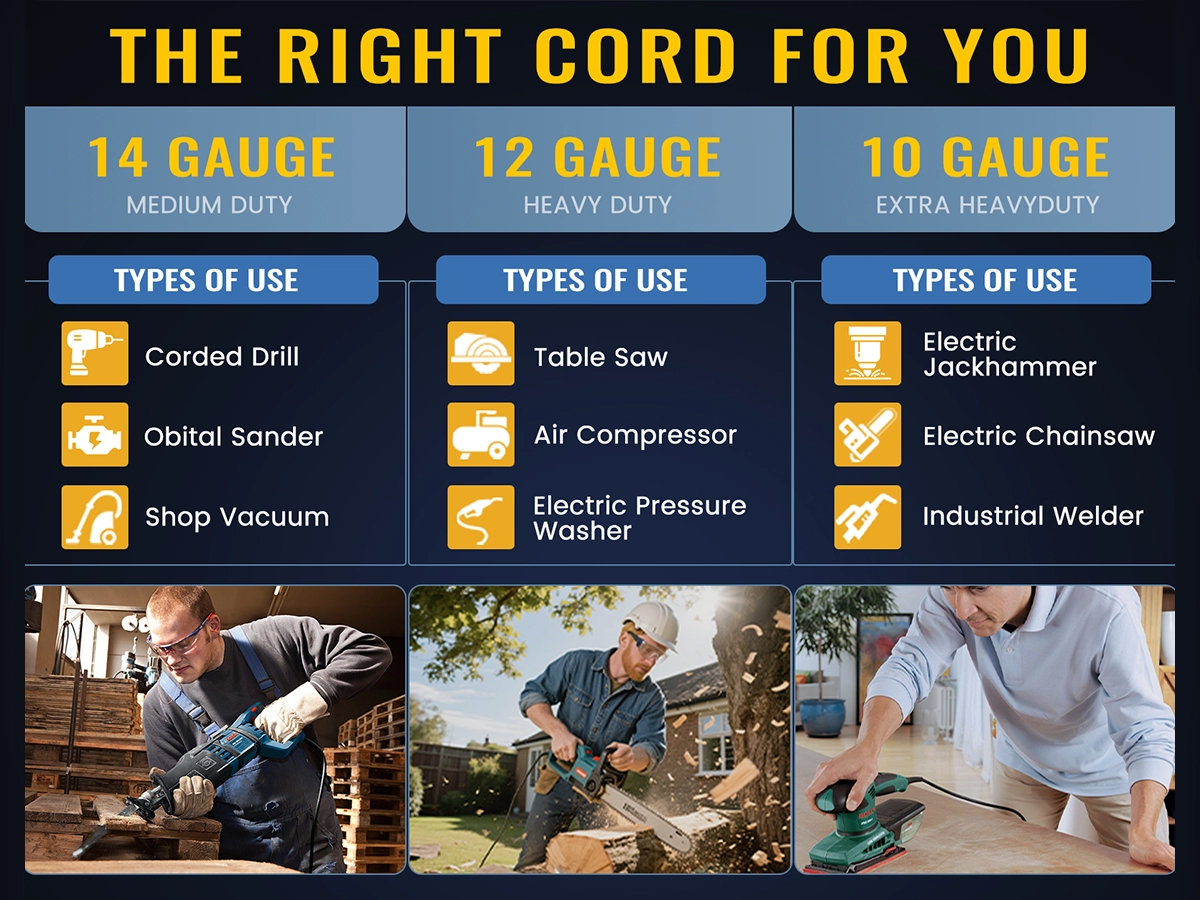
| 14 AWG | 15 Amps | Medium duty: Drills, hedge trimmers, shop vacs |
| 12 AWG | 20 Amps | Heavy duty: Circular saws, air compressors, treadmills |
| 10 AWG | 30 Amps | Pro duty: Large generators, RV power, Electric Chainsaw |
2. Choosing the Right Extension Cord for Power Tools
When looking for an extension cord for power tools, you aren't just looking for "power"—you are looking for industrial-grade durability. Job sites are brutal environments. Cords get stepped on, run over by wheelbarrows, dragged over abrasive concrete, and exposed to sawdust and moisture.
Peak Amperage vs. Running Amperage
One of the most common mistakes users make is checking the "running amps" of a tool and buying a cord based on that number. However, inductive loads (tools with motors) have a "startup" or "peak" amperage that can be 2 to 3 times higher than their running amperage.
For example, a circular saw rated at 15 Amps might draw nearly 30 Amps for a split second when the blade first starts to spin. If you use a thin 16 AWG cord, that initial surge is restricted, causing the motor to struggle and heat up. For any tool with a motor, a heavy duty extension cord (at least 12 AWG) is the professional standard to handle these surges.
The OSHA Standard for Construction
If you are using tools on a professional job site in the U.S., you must adhere to OSHA regulations (29 CFR 1926.405). OSHA requires that all extension cords be "three-wire type" (grounded) and designed for hard or extra-hard usage. Vantecable’s outdoor line features reinforced blades to prevent bending and high-visibility jackets (often yellow or bright orange) to prevent tripping hazards.
Explore our 12/3 SJTW Heavy-Duty Cords for Professional Contractors.
3. Selecting an Extension Cord for Appliances
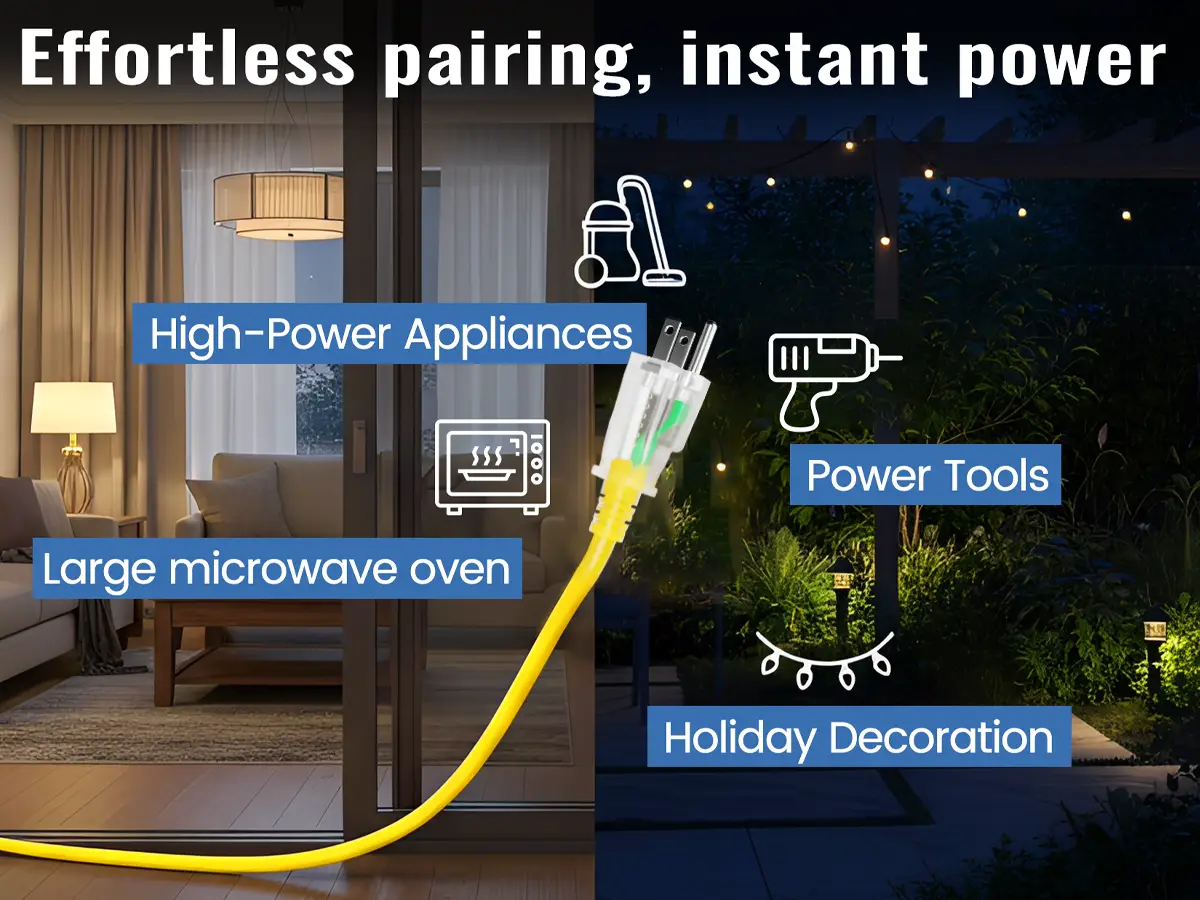
Selecting an extension cord for appliances is a different beast entirely. Unlike power tools, which run intermittently, appliances like refrigerators, portable air conditioners, and space heaters run for hours—sometimes days—at a time. This is known as a "continuous load."
The 80% Rule of Continuous Loading
In the electrical world, a circuit is considered under continuous load if it runs for 3 hours or more. For safety, you should only load a cord to 80% of its maximum capacity. If you have a portable AC unit that pulls 12 Amps, you shouldn't use a cord rated for exactly 12 Amps; you need one rated for 15 Amps or more.
-
Refrigerators & Freezers: These require a dedicated, grounded 14 AWG or 12 AWG cord. If the compressor cannot get enough voltage to start, it will overheat and fail, potentially spoiling hundreds of dollars in food.
-
Space Heaters: These are the leading cause of home electrical fires. They draw a constant, high current (usually 12.5 Amps or 1500 Watts). Never use a "household" 16 AWG cord. A 12 AWG heavy-duty cord is the only safe option if an extension is mandatory.
-
Dehumidifiers: Often found in damp basements, these need cords with moisture-resistant jackets (rated "W") to prevent insulation breakdown.
Understanding Jacket Ratings (SJTW, SOOW)
Look at the printing on the cord's jacket. It tells a story:
-
S: Service Grade (Standard)
-
J: Junior Service (Rated for 300V, standard for household/tool use)
-
T: Thermoplastic
-
W: Weather/Water Resistant (Essential for appliances in garages or basements)
4. The Critical Connection: Extension Cord for Generator Use
When the power goes out during a storm, your generator becomes your lifeline. Choosing the correct extension cord for generator use is the most critical decision you will make regarding your home backup system. Standard household cords are often insufficient for the total output of a modern portable generator.
NEMA Plugs and High-Amperage Delivery
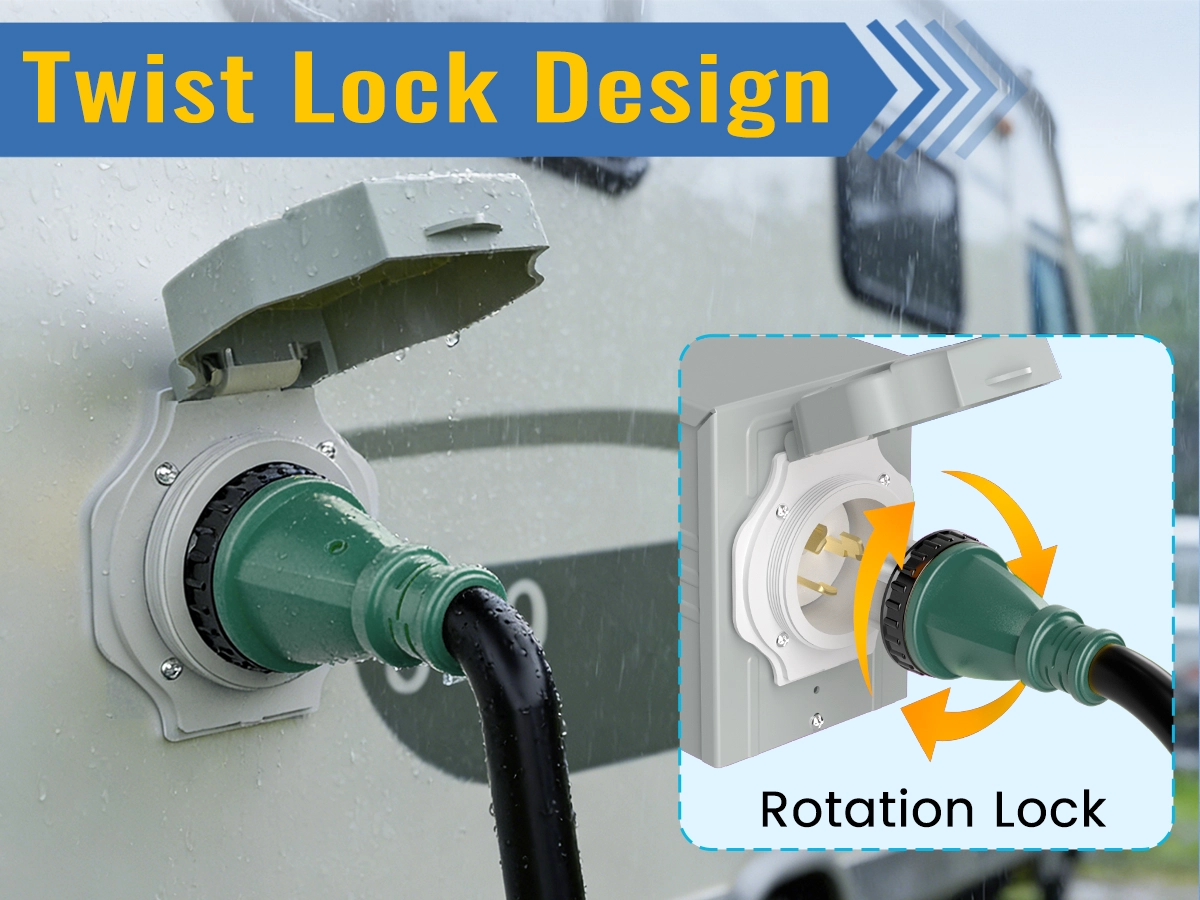
Most portable generators (5,000W to 10,000W) feature a 120/240V 30-Amp or 50-Amp outlet, typically a NEMA L14-30R or SS2-50R. You cannot plug a standard extension cord into these. You need a 10 AWG or 8 AWG "Big Orange" or "Big Blue" cord designed to carry the full load from the generator to a transfer switch or a power inlet box.
Managing Balanced Loads
A generator produces power across two "legs" or phases. When using a generator cord that splits into multiple household outlets (a "power tree"), it is vital to balance your appliances.
-
Phase Balancing: If you plug a microwave and a space heater into the same side of the generator's circuit, you may trip the generator’s breaker even if the total wattage is within limits.
-
Length Matters: Because generators must be kept at least 20 feet away from the home due to Carbon Monoxide (CO) risks, you will likely need a 25ft or 50ft cord. At these lengths, 10 AWG is mandatory to prevent voltage drop for your home's sensitive electronics.
Expert Insight: Always check for UL (Underwriters Laboratories) or ETL listing on your generator cords. Unrated cords may use "Copper Clad Aluminum" (CCA) which has higher resistance and lower safety margins than the pure copper used in Vantecable products.
5. Distance: The Silent Factor in Power Delivery
Length is the enemy of electricity. As a cord gets longer, the resistance increases. A 12 AWG cord that is perfectly safe at 25 feet might cause a dangerous voltage drop at 100 feet.
The "Sizing Up" Rule
If your application requires more than 50 feet of distance, you should automatically move to the next thicker wire gauge.
-
Tool requires 14 AWG at 25ft? Use 12 AWG for 100ft.
-
Appliance requires 12 AWG at 25ft? Use 10 AWG for 100ft.
This "oversizing" ensures that the motor at the end of the line receives the full voltage it was designed to handle, extending the life of your equipment and reducing the risk of the cord's jacket melting due to heat buildup.
6. Identifying the Signs of a Mismatched Cord
How do you know if you've made a mistake before a fire starts? Your equipment will usually provide warning signs. As an operator, you must be vigilant for the following:
-
Physical Heat: Periodically touch the plugs and the cord jacket. If they feel hot (not just warm), the cord is overloaded.
-
Dimming Lights: If your garage lights flicker or dim when your table saw triggers, you are experiencing significant voltage drop.
-
The "Hum" or "Whine": An electric motor struggling with low voltage will often make a higher-pitched whine or a deeper labored hum than usual.
-
Discolored Prongs: If the brass prongs of your cord are turning black, brown, or blue, it indicates "arcing" or excessive heat at the connection point. This usually happens when the outlet is worn out or the cord is being pushed past its amp limit.
7. Environmental Hazards: Indoor vs. Outdoor vs. Extreme Cold
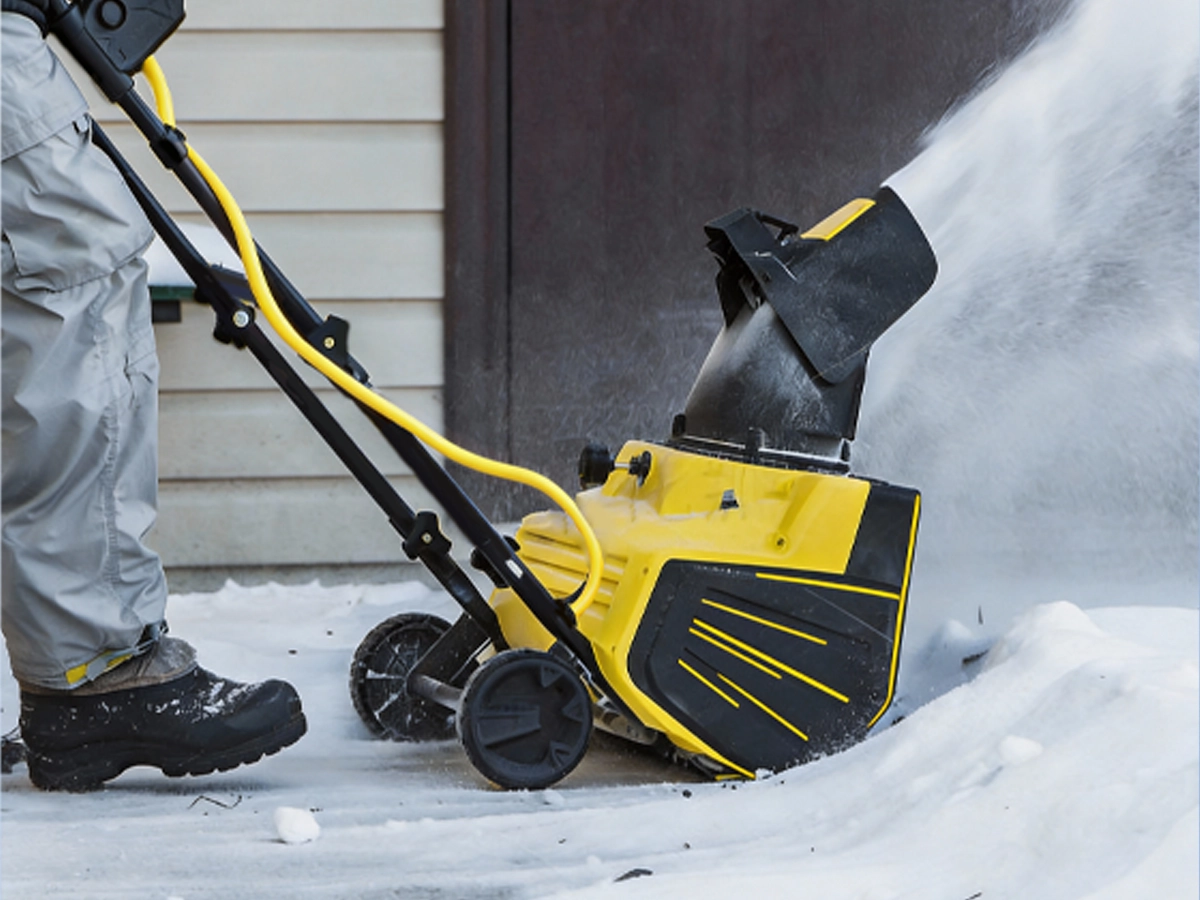
Not all heavy duty extension cords are created equal when it comes to the environment. The American climate ranges from the sub-zero winters of Minnesota to the blistering heat of Arizona.
Cold Weather Flexibility
Standard PVC (Thermoplastic) cords become stiff and brittle in freezing temperatures. They are difficult to uncoil and prone to cracking, which exposes live wires. If you work in cold climates, look for SJEOOW cords. The "E" stands for Elastomer, a rubber-like material that remains flexible down to -50°F.
UV and Chemical Resistance
For outdoor appliances or pool pumps, the cord is constantly bombarded by UV rays. Over time, sunlight breaks down standard plastic, causing it to flake and peel. Vantecable’s outdoor-rated jackets include UV stabilizers to ensure the cord remains safe for years of exposure.
8. Maintenance and Longevity: Caring for Your Investment
Investing in a high-quality 10 AWG or 12 AWG cord is an investment in your tools' longevity. Proper care can make a Vantecable cord last a decade.
-
Don't "Daisy Chain": Never plug one extension cord into another. This doubles the resistance and creates a high-heat "weak point" at the junction.
-
Inspect Regularly: Check for nicks in the jacket. Even a small cut can expose live wires to moisture or dust. Use a cord protector if the cord must cross a walkway.
-
Storage: Avoid tightly coiling cords around your arm/elbow, which can twist the internal copper strands (causing "corkscrewing"). Instead, use the "over-under" coiling method used by professional roadies and electricians.
-
Disconnect Properly: Never pull a cord out of the wall by tugging on the wire. Always grasp the molded plug head. Tugging on the wire eventually pulls the copper strands out of the internal terminals.
Conclusion: Powering Your World Safely
Choosing the right cord is a balance of mathematics, environment, and common sense. By matching the AWG to your tool’s peak amperage and keeping the distance as short as possible, you protect your expensive gear and, more importantly, your home and family.
At Vantecable, we specialize in the "heavy lifting" of the electrical world. Whether you are looking for a reliable extension cord for power tools in your workshop, a safe extension cord for appliances in your garage, or a robust extension cord for generator use during emergencies, we provide the pure copper performance you can trust.
Take Action: Upgrade Your Power Today
Don't let a $20 "bargain" cord ruin a $500 tool or a $2000 generator.
-
[Browse our 10 AWG Generator Power Cords] – The ultimate in storm-ready reliability.
-
[Shop 12 AWG Heavy-Duty Extension Cords] – Perfect for miter saws, compressors, and high-draw tools.
Still not sure which gauge is right for your specific setup? Leave a comment below with your appliance's model number or wattage, and our technical team will help you find the perfect match!
If you're specifically powering power tools, check out our dedicated guide: Power Tool Extension Cord Guide 2026