
.png?w=1368&h=240)
(1).webp?w=2730&h=1535)
Introduction: Why Outdoor Electrical Safety Demands Your Attention
Picture this: you're setting up a festive backyard gathering, powering your string lights and portable speaker with a handy extension cord. Or perhaps you're tackling a weekend gardening project, needing to operate your electric hedge trimmer far from the nearest outlet. In these moments, reaching for an extension cord feels like the obvious solution. But here's the critical truth many overlook: using a standard indoor extension cord outdoors is not just inconvenient—it's dangerous.
Every year, preventable electrical accidents occur due to the misuse of extension cords outdoors, leading to risks of electric shock, fires, and costly equipment damage. The core principle is simple: outdoor extension cords are engineered for a specific set of challenges that indoor cords are not. This guide will walk you through the essential safety knowledge you need to select and use outdoor extension cords correctly, ensuring your projects and pleasures remain safe and uninterrupted.
Part 1: How to Choose a Safe Outdoor Extension Cord – Reading the Labels
Not all extension cords are created equal. Selecting the right one is your first and most crucial line of defense.
1. Look for the Crucial Markings:
-
"For Outdoor Use" or "SUITABLE FOR USE WITH OUTDOOR APPLIANCES": This is non-negotiable. Outdoor cords have thicker, more durable insulation that resists moisture, sunlight (UV rays), and temperature changes.
-
Rating Labels (Wattage/Amps/Volts): Check the cord's rating, usually printed on the jacket or attached tag. A common safe rating for general outdoor use is 13A/125V/1625W. Never exceed the maximum wattage.
-
Wire Gauge (AWG): This indicates the thickness of the wire inside. Lower AWG number = thicker wire = can carry more power over longer distances. For example:
.webp?w=2364&h=1773)
2. Examine Key Physical Features:
-
Jacket: Should be thick, robust, and resistant to weather, abrasion, and sunlight. Look for designations like "W-A" on the jacket.
-
Plugs and Receptacles: The best outdoor cords feature built-in covers or "in-use" covers that shield the outlets from rain and debris even when something is plugged in. Prongs should fit snugly.
Actionable Tip: Before buying, add up the wattage of all devices you plan to power simultaneously. Choose a cord with a wattage rating at least 20-30% higher than that total.
Part 2: Golden Rules for Safe Outdoor Extension Cord Use
Proper usage is just as important as the right purchase.
1. Safe Placement is Vital:
-
Avoid running cords across walkways, driveways, or doorways where they pose a tripping hazard or can be damaged by vehicles.
-
Use cord protectors or covers if you must cross a path.
-
Never puncture a cord by stapling or nailing it to a surface.
2. Make Connections Properly:
-
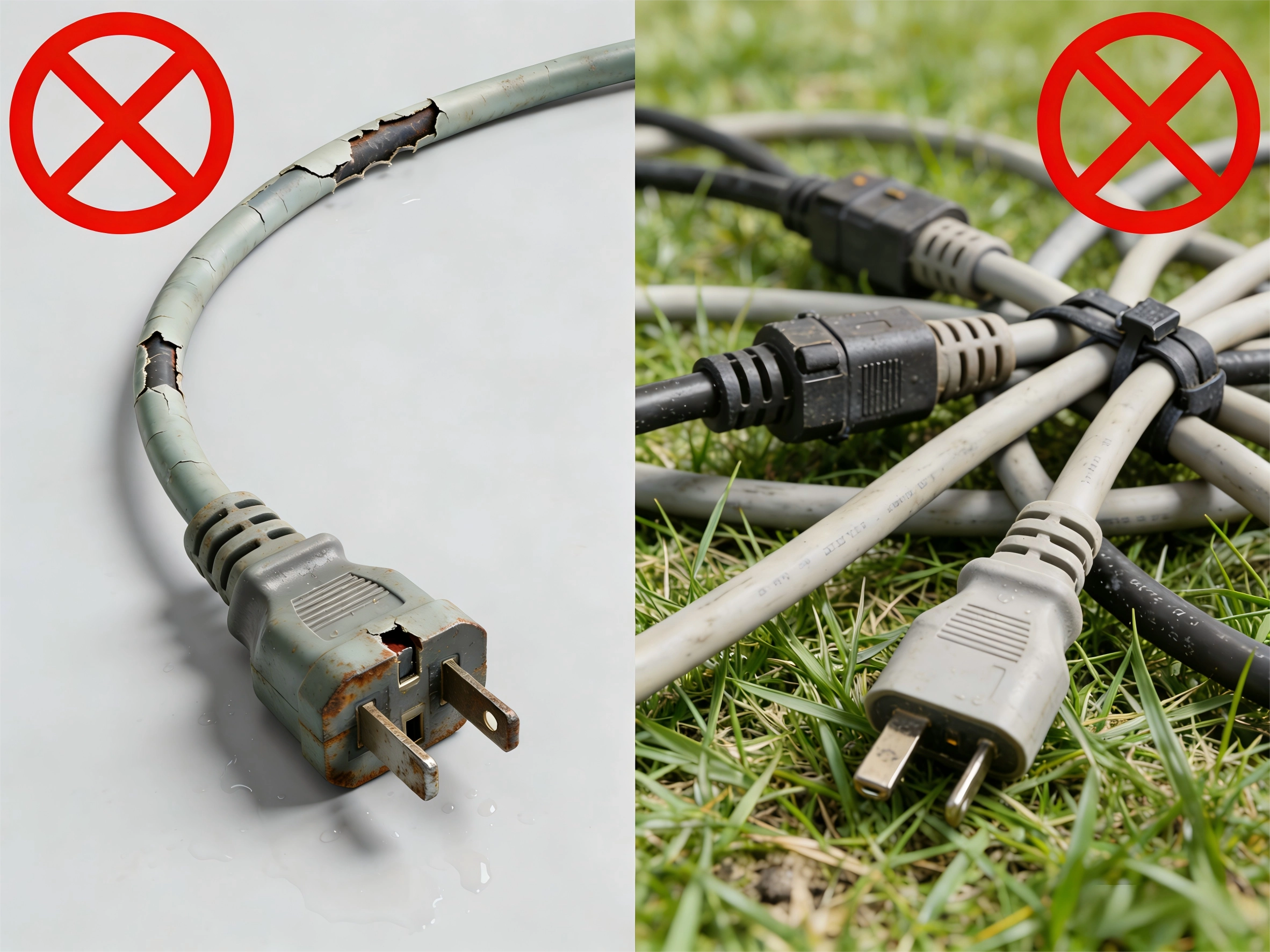
Never "daisy-chain" (connect multiple extension cords together). This increases resistance, leading to overheating and fire risk.
-
Ensure plugs are fully inserted into outlets and connectors are tight.
-
Keep connections off the ground and protected from moisture. Use a waterproof cord connector box if needed.
3. Manage Moisture and Load:
-
Position cords away from pools, puddles, and sprinklers.
-
Never use a cord that feels hot to the touch. This is a primary sign of overload. Unplug it immediately.
-
Be cautious with high-draw appliances like space heaters, grills, or power tools. They often require a dedicated, heavy-duty cord.
4. Practice Good Maintenance:
-
Unplug by pulling the plug, not the cord.
-
Before each use, inspect for cracks, frays, exposed wires, or damaged plugs. Discard damaged cords immediately.
-
Store indoors, loosely coiled in a dry place. Avoid tight kinks.
Part 3: Danger Zones - What You Should NEVER Do
-
NEVER use an indoor-rated cord outside, even temporarily.
-
AVOID using any extension cord in extreme weather like heavy rain or snow, unless it's specifically rated for it and connections are fully protected.
-
DO NOT run a cord through walls, ceilings, or under rugs/carpets.
-
NEVER modify a cord or plug, or attempt to repair a damaged section with tape.
Part 4: Smart Solutions for Common Scenarios
-
Backyard Lighting & Entertainment: A 14 AWG cord with in-use covers is ideal for powering string lights, speakers, or a projector.
-
Gardening & Power Tools: For electric mowers, trimmers, or pressure washers, choose a 12 or 14 AWG cord that's bright-colored (easy to see).
-
Camping & RV Use: Look for dedicated, heavy-duty outdoor cords rated for the full amperage of your RV hookup.
-
Holiday Decorating: Use cords specifically labeled for seasonal/outdoor use. Consider cords with a built-in timer for automation and safety.
Why Vantecable Cords Meet the Standard: Our entire range of outdoor extension cords is built with safety as the priority. Featuring thick, UV-resistant Outdoor-Flex Jackets, triple-layered plugs with full coverage, and clear amperage ratings on every product, we ensure you have the right tool for the job without compromising on safety.
Conclusion: Safety Powers Peace of Mind
Outdoor electrical safety boils down to a simple mantra: Choose the Right Cord, Use it the Right Way, and Inspect it Regularly. By understanding wire gauge, load capacity, and the importance of weather resistance, you transform an ordinary extension cord from a potential hazard into a reliable tool. Empower yourself with this knowledge. A few moments of precaution ensure that your outdoor experiences are powered by convenience and confidence, not risk.
FAQ: Quick Outdoor Extension Cord Answers
Q: Can I plug an outdoor power strip into my extension cord?
A: It's not generally recommended. If you must, ensure the combined rating of the cord AND the strip exceeds the total device draw, and keep the entire connection dry and elevated.
Q: What does "SJTW" mean on my cord?
A: This is a UL classification code: S (Hard Service), J (Junior - 300V), T (Thermoplastic), W (Weather Resistant). "SJTW" indicates a common rating for outdoor extension cords.
Q: My cord got slightly wet. Can I still use it?
A: Unplug it immediately and let it dry COMPLETELY in a warm, dry place for at least 24-48 hours. Inspect thoroughly before reuse. When in doubt, replace it.
Have more questions about your specific outdoor project? Share your scenario in the comments below, and let's discuss the safest way to power up!