
.png?w=1368&h=240)
- 01 How to Pick the Right Outdoor Extension Cord for Your Load
- 02 Correct Placement: Extension Cord Safety Starts Before You Plug In
- 03 Ensuring Your Outdoor Extension Cords Are Weatherproof
- 04 How to Avoid Overloading Your Outdoor Extension Cords
- 05 Inspect Your Extension Cords Regularly: A Practical Checklist
- 06 GFCI Outlets and Safe Outdoor Power: What You Need to Know
- 07 Always Unplug After Use and Store Outdoor Extension Cords Correctly
- 08 Follow Local Electrical Regulations and Choose ETL-Certified Extension Cords
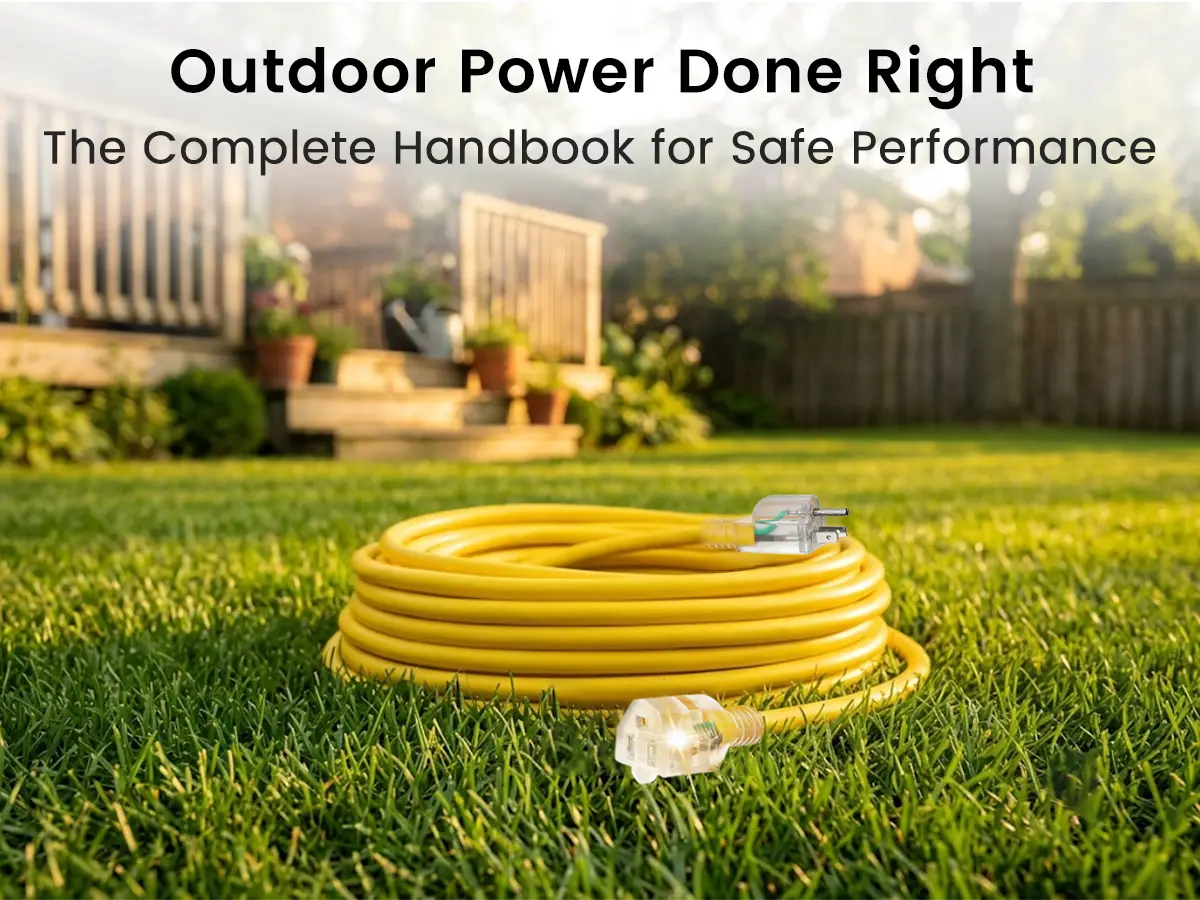
Whether you're powering a lawnmower across the yard, setting up lights for a backyard campout, or running a pressure washer on the driveway, outdoor extension cords are the backbone of safe outdoor power. But the wrong cord — or the right cord used incorrectly — can turn a routine task into a serious hazard.
This guide covers everything you need to know: how to pick the right cord, where to place it, how to protect it from the elements, and how to avoid the most common (and dangerous) mistakes homeowners make.
1. How to Pick the Right Outdoor Extension Cord for Your Load
Not all extension cords are created equal. Using an indoor cord outside — or using an undersized outdoor cord for a high-draw appliance — is one of the most common causes of electrical fires.
Gauge Matters: RV Power vs. Garden Tool Use
The wire gauge (AWG) of an extension cord determines how much current it can safely carry. Here's where most buyers go wrong: they assume a single cord can do everything.
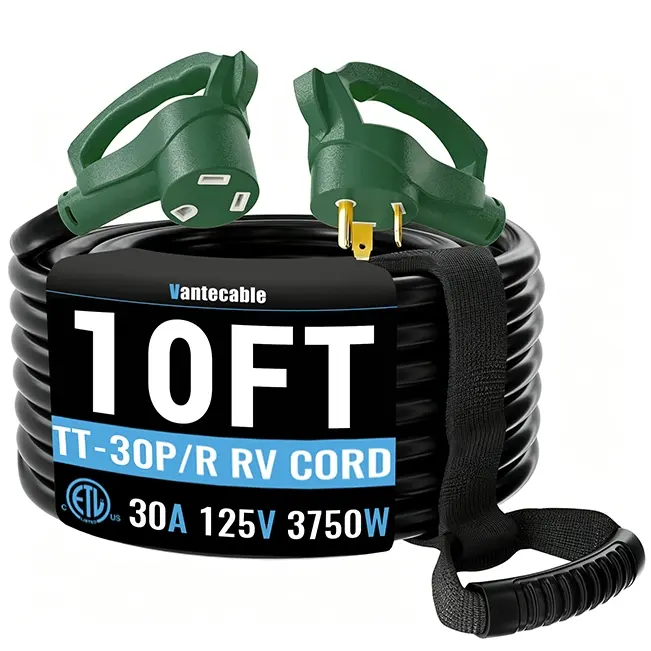
- RV camping or power tools (high draw): You need a 12 AWG or 10 AWG cord — heavier wire means lower resistance and less heat buildup over longer runs. For RV hookups, a 30-amp rated cord is the standard minimum.
- Garden tools and lighting (moderate draw): A 14 AWG or 16 AWG cord handles most lawn mowers, hedge trimmers, and string lights at distances under 50 feet.
The critical concept here is voltage drop. Every extra foot of cord adds resistance. A cord that's too light for the distance will lose voltage before the current reaches your tool — causing the motor to overheat as it strains to compensate. For runs over 100 feet, always step up one gauge size.
Vantecable Engineer's Tip: A 12 AWG/15A outdoor cord covers the majority of real-world outdoor applications. When in doubt, go heavier — a cord rated above your need is safe; a cord rated below it is a fire risk.
What to look for when buying:
- ETL or UL certification — independent lab-tested safety, not self-declared
- Three-prong grounded plug — required for outdoor use
- "W" or "WA" rating on the jacket — confirms outdoor weatherproof construction
- Correct amperage for your devices — always check the nameplate wattage of your tool
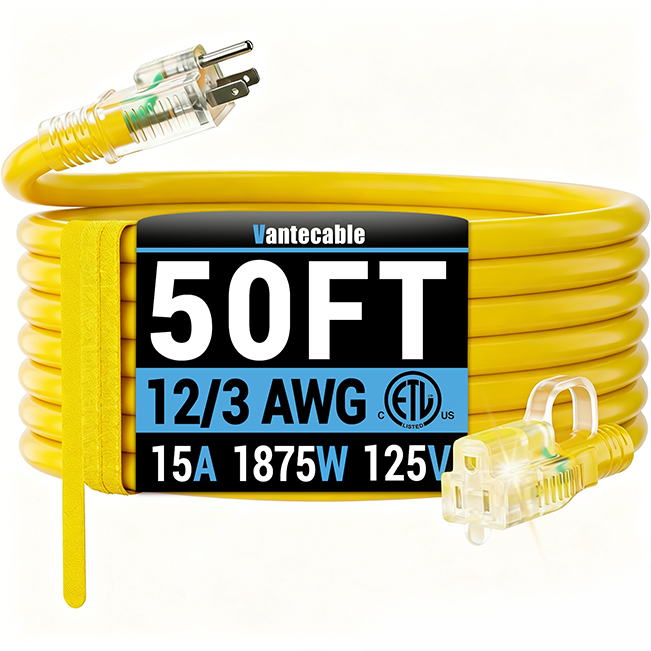
12/3 Heavy Duty Outdoor Extension Cord
12 AWG · SJTW · ETL Listed · 1875W / 15A
Available in 6 ft – 500 ft · LED lighted end
The go-to cord for lawn mowers, power tools, and general outdoor use. UV-resistant jacket stays flexible down to -40°C.
2. Correct Placement: Extension Cord Safety Starts Before You Plug In
Where you run your outdoor extension cord is just as important as which cord you choose. Poor placement causes both accidents and premature cord damage.
Protecting Your Cord from Lawn Mowers and Foot Traffic
Two placement hazards that get overlooked:
- Lawn mower contact: Run your cord along the edge of the area you're mowing — never across the cutting path. Keep it against a fence line or against the house wall, and always be aware of where the cord is relative to the blade before each pass.
- Trip hazards in camping and high-traffic areas: In campsite setups or outdoor events, route cords along the edges of walkways, not across them. Stake them flat to the ground or use cord covers rated for foot traffic. A tripped cord doesn't just injure people — it can yank the plug free of a running appliance and create a spark hazard.
Additional placement rules:
- Keep cords away from heat sources: grills, fire pits, and chimeneas can melt the insulation
- Never run a cord under a rug or through a doorway where it can be pinched
- Ensure the plug sits fully flush in the outlet — any exposed prongs indicate a poor fit or damaged outlet
3. Ensuring Your Outdoor Extension Cords Are Weatherproof
Rain doesn't automatically destroy a good outdoor cord — but only if that cord is built for the conditions. "Weatherproof" is not one-size-fits-all.
Why UV Resistance Matters as Much as Waterproofing
For rainy camping trips or garden irrigation scenarios, the instinct is to look for "waterproof" cords. That's necessary but not sufficient. Here's what your cord's outer jacket actually faces outdoors:
- Moisture and rain: A quality outdoor jacket (rubber, vinyl, or thermoplastic) seals the wire bundle and resists water ingress at connections.
- UV degradation: Direct sunlight breaks down PVC insulation over months. Standard outdoor cords left in full sun will crack and become brittle — exposing the live conductors inside. Look specifically for UV-resistant or UV-rated jacket materials if the cord will be exposed to prolonged sunlight (garden use, outdoor lighting installations, deck setups).
- Temperature extremes: In freezing conditions, cord jackets can stiffen and crack when bent. For year-round outdoor use or cold-climate camping, choose cords rated for low-temperature flexibility (often marked "cold weather" or rated to -40°F/°C).
Vantecable Engineer's Tip: For any cord that will stay outdoors for more than a day or two — seasonal garden power, permanent deck lighting, RV site hookups — UV-resistant jacket material is non-negotiable.
Use weatherproof outlet covers or in-use covers on your outdoor outlets to protect the connection point itself when the cord is plugged in.
4. How to Avoid Overloading Your Outdoor Extension Cords
Overloading is the most dangerous mistake homeowners make with extension cords — and it's almost always invisible until something goes wrong.
The 12 AWG / 15A Rule and Why Daisy Chaining Is Never Safe
A 12 AWG cord rated for 15 amps can safely carry approximately 1,800 watts at 120V. That sounds like a lot — until you add up what's running on it. A leaf blower draws 12A alone. A pressure washer can pull 13-15A. Plug in a second device and you've exceeded capacity.
Daisy chaining — connecting multiple extension cords end to end — multiplies the problem. Each connection point adds resistance, increases heat, and reduces the effective amperage the end device receives. It is one of the leading causes of electrical fires in residential settings.
Daisy chaining is one of the leading causes of residential electrical fires, according to the NFPA — which estimates roughly 3,000 home fires start from extension cords each year.
The rule is simple: one extension cord per outlet. No exceptions.
If your outdoor setup requires power in multiple locations, run a longer single cord to the farthest point, or have a licensed electrician install additional outdoor outlets. A proper 100-foot 12 AWG outdoor extension cord costs far less than replacing a fence, deck, or structure after a fire.
Never do this:
- Daisy chain two or more extension cords for extra length
- Use a multi-outlet adapter to run multiple high-draw tools from one cord
- Run a cord rated for less amperage than your tool requires
5. Inspect Your Extension Cords Regularly: A Practical Checklist
Even the best outdoor extension cord degrades over time. Regular inspection before each use catches problems early — before they become hazards.
What to Look for Before Every Use
Work through this checklist before plugging in:
Plug and connection points:
- ☐ Check the plug blades for burn marks or discoloration — heat damage at contact points indicates a prior overload or arcing event
- ☐ Look for bent, loose, or corroded prongs — these cause poor contact and can spark
- ☐ Inspect the strain relief (where cord meets plug) for cracks or separation
Cord body:
- ☐ Run your hand along the entire cord length and feel for hard or brittle sections — PVC hardens with cold exposure and becomes crack-prone
- ☐ Look for cuts, abrasions, or kinks — kinks can damage internal conductors even when the outer jacket looks intact
- ☐ Check for discoloration or melting anywhere along the run
After use:
- ☐ Does any section feel warm or hot? Heat during normal use = the cord is undersized for the load
If you find any of the above issues, retire the cord immediately. The cost of a replacement is negligible compared to the risk of continued use.
For a complete breakdown of what to look for before, during, and after outdoor use, see our Outdoor Extension Cord Safety: Essential Tips You Must Know.
6. GFCI Outlets and Safe Outdoor Power: What You Need to Know
A Ground Fault Circuit Interrupter (GFCI) is the single most important safety device for outdoor electrical use. It monitors the current flowing through the circuit and cuts power within milliseconds if it detects a ground fault — the type of fault that causes electrocution.
The CPSC has stated that widespread GFCI installation could reduce electrocution deaths in and around the home by half — making it the single highest-impact safety upgrade for any outdoor power setup.
When to Use a Portable GFCI Adapter
Most homes built after 1978 are required to have GFCI-protected outdoor outlets (identifiable by the TEST/RESET buttons on the outlet face). But many older homes — and most campsites, rented properties, and temporary installations — don't.
If there's no GFCI protection at the outlet, don't assume you're safe. Use a portable GFCI adapter.
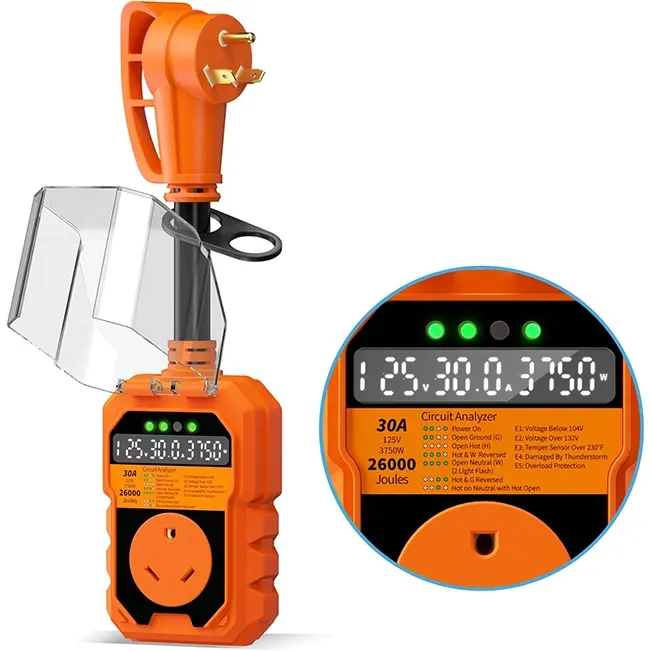
Portable GFCI adapters plug directly into a standard outlet and provide the same protection as a built-in GFCI outlet. They're inexpensive, compact, and should be part of every outdoor power kit — especially for:
- Wet environments: Garden watering, pool equipment, pressure washing
- Camping: Campsite outlets often have no GFCI protection
- Older homes: Pre-code outdoor outlets with no built-in protection
Vantecable Engineer's Tip: Test your GFCI outlet or adapter before every outdoor session by pressing the TEST button — the power should cut immediately. If it doesn't, the GFCI is faulty and should be replaced before use.
✔ Complete Your RV Power Setup
7. Always Unplug After Use and Store Outdoor Extension Cords Correctly
An extension cord left outdoors degrades faster than almost any other electrical component in your home. UV exposure, moisture cycling, temperature swings, and foot traffic all take their toll — and most of the damage is invisible from the outside.
The Butterfly Coiling Method: How to Store Cords Without Damaging the Copper
Here's the storage mistake almost everyone makes: wrapping the cord tightly in a circle. This creates a twist every half-turn — and over hundreds of storage cycles, those twists stress and eventually fracture the copper conductors inside. The cord looks fine on the outside while quietly failing internally.
Use the butterfly (over-under) coil method instead:
- Hold the cord in your non-dominant hand
- Make one loop going over and the next going under, alternating each time
- The cord falls into a natural, kink-free coil with no net twist built into it
- Secure loosely with a velcro tie or the cord's own strain relief loop
This method is standard practice for electricians and AV professionals — it's the reason their cords last for years instead of seasons.
Additional storage rules:
- Always unplug from the outlet end, not the appliance end — this is safer and reduces prong damage
- Store in a cool, dry location indoors — a garage shelf or storage bin, never left coiled outside
- Never hang a cord by the cable itself; use the plug loop or a proper reel
8. Follow Local Electrical Regulations and Choose ETL-Certified Extension Cords
Safety regulations for outdoor electrical use exist at the national, state, and local level — and they matter more than most homeowners realize.
Why ETL Certification Is a Condition of Insurance Coverage
In the United States, the NEC (National Electrical Code) sets baseline requirements for outdoor extension cord use, including ampacity ratings, weatherproofing standards, and GFCI requirements. Many states and municipalities layer additional requirements on top of these standards.
The practical implication most homeowners miss: insurance claims involving electrical fires caused by non-certified equipment are routinely denied. If an extension cord without independent lab certification is the origin of a fire, your homeowner's policy may not cover the damage.
ETL certification (from Intertek) and UL listing are the two primary independent safety certifications for electrical products in North America. They confirm that the cord has been tested to published safety standards — not just claimed to meet them.
Vantecable Engineer's Tip: Every Vantecable outdoor extension cord carries ETL certification and meets ETL/UL safety standards. This isn't marketing — it's the baseline that protects your home and validates your insurance coverage. When buying any extension cord, look for the ETL or UL mark on the cord jacket itself, not just the packaging.
Summary: Outdoor Extension Cord Safety at a Glance
| Situation | Recommended Cord | Key Safety Step |
|---|---|---|
| RV hookup / power tools | 10–12 AWG, 30A rated | GFCI adapter + no daisy chaining |
| Garden tools / lawn mower | 12–14 AWG, outdoor rated | Route away from cutting path |
| Rainy / wet environment | Outdoor + UV-resistant jacket | GFCI required, weatherproof cover |
| Long runs (75–100 ft+) | Step up one gauge | Check voltage drop at tool |
| Camping / temporary setup | Portable GFCI adapter | Inspect before each use |
The bottom line: safe outdoor power starts with the right cord for the right job, used in the right way. An ETL-certified, properly gauged, UV-resistant outdoor extension cord from a trusted brand is the foundation. Everything else in this guide is how you protect that investment — and your home.
Looking for outdoor extension cords built to these standards? Explore Vantecable's full range of ETL-certified outdoor extension cords — engineered for RV power, garden use, and everything in between.
Explore Vantecable Collection →