
.png?w=1368&h=240)
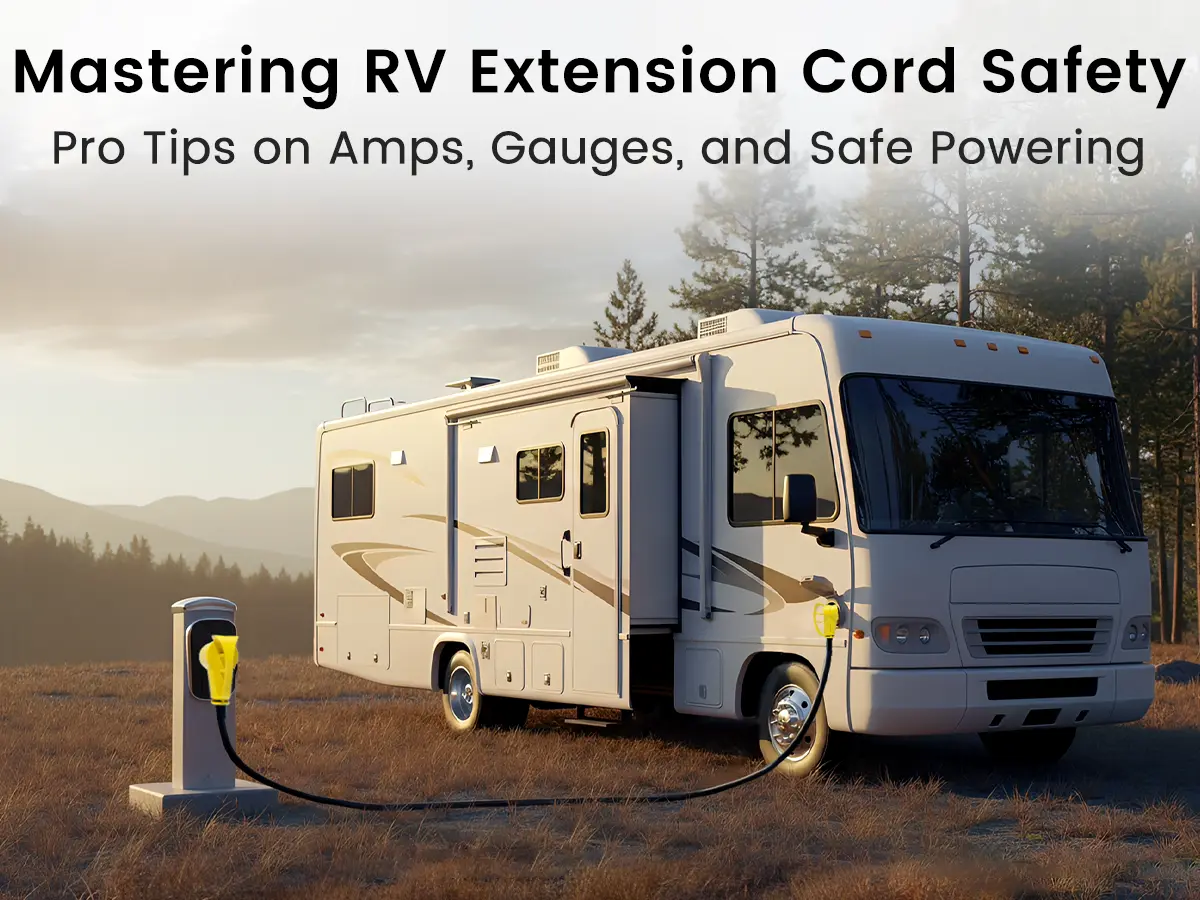
Every RVer knows the sinking feeling of pulling into a dream campsite, leveling the rig, and realizing the power pedestal is just five feet too far for the factory power cord to reach. It’s a classic "so close, yet so far" scenario.
In these moments, a high-quality RV extension cord is your most important piece of gear. However, choosing the right one isn't just about length; it's about electrical safety, voltage stability, and protecting your expensive RV appliances.
As a manufacturer specializing in heavy-duty outdoor power cables, Vantecable’s engineers have seen firsthand what happens when the wrong cord is used. In this comprehensive guide, we will break down everything you need to know about 30 amp and 50 amp RV extension cords, wire gauges, and how to avoid the "silent killers" of RV electronics: voltage drop and heat buildup.
What Is an RV Extension Cord?
Before we dive into the technical specs, let’s clear up a common point of confusion. Many new owners ask: "Is my RV power cord the same as an RV extension cord?"
The answer is no.
- RV Power Cord (Shore Power Cord): This is the heavy-duty cable that is either hardwired to your RV or connects directly to the RV's power inlet. It usually comes in lengths of 25 to 35 feet.
- RV Extension Cord: This is an auxiliary cable designed to "extend" your reach. One end (the male plug) goes into the campground pedestal, and the other end (the female connector) receives your RV's main power cord.
You should only use an RV extension cord when your primary cord cannot reach the pedestal. Adding an extension increases electrical resistance, so choosing a professional-grade, heavy-duty cable is non-negotiable for safety.
30 Amp vs. 50 Amp RV Extension Cord: What’s the Difference?
The most critical step in buying an RV extension cord is matching the amperage to your RV's electrical system. Using an underrated cord is a fire hazard, while using an overpowered one is an unnecessary expense.
Vantecable 30 Amp System (TT-30 Standard)
![[15ft to 100ft] 10/3 Gauge 30 Amp RV Extension Cord, Heavy Duty Waterproof with Easy Grip Handle, Yellow/Green,Waterproof,ETL,flexible](https://img-va.myshopline.com/image/store/1754964108957/imagetools1-5.webp?w=350&h=350)
Vantecable 30 amp RV extension cord is designed for smaller to mid-sized rigs, such as travel trailers, pop-up campers, and small Class C motorhomes. It features a 3-prong plug and provides 125 volts.
-
Max Power: 3750 Watts.
-
Typical Usage: Can run one rooftop air conditioner along with basic lights and a microwave.
Vantecable 50 Amp System (14-50 Standard)
![[6ft to 100ft] NEMA 14-50P to NEMA 14-50R 50 Amp RV/EV Extension Cord Outdoor with Grip Handle,yellow,Waterproof,ETL,flexible](https://img-va.myshopline.com/image/store/1754964108957/imagetools2-2.webp?w=350&h=350)
A 50 amp RV extension cord is a beast. It features a 4-prong plug and actually provides two separate "legs" of 50-amp, 125/250-volt power.
-
Max Power: 6250/12500 Watts.
-
Typical Usage: Found on luxury Fifth Wheels and Class A diesel pushers. This system is required to run 2 or 3 air conditioners, a washer/dryer, and a residential refrigerator simultaneously.
| Feature | 30 Amp RV Extension Cord | 50 Amp RV Extension Cord |
|---|---|---|
| Plug Design | 3-Prong | 4-Prong |
| Wire Configuration | 3 Wires (Hot, Neutral, Ground) | 4 Wires (2 Hots, Neutral, Ground) |
| Max Capacity | 3,750W | 12,500W |
| Vantecable Best Seller | 10 Gauge / 30 Amp Series | 6 Gauge / 50 Amp Series |
Pro Tip: If you have a 50 amp RV but the campsite only offers 30 amp service, you’ll need a "dogbone" adapter. However, your extension cord should ideally match your RV’s native amperage to minimize resistance.
What Gauge Extension Cord Do You Need for an RV?
When it comes to electricity, thickness matters. The thickness of the copper wire inside the cord is measured by AWG (American Wire Gauge).
One of the most frequent questions we receive at Vantecable is: "What gauge extension cord for RV 30 amp is safe?"
When charging a 30-amp RV, it uses a 10AWG, NEMA TT-30P/R plug, has a current carrying capacity of 30A, and features a three-prong plug and socket. This is a standard 30-amp RV extension cord.
In the AWG system, smaller numbers indicate thicker wire.
-
10 Gauge (10/3 AWG): The industry standard for a 30 amp RV extension cord. 10-gauge wire is thick enough to carry 30 amps over standard distances without generating excessive heat.
-
6 Gauge (6/3 & 8/1 AWG): The standard for a 50 amp RV extension cord. Because 50-amp service carries so much more wattage, the wires must be significantly thicker to prevent melting.
Engineers' Warning: Never use a standard household extension cord (which is typically 14 or 16 gauge) for your RV. These thin wires will act like a heating element under an RV load, potentially leading to a fire.
How Length Affects RV Extension Cord Performance
Distance is the enemy of consistent power. This leads us to a concept called Voltage Drop.
Voltage drop is the decrease in electrical potential as current travels through a conductor. The longer the RV extension cord, the more resistance the electricity faces. If your voltage drops too low (typically below 105V), your RV’s air conditioner compressor can burn out.
RV Extension Cord Length Guide
To help you choose, our Vantecable engineering team has developed this quick reference guide for 30A systems:
| Length | Recommended Gauge | Best Use Case |
|---|---|---|
| 25 ft | 10 AWG | Most standard campsites; adds just enough reach. |
| 50 ft | 10 AWG | Recommended for pedestals located at the far end of the lot. |
| 100 ft | 8 AWG (or 10 AWG with Caution) | Long-distance hookups. Monitor voltage closely. |
Pro Tip: If you frequently use a 50 ft RV extension cord, we highly recommend installing a digital voltmeter inside your RV to monitor incoming power. If you see the voltage dip when the AC kicks on, you may need a thicker gauge cord or a shorter run.
Key Safety Features to Look for in an RV Extension Cord
When you are shopping for the best RV extension cord, don't just look at the price tag. Look for the technical specifications that indicate a "Heavy Duty" build. At Vantecable, we prioritize the following four features:
1. STW Outdoor Rating
The jacket (outer skin) of the cord should be rated STW.
-
S: Service Grade
-
T: Thermoplastic
- W: Weather Resistant
An STW-rated heavy duty RV extension cord will remain flexible in freezing temperatures and won't crack under the harsh UV rays of the American Southwest.
2. Molded Easy-Pull Handles
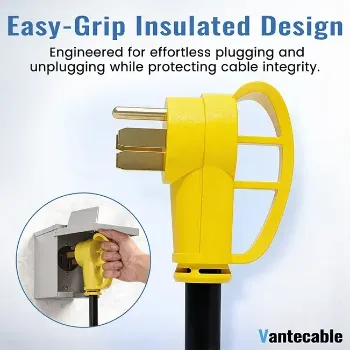
RVs use high-amperage connections that can be "sticky" to unplug. Many users make the mistake of pulling on the wire itself, which damages the internal connections. Look for cords with molded finger-pull handles (often called Easy-Pull) to ensure safe disconnection.
3. LED Power Indicators
A simple but life-saving feature. A green or red LED light on the female end of the RV shore power extension cord tells you instantly if the pedestal is providing power. This saves you from troubleshooting your RV’s internal breaker when the problem is actually at the camp's power post.
4. UL or ETL Certification
Never buy an electrical cable that hasn't been third-party tested. Vantecable products are built to meet strict safety standards, ensuring that the copper purity and insulation thickness are exactly what is advertised.
Should You Pair Your RV Extension Cord with a Surge Protector?
A heavy-duty extension cord protects against heat and voltage drop over distance — but it can't protect your RV from a sudden voltage spike, a lightning strike near the campground, or a miswired pedestal (a surprisingly common issue at older RV parks). That's where a surge protector , also called an EMS (Electrical Management System), comes in.
There are two main types: a basic surge protector simply absorbs voltage spikes, while a full EMS unit also monitors for low/high voltage, open ground, and reverse polarity, automatically cutting power before it reaches your RV if something is wrong. For 30 amp systems, look for a 30A-rated unit; for 50 amp rigs, you'll need the 50A version with the matching 4-prong configuration.
Where it goes: Plug the surge protector directly into the campground pedestal first, then connect your RV extension cord to the protector — not the other way around. This way, the protector catches any irregular power before it ever travels down your cord.
RV Extension Cord Buying Guide: A 5-Point Checklist
Before you click "Add to Cart," run through this checklist to ensure you are getting the right equipment for your rig:
-
Match the Amperage: Confirm if your RV is 30A (3 prongs) or 50A (4 prongs).
-
Verify the Gauge: Ensure a 30 amp RV extension cord is at least 10 gauge. For 50A, look for 6 gauge.
-
Choose the Right Length: A 25 ft or 50 ft RV extension cord is usually sufficient. Avoid "daisy-chaining" (connecting two cords together) whenever possible.
-
Check the Jacket Rating: Ensure it is "Outdoor Rated" or "STW" to handle rain, snow, and sun.
-
Look for Safety Certification: Ensure the cord carries a UL or ETL listing.
Frequently Asked Questions (FAQ)
Q1: What size extension cord is safe for a 30 amp RV?
A1: For a 30 amp RV, you should always use a 10 gauge (10/3 AWG) extension cord. Using a 12 gauge or higher (thinner) cord can cause a significant voltage drop and may lead to the plug melting.
Q2: Can I use a household extension cord for my RV?
A2 Absolutely not. Standard household cords are designed for lamps and small appliances. They cannot handle the 3,600 to 12,000 watts required by an RV. Using one is a major fire hazard.
Q3: How long can an RV extension cord be without voltage drop?
A3: Ideally, you want to keep your total cable run (power cord + extension) under 50 feet. If you must go to 100 feet, you should use a thicker gauge (like 8 AWG for a 30A system) to compensate for the distance.
Q4: Are RV extension cords waterproof?
A4: Most high-quality cords, including Vantecable’s shore power extensions, are water-resistant and designed for rain. However, the connection point (where the two cords plug into each other) is NOT waterproof. You should use a "cord protector" cover or keep the connection off the wet ground.
Q5: Can I plug my 50 amp RV into a 30 amp extension cord?
A5: You can use an adapter, but your power will be limited to 30 amps. This means you cannot run all your appliances at once. It is always better to have a 50 amp RV extension cord to utilize your rig's full capacity.
Conclusion: Power Your Adventure Safely
Your RV is an investment in freedom and family memories. Don't let a cheap, undersized extension cord put that at risk. By understanding the relationship between amperage, gauge, and length, you can choose an RV extension cord that provides stable, safe power no matter where the road takes you.
If you frequently camp in RV parks where the power pedestal is far from your parking spot, investing in a reliable heavy-duty RV extension cord can make your setup much easier.
Explore Vantecable’s range of heavy-duty RV extension cords designed for safe and stable campground power connections. From our 30 amp 10 gauge series to our 50 amp heavy-duty lines, we build the bridge between the pedestal and your home-on-wheels.