
.png?w=1368&h=240)
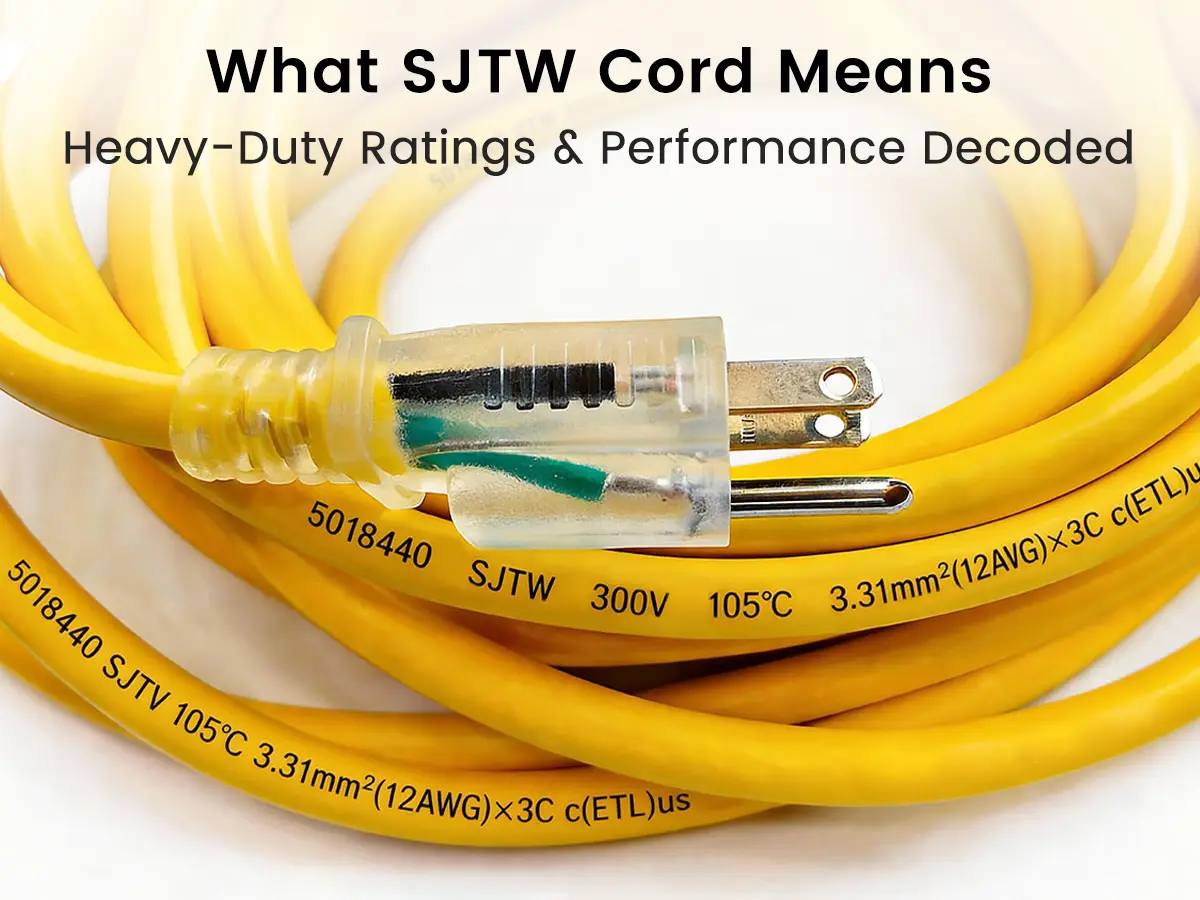
If you’ve ever purchased an extension cord, you may have noticed letters printed on the cord jacket, such as SJTW, SJOOW, SJTOW, or SOOW. At first glance, these letters might seem confusing, but they are not marketing codes—they are industry-standard designations defined by UL and NEC. They convey essential information about a cord’s voltage rating, construction, jacket material, environmental suitability, and durability. Understanding the SJTW extension cord meaning, the differences between SJOOW vs SJTW, and the implications of extension cord jacket ratings is crucial for selecting cords that are both safe and long-lasting.

What is a SJTW Extension Cord?
An SJTW extension cord is designed for light to medium-duty outdoor use. It is rated for 300 volts and typically handles up to 15 amps of current. The cord is made with a thermoplastic jacket, providing durability and flexibility, and it is weather-resistant (denoted by the "W"), making it suitable for outdoor exposure to sunlight and rain. SJTW extension cords can operate within a temperature range of -40°F to 140°F (-40°C to 60°C), and are commonly used for powering small outdoor tools, holiday lights, and light appliances. However, they are not designed for heavy-duty industrial applications or extreme weather conditions.
Why Extension Cords Use Letter Ratings
The letters printed on an extension cord’s jacket are more than labels—they provide a complete profile of the cord’s mechanical and environmental capabilities. They indicate whether a cord is suitable for outdoor exposure, oil resistance, cold weather, or heavy-duty industrial use. They also communicate the cord’s durability, flexibility, and the type of materials used in its construction.
Understanding these letters is especially important when comparing similar-looking cords. For example, a thick black cord might appear industrial-grade, but thickness alone does not indicate outdoor suitability or oil resistance. A cord marked SJTW may look similar to a SJOOW, yet their applications, tolerances, and safety parameters are very different. Knowing the SJTW extension cord meaning helps users make informed, safe choices for their environment and equipment.
Many users underestimate the impact of environmental exposure. A cord used outside during winter or in a damp yard will age differently than a cord kept indoors. Letter ratings give a quick reference to what the cord can endure. For example, cords rated W are tested for UV and moisture resistance, ensuring long-term durability even when left in sunlight or rain. By understanding these ratings, users can avoid premature cord failure and reduce the risk of hazards.
How Extension Cord Letter Ratings Are Structured
Extension cord ratings follow a layered logic, moving from basic electrical capacity to jacket material and environmental adaptations. Understanding this hierarchy allows users to quickly determine a cord’s capabilities.
Service Rating / Voltage
The service rating is the first layer of a cord’s designation. It indicates the basic voltage capacity and duty level:
-
S (Service Cord): Rated for 600 volts, suitable for heavy-duty industrial applications.
-
SJ (Junior Service Cord): Rated for 300 volts, intended for medium- to light-duty household use.
This distinction is important because environmental features (such as jacket type) do not compensate for insufficient voltage or current capacity. Using an SJ cord for a high-powered generator rated at 240 volts could cause overheating, even if the cord is rugged and oil-resistant. Voltage ratings also influence the maximum current a cord can safely carry. Combining voltage and wire gauge information ensures tools and appliances receive adequate power without excessive voltage drop.
Jacket Material
The second layer indicates the type of material used for the cord jacket, which affects flexibility, durability, and handling:
-
T (PVC): Cost-effective, moderate durability. May stiffen in cold temperatures, reducing flexibility.
-
E (Thermoplastic Elastomer): Maintains flexibility in cold conditions, easier to handle. Higher cost.
-
R (Rubber): Highly flexible and durable, suitable for industrial sites with rough surfaces and mechanical stress.
PVC jackets are common for household cords, providing adequate protection for indoor and light outdoor use. Thermoplastic elastomer (E) jackets are particularly useful in garages or workshops where the cord is frequently moved or coiled. Rubber jackets are standard for construction sites or heavy machinery, resisting cuts, abrasion, and repeated bending.
By considering jacket material alongside service rating, users can choose cords that remain functional over their expected lifespan. Flexible jackets in cold weather prevent cracking, reducing the likelihood of exposed live wires, which could otherwise cause shocks or short circuits.
Environmental Suitability
The third layer specifies the environmental conditions the cord can safely endure:
-
O (Oil-resistant jacket): Protects against oils and light chemical exposure.
-
OO (Dual oil resistance): Both jacket and insulation are oil-resistant.
-
W (Weather-resistant / Outdoor): Suitable for outdoor exposure, UV-resistant, and moisture-tolerant.
-
C (Cold-resistant): Maintains flexibility and usability in freezing conditions.
Environmental letters indicate the situations the cord can be safely used in, which is particularly important for outdoor or industrial applications. For instance, SJTW cords are weather-resistant but not oil-resistant, making them suitable for lawn equipment but not for oily garage floors. SJOOW cords combine oil resistance with cold-weather flexibility, suitable for frequent handling in colder climates.
Reading the cord code from left to right allows users to evaluate whether a cord meets their mechanical, electrical, and environmental requirements. Ignoring this can lead to safety hazards, including cord deterioration or electrical faults.
Detailed Letter Interpretation
Understanding each letter individually provides clarity when selecting a cord. The following breakdown highlights practical implications and common applications:
-
S – Service Cord: Industrial-grade, 600V rating. Not intended to indicate power capacity; only defines baseline electrical rating.
-
SJ – Junior Service Cord: Household or light industrial use, 300V rating, moderate duty.
-
T – PVC Jacket: Normal temperature use. Stiffens in winter, may limit flexibility for outdoor or cold conditions.
-
E – Thermoplastic Elastomer Jacket: Cold-weather flexibility, suitable for frequent handling. Higher cost but easier to manage in tough environments.
-
R – Rubber Jacket: Industrial durability, high flexibility, abrasion-resistant. Ideal for construction sites or heavy machinery.
-
O – Oil-Resistant Jacket: Protects the exterior from automotive oils or minor chemical exposure.
-
OO – Dual Oil-Resistant Jacket and Insulation: Suitable for industrial oily environments, both jacket and insulation are protected.
-
W – Weather-Resistant / Outdoor: Sunlight, rain, and moisture protection. Essential for outdoor use.
-
C – Cold-Resistant: Maintains flexibility at low temperatures, preventing cracking or brittleness.
Each letter represents a critical specification. For example, using a cord without the “W” rating outdoors exposes the insulation to UV damage, which can lead to cracks and short circuits. Similarly, omitting oil resistance in workshop areas can degrade the jacket over time, increasing risk of failure.
Common Extension Cord Ratings and Applications
Applying these letters in real-world scenarios clarifies how SJTW extension cord meaning translates to everyday use. Below is a summary of common cords, their composition, and typical applications:
SJTW
-
Composition: SJ + T + W
-
Use: Outdoor household tools, lawn equipment, holiday lights, small appliances, light outdoor power needs
-
Limitations: Light- to medium-duty, not oil-resistant, not suitable for industrial environments, avoid heavy machinery and extreme weather
SJOOW
-
Composition: SJ + OO + W
-
Use: Industrial tools, portable generators, factory equipment, construction sites, environments with frequent oil, grease, or chemical exposure, temporary outdoor power applications, cold-weather use
-
Limitations: Medium-duty rating (300V), not suitable for heavy industrial loads, not for permanent installation or fixed building wiring, heavier and less flexible than thermoplastic cords, overkill for basic household use
SJTOW
-
Composition: SJ + T + O + W
-
Use: Garage tools, light oil exposure, outdoor work, small workshops, portable power tools
-
Limitations: Medium-duty, avoid heavy industrial load, not for permanent installation, limited heavy outdoor use
SOOW
-
Composition: S + OO + W
-
Use: Heavy-duty industrial equipment, generators, construction machinery, factory and outdoor industrial environments, oil and chemical exposure, cold and harsh conditions
-
Limitations: Heavier and less flexible than SJ cords, overkill for light household or small workshop use, not intended for permanent building wiring, requires proper handling due to weight and stiffness
This comparison demonstrates why SOOW vs SJTW is an important distinction. While both may look similar, SOOW is engineered for heavy-duty industrial stress, whereas SJTW is optimized for moderate-duty household and light outdoor use.
Wire Gauge and Power Capacity
Letter ratings indicate environmental and mechanical suitability, but electrical capacity depends on wire gauge (AWG) and cord length. For example:
| AWG | Max Safe Current (120V) | Typical Use |
|---|---|---|
| 16 | 13A | Light tools, holiday lights |
| 14 | 15A | Household tools, moderate loads |
| 12 | 20A | Heavy-duty tools, generators |
Longer cords increase resistance, causing voltage drop, which can affect tool performance. A 100-foot 16 AWG cord powering a table saw may result in noticeable voltage loss, reducing cutting efficiency. Selecting the correct wire gauge ensures tools operate safely and efficiently, while preventing excessive heat buildup in the cord.
If you’re still unsure about how to choose the right gauge extension cord, you can use our wire gauge calculator to easily determine the extension cord that’s best for your needs.
Choosing the Right Extension Cord
Selecting a cord requires a holistic approach. Begin with letter ratings to confirm environmental suitability, then verify wire gauge and length for electrical requirements. Matching these factors ensures the cord performs safely and efficiently.
Some general guidance:
-
Household and light outdoor use → SJTW
-
Garage with oil exposure or frequent handling → SJTOW or SJOOW
-
Generators, industrial equipment, construction → SOOW
Avoid common misconceptions:
-
Higher letter rating ≠ higher electrical capacity
-
Thicker cord ≠ more durable in harsh environments
-
Outdoor usage without “W” rating can degrade cord quickly
-
Using a cord in cold weather without “C” rating can cause cracking
By following these principles, users extend the life of their cords and maintain safety.
UL Extension Cord Ratings and Safety Considerations
Selecting a UL-certified cord ensures compliance with rigorous safety standards. UL testing evaluates voltage rating, insulation integrity, jacket durability, oil and weather resistance, and low-temperature flexibility. Choosing a UL-rated cord guarantees that it meets the described letter rating specifications and reduces risk of electrical hazards or premature cord failure.
UL standards also require marking the cord with manufacturer information, voltage, and duty rating, making it easier for users to verify compatibility. These certifications are particularly important for commercial or industrial settings, where improper cord selection can lead to costly equipment damage or workplace accidents.
Conclusion
Understanding the SJTW extension cord meaning, the practical differences of SOOW vs SJTW, and the implications of extension cord jacket ratings is essential for safety, efficiency, and durability. By combining environmental suitability, proper wire gauge, and UL certification, users can select extension cords that perform reliably across applications—from household yard work to industrial generators. Making informed decisions based on these factors ensures not only tool performance but also the safety of operators and longevity of equipment.