
.png?w=1368&h=240)
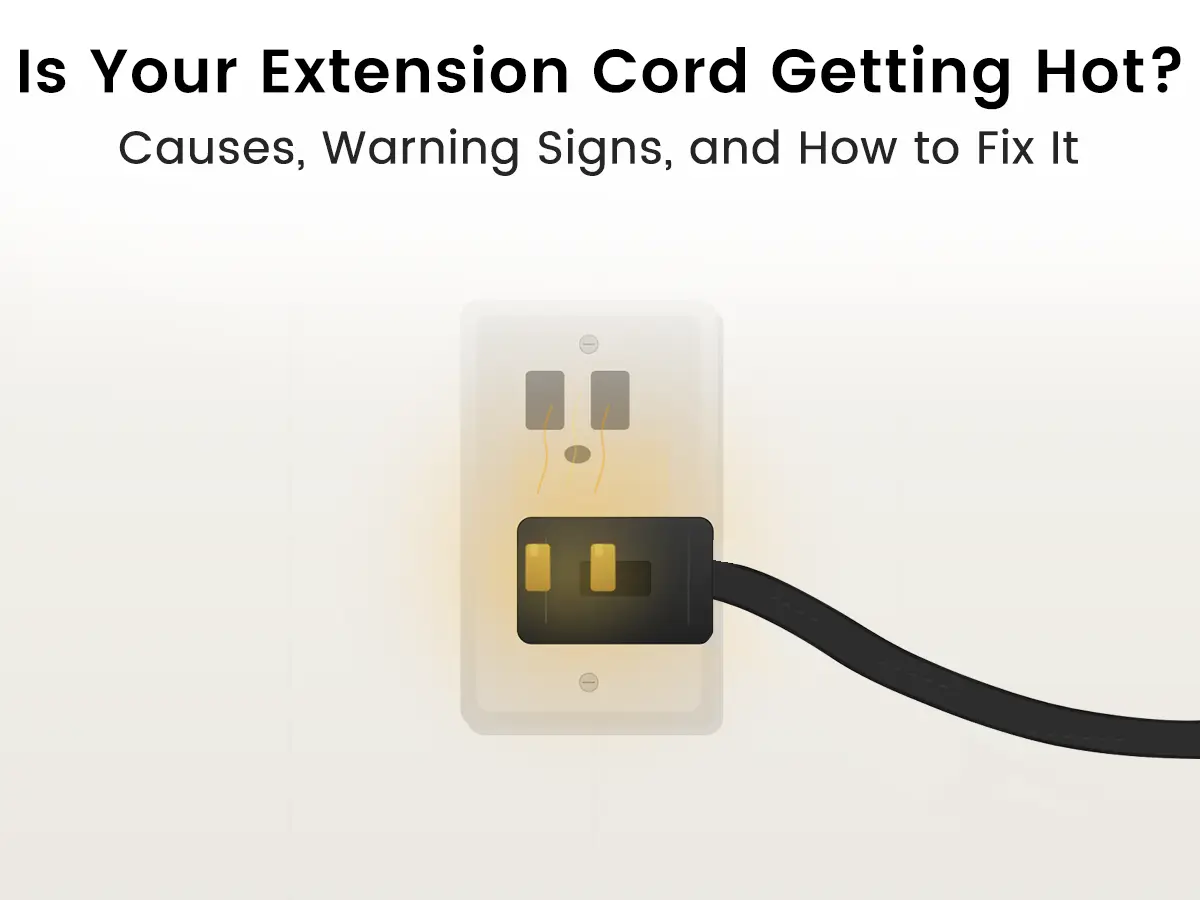
You reach down to unplug a device and notice the cord is uncomfortably warm — or worse, hot. It's easy to brush off, but extension cord overheating is one of the most overlooked fire hazards in homes and workplaces. According to the Electrical Safety Foundation International (ESFI), extension cords are involved in roughly 3,300 home fires each year in the United States.
A little warmth under a heavy load can fall within normal range. But if your extension cord is hot to the touch, discolored, or smells like something burning, that's a clear signal worth addressing immediately. This guide walks through the warning signs, the most common causes, and exactly what you can do — including how to choose the right cord so the problem doesn't come back.
How Hot Is Too Hot?
Not all heat is cause for alarm. When current flows through any conductor, some energy is lost as heat — that's basic physics. A cord powering a large appliance may feel slightly warm along its length, and that's generally acceptable.
What isn't acceptable: a cord that's uncomfortable to hold, hot at the plug or outlet, emitting a burning or plastic smell, or showing any visible discoloration. At that point, the cord is working outside its rated capacity, and the insulation — the only thing standing between the wire and everything around it — is under stress. Sustained overheating degrades insulation over time, which increases the risk of arcing and fire even after the immediate load is removed.
If your extension cord ever feels that hot, unplug it and stop using it until you've identified the cause.
Warning Signs Your Extension Cord Is Overheating
Catching the problem early matters. Watch for these indicators:
- The cord is warm or hot along its length — not just at the plug end, but along the wire itself
- Discoloration, melted spots, or a scorched smell — signs the insulation is already breaking down
- Flickering lights or devices cutting out — often a sign of voltage drop or a loose, heat-damaged connection
- Tripped breakers or blown fuses on the circuit the cord is running from
- Visible cracks or damage to the jacket — especially on older cords or those used outdoors
- The plug or outlet feels hot at the connection point, which can indicate arcing or a poor contact
Any one of these is worth taking seriously. Several of them together means the cord needs to come out of service now.
The Most Common Causes of Extension Cord Overheating
1. Using the Wrong Gauge for the Load
This is the most frequent cause — and the most preventable. Extension cords are rated by wire gauge, expressed as AWG (American Wire Gauge). The lower the AWG number, the thicker the wire and the more current it can safely carry.
A 16 AWG cord is perfectly fine for a lamp or phone charger. Use it to power a space heater or a circular saw, and you're pushing far more current through a wire that wasn't built for it. The wire heats up, the insulation softens, and the risk of fire climbs quickly.
As a practical reference:
- 16 AWG — small electronics, lamps, fans
- 14 AWG — medium appliances, TVs, computers
- 12 AWG — power tools, outdoor equipment, space heaters
- 10 AWG — high-draw tools, compressors, generators
When in doubt, go heavier. A 12 AWG cord can safely power anything a 16 AWG cord can handle, but not the other way around.
2. Daisy-Chaining or Overloading the Cord
Plugging one extension cord into another — known as daisy-chaining — multiplies resistance across the circuit and dramatically increases heat generation. It also makes it easy to lose track of how many watts you're pulling through a single cord.
Multi-outlet extension cords have a total wattage rating that applies to all plugged-in devices combined, not per outlet. Check the label, add up the wattage of every device plugged in, and make sure you're comfortably under that limit.
3. Cord Length and Voltage Drop
The longer a cord, the more electrical resistance it introduces — and more resistance means more heat, particularly under load. A 100-foot 16 AWG cord carries far more resistance than a 10-foot version of the same cord.
For longer runs, you need to step up in gauge to compensate. If you're running a 50-foot cord to power outdoor tools, a 12 AWG cord will perform — and run cooler — than a 14 AWG cord doing the same job. For a deeper look at how cord length affects performance, see our voltage drop calculator and guide.
4. Coiled or Covered Cords
A tightly coiled cord on a reel, or one running under a rug or carpet, traps the heat it generates with nowhere to go. Even a properly rated cord can overheat if airflow around it is blocked.
Always fully uncoil extension cords before use, particularly under any significant load. Never run cords under rugs, carpets, or through doorframes where they can be pinched or covered.
5. Damaged or Degraded Insulation
An older cord with cracked or brittle insulation doesn't just look worn — it has a higher effective resistance, which generates more heat. Physical damage from being pinched in a door, run over by furniture, or repeatedly bent at a sharp angle can compromise the insulation without being immediately obvious.
Outdoor cords used continuously in UV exposure, temperature extremes, or moisture will degrade faster than their indoor counterparts if they're not designed for those conditions.
6. Poor-Quality Cord Construction
Not all extension cords are built the same way. Cords using CCA (Copper-Clad Aluminum) conductors instead of pure copper carry more resistance per foot, which translates directly to more heat generation at the same load level. Cords lacking proper safety certifications — ETL, cETL, or UL listing — may not meet minimum standards for insulation quality or conductor capacity.
A cord that looks fine on the outside can have undersized conductors, thin insulation, or substandard connections internally. This is where certification and construction quality actually matter.
The Real Risks — Why This Isn't Something to Ignore
Extension cord fires cause an estimated 3,300 home fires, 50 deaths, and 270 injuries each year in the U.S., according to ESFI. The NFPA similarly identifies electrical cord misuse as a leading contributor to residential electrical fires. Overheating is a primary factor in both.
Beyond fire risk, a cord running hot is also a threat to the devices plugged into it. Voltage fluctuations caused by resistance can damage sensitive electronics. In commercial or job site settings, a cord failure mid-operation creates safety and liability exposure beyond just property damage.
The reassuring part: this is a well-understood problem with straightforward solutions.
How to Stop Your Extension Cord from Overheating
Match the Gauge to Your Appliance
This single step prevents the majority of overheating issues. Before buying or using an extension cord, check the wattage of the devices you're powering and match the cord's gauge accordingly. Use the reference above, and when running longer lengths, go one gauge heavier than you think you need.
The math for checking load is simple: watts ÷ 120 volts = amps required. A 1,500-watt space heater draws 12.5 amps. A 16 AWG cord rated for 13 amps is at its absolute ceiling — a 12 AWG cord rated for 20 amps is the right tool for that job.
Never Exceed the Cord's Rated Amperage or Wattage
Check the label on the cord itself. Most cords list both their amperage rating and a maximum wattage. Add up the draw of every device plugged into that cord and make sure you're well under that ceiling, not right at it.
Fully Uncoil Before Use
It takes 30 seconds and meaningfully reduces heat buildup. If the cord is on a reel, pull out the entire length even if you don't need all of it. Coiled conductors trap heat and reduce the cord's effective capacity.
Choose the Right Cord for the Environment
Indoor cords are not built for outdoor use. Outdoor-rated cords carry a weather-resistant SJTW or STW jacket that resists moisture, UV exposure, and temperature extremes. Using an indoor cord outside exposes the insulation to conditions that accelerate degradation.
For generators, you need a generator-specific extension cord rated for the amperage of your unit — not a standard household cord. RV connections similarly require purpose-built RV extension cords with the correct NEMA connectors (TT-30 for 30-amp service, 14-50 for 50-amp) and the appropriate gauge to match.
Inspect Regularly — and Replace When the Cord Is Done
A visual check before each use takes seconds. Look for cracked or brittle jacket material, bent or corroded prongs, looseness at the plug connection, and any discoloration along the cord. If the cord fails any of these checks, replace it. Don't repair damaged insulation with electrical tape as anything more than a temporary, emergency measure.
Don't Run Cords Under Rugs or Through Walls
Cords under rugs get walked on, abraded, and — critically — can't dissipate heat. Cords run through walls present a fire risk because damage in a concealed location is impossible to inspect. If you need a permanent power run to a part of the room, a properly installed outlet is the right solution, not a permanently placed extension cord.
How to Choose an Extension Cord That Won't Overheat
When you're buying a cord, these are the factors that matter:
Wire gauge — Match it to your intended use. For anything beyond basic electronics, 12 AWG is a solid default for most households. For generators, RVs, or high-draw tools, 10 AWG is appropriate.
Cord length — Shorter runs are always preferable. For longer runs, increase the gauge to offset resistance.
Safety certification — Look for ETL, cETL, or UL listing. These certifications mean the cord has been independently tested against recognized safety standards, not just self-certified by the manufacturer.
Jacket type — SJTW and STW jackets are weather-resistant and suitable for outdoor use. SOOW jacketing is used for heavy-duty flexible applications. Standard indoor cords carry an SPT or SJT designation.
Conductor material — 100% pure copper conducts electricity more efficiently than CCA alternatives, which means less resistance, less heat, and better performance across the cord's lifespan.
Lighted end indicator — A small but useful feature: a lighted plug end confirms the cord is receiving power and that the connection is intact.
Browse Vantecable's full range of extension cords — organized by gauge, length, and application — to find the right match for your setup.
Frequently Asked Questions
Q1: Is it normal for an extension cord to get warm?
A1: Slight warmth under a heavy load is within normal range. If the cord is uncomfortable to hold or hot at the plug end, that indicates the cord is being used beyond its capacity or has a wiring issue.
Q2: What happens if an extension cord overheats?
A2: Sustained overheating degrades the insulation, which can lead to arcing, short circuits, and fire. It can also cause voltage fluctuations that damage connected devices.
Q3: Can a coiled extension cord cause a fire?
A3: Yes. A tightly coiled cord under load traps heat and can overheat even if the cord is otherwise properly rated for the amperage being drawn. Always fully uncoil before use.
Q4: What gauge extension cord do I need for a space heater?
A4: Most space heaters draw 1,500 watts (12.5 amps). Use a 12 AWG cord rated for 20 amps, and keep the cord length as short as practical. A 16 AWG cord is not suitable for a space heater.
Q5: How do I know if my extension cord is overloaded?
A5: Calculate the total wattage of everything plugged in, divide by 120 to get amps, and compare to the cord's rated amperage (printed on the label or jacket). If you're at or above the rated limit, the cord is overloaded.
Conclusion
An extension cord that runs hot isn't just an inconvenience — it's a sign that something is mismatched, worn out, or being pushed past its design limits. The good news is that the causes are well understood and the fixes are straightforward: use the right gauge for your load, keep cords fully uncoiled, inspect them regularly, and replace them when they show signs of wear.
The right cord for the job doesn't just perform better — it lasts longer, runs cooler, and gives you one less thing to worry about.