

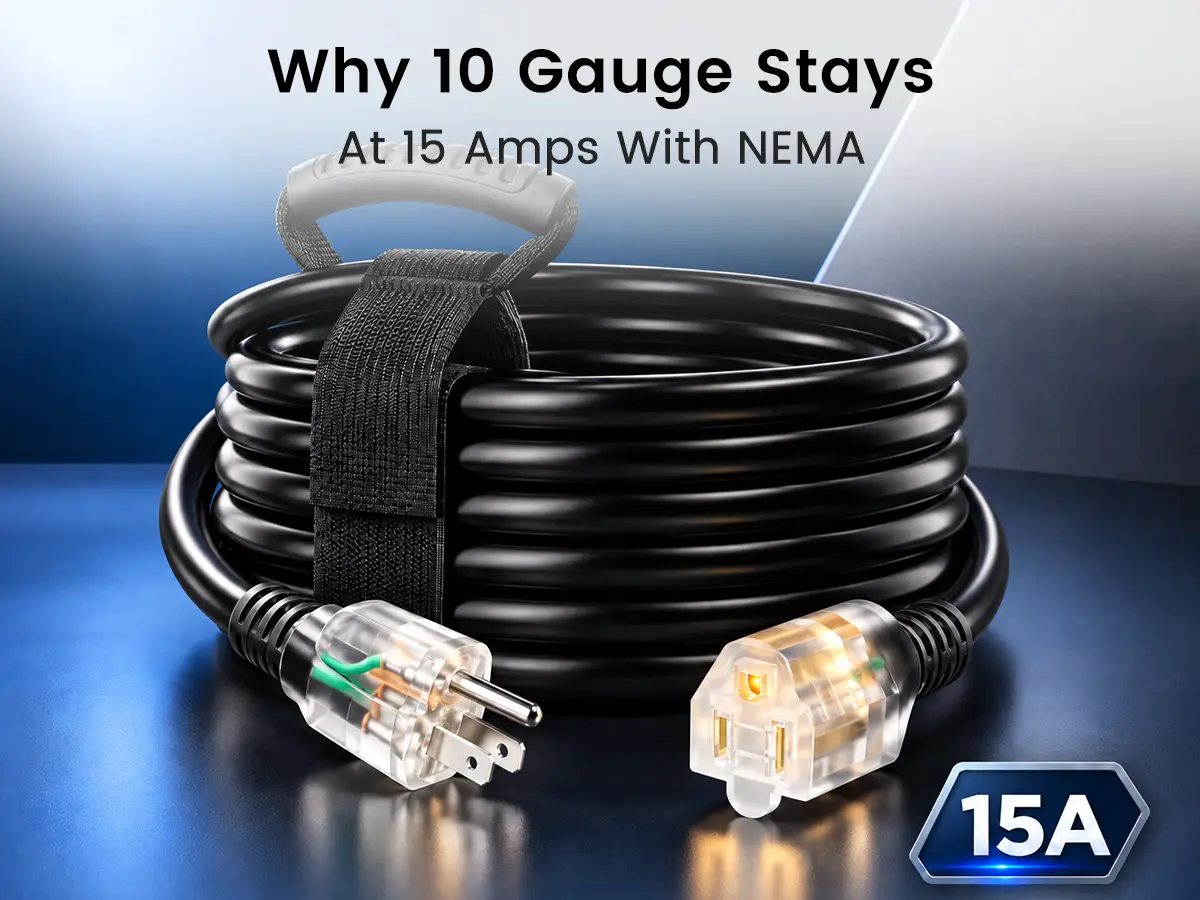
A 10 gauge extension cord with a standard NEMA 5-15 plug is still rated 15 amps because the plug and receptacle set the ceiling, not the copper conductor underneath — the wire itself is built to carry more.
This guide explains why a 10 gauge extension cord can still be rated 15 amps, when a 10/3 cord is useful, and when you need to move to a different plug configuration.
For additional generator and emergency-power options, visit the Emergency Power Cords collection.
What a 10/3 Extension Cord’s Wire Can Actually Carry
Under the ampacity tables the National Electrical Code uses for copper conductors, a 10 AWG wire carries meaningfully more current than a 10/3 extension cord amperage rating of 15 amps ever asks of it through a standard household plug. That headroom is the point. A thicker gauge extension cord is not chosen because it needs to exceed 15 amps; it is chosen because a heavier wire runs cooler, holds voltage more consistently over long distances, and tolerates a continuous, near-maximum load with less stress on the insulation. None of that changes what the plug allows through. Cord length and gauge together determine how much amperage a cord can safely deliver, which is why safety organizations such as ESFI publish gauge-to-length reference guidance separate from the plug's printed rating.
Why the NEMA 5-15 Amp Rating Caps Every Cord at 15A
The Wire Rating vs. the Plug Rating — Two Different Numbers
Every corded product is only as strong as its weakest link, and on a standard household extension cord, that weak link is almost always the plug and receptacle rather than the wire. A NEMA 5-15 amp rating is fixed at 15 amps, 125 volts, no matter what gauge feeds into it. Put a 10 gauge conductor behind a 5-15 plug, or a 14 gauge conductor behind the same plug, and the printed rating on both stays 15 amps, because that number describes the connector, not the copper. To legally push more current through a cord, the entire plug-and-receptacle pair has to change to a higher-rated configuration — moving from NEMA 5-15 to a twist-lock connector rated for 30 amps or 50 amps.
When You Actually Want a 10 Gauge, 15 Amp Cord
Long Runs Where Voltage Drop Matters
Voltage drop increases as a cord gets longer and the connected equipment draws more current. A 10 gauge 15 amp cord can help reduce voltage drop and heat compared with a thinner cord of the same length, making it useful for tools, pumps, compressors, lighting, and other continuous loads. The actual result depends on cord length, current draw, conductor resistance, connection condition, and equipment requirements, so always confirm the cord rating and application before use.
Heat Buildup Under Continuous or High-Draw Loads
Continuous, near-15-amp loads — a generator transfer setup, a job-site compressor, a heater running for hours — generate heat in any conductor. A 10 gauge extension cord runs cooler under that kind of sustained draw than a 12 or 14 gauge cord, which matters for cord lifespan and for safety when the cord is coiled, run through a doorway, or left outside for an extended period. Sustained, near-maximum loads are exactly the scenario the CPSC's extension cord safety guidance addresses when it recommends checking that a cord is listed by a recognized testing laboratory and matched to the wire gauge the load actually requires.
Need More Than 15 Amps? Move to a Different Plug Type
NEMA 5-20 and Twist-Lock Options for Higher Amperage
Once a load genuinely exceeds 15 amps — a larger generator, an RV pulling a 30 amp or 50 amp service, or shop equipment on a dedicated circuit — no amount of extra wire gauge behind a NEMA 5-15 plug will help, because the plug is still the limiting factor. That is where twist-lock configurations come in.
For loads that need both 120V and 240V legs, a 10/4 gauge generator extension cord with L14-30 connectors is rated 30 amps at 250 volts, or 7,500 watts. For RV and camper setups pulling a full 50 amp service, twist-lock 50 amp generator cords with NEMA 14-50P to SS2-50R connectors are available in a black-and-yellow and a black-and-green configuration, each built with heavy-duty STW wire for that higher load.
The table below lists the ratings of the cord configurations mentioned in this guide, with a link to each product. The key point is that to exceed 15 amps you change the plug type, not just the wire gauge.
| Cord Configuration | Plug / Receptacle | Amp Rating | Voltage | Wattage | Product |
|---|---|---|---|---|---|
| 10/3, NEMA 5-15 Extension Cord | 5-15P / 5-15R | 15A | 125V | 1,875W | Buy 15A Cord |
| 10/3, Twist-Lock Generator Cord | L5-30P / L5-30R | 30A | 125V | 3,750W | Buy 30A L5-30 |
| 10/4, Twist-Lock Generator Cord | L14-30P / L14-30R | 30A | 250V | 7,500W | Buy 30A L14-30 |
| 50A Twist-Lock RV/Generator Cord | 14-50P / SS2-50R | 50A | 250V | up to 12,000W | Buy 50A Cord |
How to Choose the Right 10 Gauge Extension Cord
Choose a cord based on the outlet, equipment connection, load, and length—not wire gauge alone. A 10 gauge cord can be useful for longer runs and sustained loads, but it does not automatically increase the amp rating of the plug. If you are comparing 10 and 12 gauge options, see our guide to Gauge Comparison Guide.
Before buying, confirm the plug configuration, voltage, amp rating, cord length, number of conductors, intended environment, and equipment requirements. A 10/3 NEMA 5-15 cord remains rated for 15 amps, while a 10/3 L5-30 cord is designed for a compatible 30-amp connection. The correct choice depends on the complete electrical setup, not the gauge number alone.
FAQ
Why is a 10 gauge extension cord only rated for 15 amps?
Because the NEMA 5-15 plug and receptacle it uses are rated 15 amps regardless of wire gauge. A 10 gauge cord adds current-carrying headroom in the wire itself, not a higher printed rating on a standard household plug.
How many amps can a 10/3 extension cord actually handle?
On a standard NEMA 5-15 configuration, a 10/3 extension cord is rated 15 amps by the plug, even though the 10 AWG conductor is built to carry more. Moving to a 30 amp twist-lock configuration like L5-30 raises the usable rating to 30 amps.
What size extension cord do I need for a 15A circuit?
Any gauge rated 15 amps or better will work electrically on a 15A circuit, but for long runs or continuous heavy loads, a 10 or 12 gauge cord holds voltage better than 14 or 16 gauge over the same distance.
Conclusion
A 10 gauge extension cord earns its keep on long runs and continuous loads, not by pushing past 15 amps on a standard household plug. The plug and receptacle set the ceiling; the wire gauge decides how well the cord performs under that ceiling — cooler, with less voltage drop, over a longer distance. For everyday 15 amp use around a generator or outdoor project, that is the difference between a cord that holds up and one that does not. For loads that genuinely need more than 15 amps, moving to a 30 amp or 50 amp twist-lock configuration is the right next step, not a heavier NEMA 5-15 cord.
Browse the full Emergency Power Cords collection for generator, RV, and job-site extension cords built around these ratings.