

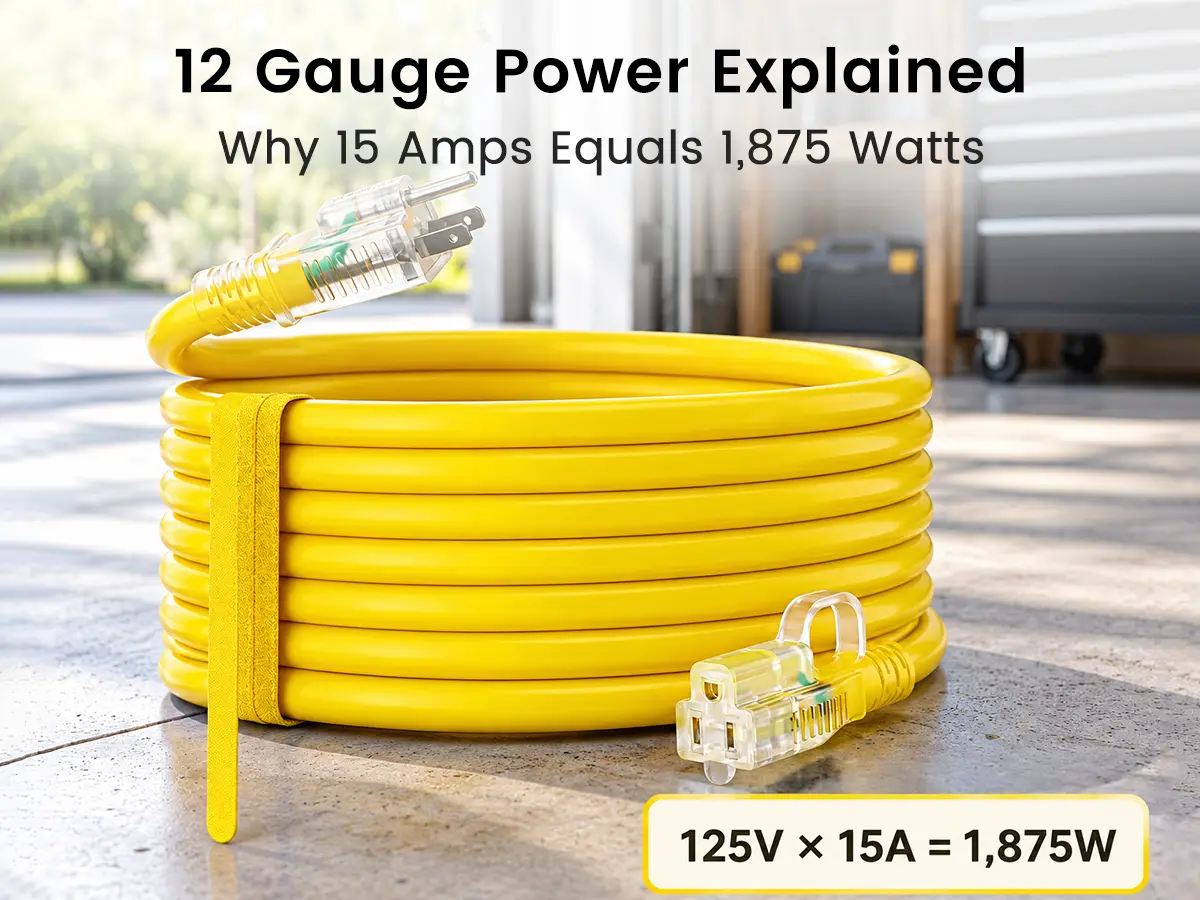
A 12 gauge 15 amp extension cord is rated for up to 1,875 watts because its 125-volt rating is multiplied by its 15-amp rating: 125V × 15A = 1,875W. This number represents the maximum nameplate rating of the complete cord set at its rated voltage. It does not mean every appliance should operate continuously at 1,875 watts or that every cord length will deliver the same voltage under a 15-amp load.
The 12 AWG conductors help reduce electrical resistance and voltage drop compared with thinner conductors. However, wire gauge alone does not determine the rating of a finished extension cord. The plug, receptacle, insulation, construction, length and certified configuration must also be considered.
Why Is a 12 Gauge 15 Amp Extension Cord Rated for 1,875 Watts?
The 1875 watts extension cord rating comes from a straightforward electrical calculation:
125V × 15A = 1,875W
This calculation uses the cord’s rated voltage and current. The 12-gauge conductor does not directly create the 1,875-watt figure. Instead, the wattage comes from the complete extension cord being rated for 15 amps at 125 volts.
This distinction matters because 12 AWG conductors can be used in different electrical products with different plugs, connectors and ratings. A wire gauge describes conductor size, but it does not by itself establish the allowable amperage of every finished product that contains that wire.
Amps to Watts Extension Cord Calculation
The basic amps to watts extension cord calculation is useful when equipment lists amperage but does not show wattage. Multiply the voltage by the current: 5A at 120V equals approximately 600W, 10A equals 1,200W, and 12A equals 1,440W. At the cord’s 125V rating, 15A equals 1,875W.
The table below lists common voltage and amperage calculations. The key point is that the 1,875-watt figure comes from the cord’s 125V and 15A ratings.
| Voltage | Current | Calculation | Calculated Power | What It Means |
|---|---|---|---|---|
| 125V | 15A | 125 × 15 | 1,875W | Maximum nameplate calculation at the cord’s rated voltage |
| 120V | 15A | 120 × 15 | 1,800W | Theoretical calculation using a 120V supply |
| 125V | 12A | 125 × 12 | 1,500W | Mathematical result, not a universal operating recommendation |
| 120V | 12A | 120 × 12 | 1,440W | Mathematical result that does not replace equipment instructions |
These figures explain the relationship between voltage, current and power. They do not override the cord label, the equipment manual, the circuit rating or limitations created by distance and operating conditions.
Why a 125V Extension Cord Can Be Used on a 120V Supply
North American household electrical systems are commonly described as 120V systems, while plugs, receptacles and extension cords are frequently marked with a 125V rating.
The 125V marking is the product’s rated voltage. It does not mean that the cord converts a 120V supply into 125V, nor does it force connected equipment to consume more power. The actual power draw depends on the supply voltage and the electrical characteristics of the connected equipment.
This is why both 1,800W and 1,875W may appear in discussions about 15-amp extension cords. At 120V, the simple calculation is 1,800W. At the product’s stated 125V rating, the calculation is 1,875W.
For the Vantecable product covered in this guide, the published electrical rating is 15A / 125V / 1875W.
Calculating 12 Gauge Extension Cord Wattage Limits
A 12-gauge copper conductor is commonly associated with 20-amp branch circuits in North American building wiring. However, that does not mean every flexible cord made with 12 AWG conductors is automatically a 20-amp extension cord.
Conductor ampacity depends on more than gauge alone. Insulation type, temperature rating, installation method, number of current-carrying conductors and operating conditions can all affect an allowable electrical rating.
A complete extension cord introduces additional components, including the male plug, female connector, molded terminations, insulation and outer jacket. The cord must therefore be evaluated as a complete assembly rather than as an individual conductor.
The Vantecable 12 gauge 15 amp extension cord uses 12/3 AWG conductors but is fitted with a NEMA 5-15P plug and NEMA 5-15R connector. Because the NEMA 5-15 connection is a 15-amp configuration, the finished extension cord is rated and should be used at no more than:
This can be understood as a heavier-conductor 15-amp configuration. The 12 AWG conductors provide lower resistance than thinner 14 AWG or 16 AWG conductors under comparable conditions. That can help reduce voltage drop and conductor heating, particularly as length and current increase.
The thicker conductors do not authorize the cord to deliver a 20-amp load through NEMA 5-15 connectors. The complete product’s marked 15A / 125V / 1875W rating takes priority over a general ampacity value associated with 12 AWG building wire.
How NEMA 5-15 Connectors Set the 15 Amp Extension Cord Limit
The NEMA 5-15P male plug and NEMA 5-15R female connector are designed for 15-amp, 125-volt service. They are the limiting components when 12 AWG conductors are used in this extension-cord configuration.
This separates two related but different concepts: conductor ampacity describes the current a conductor may carry under specified wiring and operating conditions, while the cord-set rating applies to the complete assembled product, including its conductors, plug, connector, insulation, jacket and tested configuration.
For the extension cord discussed here, the relevant consumer rating is the complete cord-set rating: 15 amps at 125 volts, or 1,875 watts.
Do not replace the plug, use an improvised adapter or connect the cord to equipment that exceeds its marked 15-amp rating. Changing one component does not automatically make the rest of the cord suitable for a higher load.
What 12/3 AWG Means on a 15 Amp Extension Cord
The 12/3 AWG designation provides two pieces of information:
- “12” identifies the American Wire Gauge size of the conductors.
- “3” indicates that the cord contains three conductors.
In a grounded extension cord, the three conductors serve line, neutral and equipment grounding functions. The grounding conductor is an important safety feature and should never be removed or bypassed.
A lower AWG number indicates a thicker conductor. Under comparable conditions, thicker copper conductors have lower electrical resistance than thinner conductors. That is why a 12 AWG cord can be useful for higher-current tools and longer distances even when the complete cord remains limited to 15 amps.
The Vantecable cord uses 12/3 AWG conductors made with 99.9% oxygen-free copper. However, neither the copper specification nor the conductor gauge changes the NEMA 5-15 connector rating. The assembled product remains a 12 gauge 15 amp extension cord rated for 125V and 1,875W.
How Many Watts Can a 12 Gauge Extension Cord Handle at Different Lengths?
The most accurate answer to how many watts can a 12 gauge extension cord handle begins with the label on the complete cord set. For the Vantecable product covered here, the stated electrical rating is 15A, 125V and 1,875W.
However, the printed rating is not the only factor to consider. Once connected, the cord becomes part of the electrical path between the outlet and the equipment. As cord length increases, total conductor resistance also increases. When current flows through that resistance, part of the source voltage is lost before reaching the equipment.
This means a 6-foot cord and a 500-foot cord should not be treated as electrically identical simply because they use the same 12 AWG conductors and NEMA 5-15 connectors.
The cord may carry the same printed maximum rating across multiple product options, but an appropriate connected load must still be selected according to distance, voltage drop and equipment requirements.
The Electrical Safety Foundation International provides general length-and-amperage guidance for extension cords. Its published chart places 12 AWG at 14–15 amps for a 100-foot cord and at 8–10 amps for a 150-foot cord. These are general selection guidelines rather than product-specific test results, but they demonstrate why gauge, current and length must be considered together. See the complete ESFI guidance.
For a broader comparison of conductor sizes and cord lengths, see Vantecable’s gauge chart.
How Extension Cord Length Affects Voltage Drop
Voltage drop is the difference between the voltage measured at the power source and the voltage that reaches the connected equipment.
Every conductor has electrical resistance. Increasing the conductor length increases the total resistance of the circuit path. The resulting voltage drop becomes more noticeable as current demand rises.
Voltage drop requires closer attention when the extension cord is especially long, the connected equipment operates near the cord’s current limit, or the equipment contains a motor, pump or compressor. It can also become more significant when several plugs or connection points are involved, or when a plug, connector or outlet is loose, damaged or contaminated.
A 12-gauge conductor helps reduce voltage drop compared with a thinner conductor of the same material and length. It does not eliminate voltage drop.
If a tool operates slowly, struggles to start, repeatedly trips a breaker or causes a connector to become unusually warm, stop using the setup. Inspect the equipment, power source and extension cord before further operation.
Why 1,875 Watts Is Not a Universal Operating Target
The 1,875W figure is the maximum nameplate calculation for the complete cord at its rated voltage. It should not be treated as a recommended operating target for every application.
Equipment manufacturers may impose their own restrictions. Some appliances must be connected directly to a wall receptacle. Others specify a minimum conductor gauge or maximum extension-cord length.
A device may also draw more current during startup than during normal operation. Motors, pumps and compressors commonly produce short periods of higher current demand while starting or operating under mechanical load.
For these reasons, do not choose a cord solely because the equipment’s advertised wattage appears to be lower than 1,875W. Check the equipment input rating, manufacturer instructions, cord length and complete cord rating together.
Amps to Watts Extension Cord Calculations for Real Equipment
The watts formula is a useful starting point, but it is not a complete extension-cord selection method.
Begin by checking the equipment nameplate. Look for input voltage, amperage, wattage and any manufacturer instructions concerning extension cords. If the nameplate only provides voltage and amperage, multiply them to obtain a basic power calculation.
Next, check the complete extension cord label. Confirm that its voltage and amperage ratings meet or exceed the equipment’s requirements. Do not rely only on the AWG number printed on the jacket.
The table below compares the ratings that matter when matching a 12-gauge extension cord to equipment. The focus should remain on the complete cord set rather than wire gauge alone.
| What to Check | Where to Find It | Why It Matters |
|---|---|---|
| Cord voltage and amperage | Cord label or product specifications | Establishes the rating of the complete cord set |
| Equipment input rating | Equipment nameplate or manual | Shows the load the cord must supply |
| Plug and connector type | Cord ends and receptacle | Determines compatibility and limits the assembled cord rating |
| Cord length | Product label or order information | Longer conductors have more total resistance |
| Jacket designation | Marking printed on the cord | Helps identify the cord’s intended environment |
| Independent listing | Cord label or listing information | Confirms evaluation by an independent testing organization |
Resistive Loads and Motor Loads on a 12 Gauge Extension Cord
Not every device with the same advertised wattage places the same demand on an extension cord.
A primarily resistive load converts electrical energy into heat and may have a relatively steady current draw. Equipment containing a motor, pump or compressor may draw additional current during startup or when operating under mechanical load.
The simple volts-times-amps calculation also does not fully describe every alternating-current device. Power factor, efficiency, load condition and startup behavior may affect actual operation.
Use the equipment manufacturer’s input rating and extension-cord recommendations instead of calculating only from advertised output power. If a tool manual specifies a particular gauge for a particular distance, follow that table even when the cord has a higher printed maximum wattage.
Continuous High Loads on a 15 Amp Extension Cord
Equipment that runs briefly is not the same as a load that remains near the cord’s maximum rating for an extended period.
Higher current over a longer operating period gives heat more time to build at the outlet, plug, connector and conductors. Loose or worn connections are especially concerning because additional resistance at the connection point can produce localized heating. During use, keep the cord accessible so heat can dissipate, and do not place it beneath rugs, doors or building materials. Avoid using a cord that is damaged or unusually warm, connecting multiple extension cords together, or leaving plugs and connectors exposed to moisture. Use one cord of an appropriate length for the required distance.
ESFI advises users to match the cord rating to the connected equipment, avoid overloading and use extension cords as temporary rather than permanent wiring. Workplace users should also follow applicable OSHA cord rules, including inspection of cord-and-plug equipment for visible defects.
How to Choose a 12 Gauge 15 Amp Extension Cord
Start with the connected equipment rather than the cord’s advertised maximum wattage.
Check the equipment’s input rating and manufacturer instructions. Determine the required distance between the outlet and the operating location, then select one cord that reaches without being stretched or connected to another extension cord.
For outdoor work, confirm that the cord is marked for outdoor use. An SJTW cord is designed with thermoplastic insulation and a weather-resistant outer jacket for outdoor applications. Even when using an outdoor-rated cord, keep the plug and connector away from standing water.
The cord should have a grounded three-prong configuration when used with grounded equipment. Never remove the grounding pin to make a plug fit an incompatible outlet.
Finally, look for an independent safety listing. The Vantecable product covered in this article is ETL Listed by Intertek. It should not be described as UL Listed.
Checking a 12 Gauge Extension Cord Before Use
Before connecting equipment, inspect the entire cord. Look for cuts, crushed areas, exposed conductors, loose plug blades, cracked connector housings and signs of overheating.
Confirm that the plug is fully inserted and that the connection is not supporting the weight of the cord.
A lighted connector can indicate that power has reached the female end of the cord. It does not confirm grounding, polarity, voltage quality or the operating condition of the connected equipment.
Stop using the cord if it becomes unusually warm, produces an odor, shows visible damage or repeatedly causes a circuit breaker or GFCI to trip. Do not cover a damaged outdoor cord with ordinary tape and return it to service.
Vantecable 12 Gauge 15 Amp Extension Cord Specifications
The Vantecable 12/3 AWG outdoor extension cord is designed for grounded 125V equipment using a standard NEMA 5-15 connection.
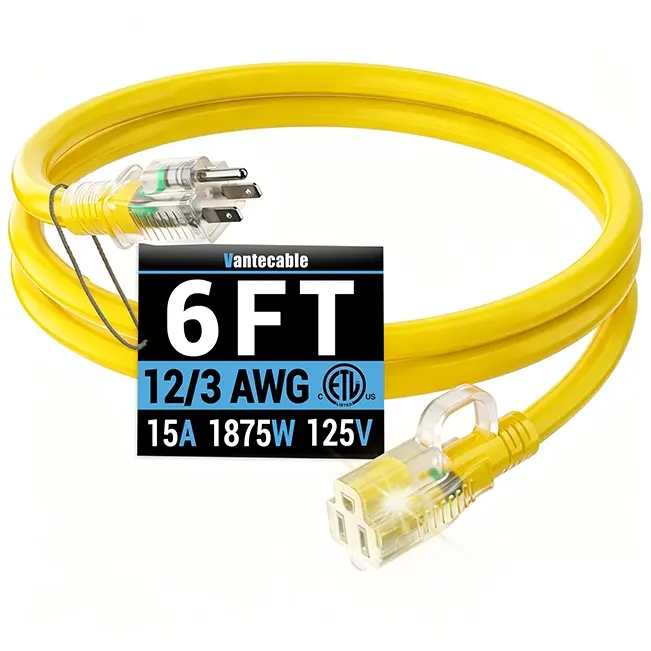
Vantecable 12/3 Gauge Outdoor Extension Cord
- Length Range: 6FT / 10FT / 15FT / 25FT / 50FT / 75FT / 100FT / 150FT / 200FT / 500FT
- Wire Gauge: 12/3 AWG
- Conductor Material: 99.9% Oxygen-Free Copper
- Electrical Rating: 15A / 125V / 1875W
- Temperature Range: -40°C to +70°C
- Jacket Type: SJTW
- Connector Type: NEMA 5-15P to NEMA 5-15R, 3-Prong
- Available Colors: Yellow / Orange / Black
- Safety Certification: ETL Listed
- Feature: LED Lighted End
Select the shortest length that reaches the work area without tension. For extended runs, compare the equipment load with suitable length-and-amperage guidance instead of relying only on the cord’s 1,875W label.
FAQ About 12 Gauge 15 Amp Extension Cords
Q1: Is 1,875 Watts the Same as 15 Amps on an Extension Cord?
No. Amps measure electric current, while watts measure electrical power. The relationship between them depends on voltage.
At 125V, a 15A rating corresponds to 1,875W because 125 × 15 = 1,875. At 120V, the same 15A calculation produces 1,800W.
Q2: Can a 12 Gauge Extension Cord Handle 20 Amps?
A 12 AWG copper conductor is commonly associated with 20-amp branch circuits in North American building wiring. However, that does not make every 12-gauge extension cord a 20-amp product.
If the assembled cord uses NEMA 5-15 connectors and is marked 15A, it must be used as a 15-amp cord. The complete product rating takes priority over a general ampacity value associated with the conductor gauge.
Q3: Why Does a 12 Gauge Extension Cord Have a 15 Amp Plug?
The thicker 12 AWG conductors help reduce resistance and voltage drop. The complete cord’s amperage rating, however, also depends on its plug and connector.
A cord with a NEMA 5-15P plug and NEMA 5-15R connector remains a 15A cord even when it uses conductors commonly associated with some 20-amp wiring applications.
Q4: Can I Use a 1,875-Watt Extension Cord for a 1,500-Watt Heater?
Check the heater manufacturer’s instructions first. Many portable heaters require direct connection to a wall receptacle or specifically warn against using an extension cord.
A wattage below the cord’s printed maximum does not override the appliance manufacturer’s instructions. Operating time, outlet condition, cord length and connection quality must also be considered.
Q5: Does a Longer 12 Gauge Extension Cord Handle Fewer Watts?
The printed electrical rating may remain the same across multiple product lengths, but a longer conductor has more total resistance and produces more voltage drop under load.
As a result, cord length can affect the voltage reaching the equipment and whether a particular load is appropriate. Use the shortest practical cord and follow the equipment manufacturer’s conductor-size and distance recommendations.
Conclusion: Understanding the 1,875-Watt Extension Cord Rating
A 12 gauge 15 amp extension cord is rated at 1,875 watts because 125 volts multiplied by 15 amps equals 1,875 watts. The calculation is straightforward, but choosing and using the cord requires more than checking one number.
Although 12 AWG copper conductors are commonly associated with 20-amp branch circuits, the finished Vantecable cord uses NEMA 5-15 connectors. The complete cord is therefore rated for 15A at 125V and must not be treated as a 20-amp cord.
The thicker conductors help reduce resistance and voltage drop, especially compared with thinner cords under similar conditions. Cord length, equipment type, startup current and manufacturer instructions must still be considered.
Use the complete cord label as the primary reference, choose the shortest practical length and never exceed the marked rating. Browse Vantecable’s extension cords to compare available gauges, lengths and connector options.