
.png?w=1368&h=240)
Extension Cord Gauge Chart: Quick Reference
Scan the three cards below for a fast answer. If your device sits near the upper limit of a gauge, or your run is over 50 feet, move to the next heavier size.
Extension Cord Gauge Chart by Cord Length
Amp capacity isn't fixed — resistance builds over distance, so the same gauge wire safely carries less current at 100 ft than at 25 ft. Use this table to find the maximum safe load at your cord's length.
| Gauge (AWG) | Duty rating | 25 ft | 50 ft | 100 ft | 150 ft |
|---|---|---|---|---|---|
| 16 AWG | Light duty | 10A / 1,200W | 10A / 1,200W | Not recommended | Not recommended |
| 14 AWG | Medium duty | 13A / 1,560W | 13A / 1,560W | 10A / 1,200W | 7A / 840W |
| 12 AWG | Heavy duty | 15A / 1,800W | 15A / 1,800W | 15A / 1,800W | 12A / 1,440W |
| 10 AWG | Extra heavy | 20A / 2,400W | 20A / 2,400W | 20A / 2,400W | 15A / 1,800W |
Why a Smaller Gauge Number Means a Thicker Wire
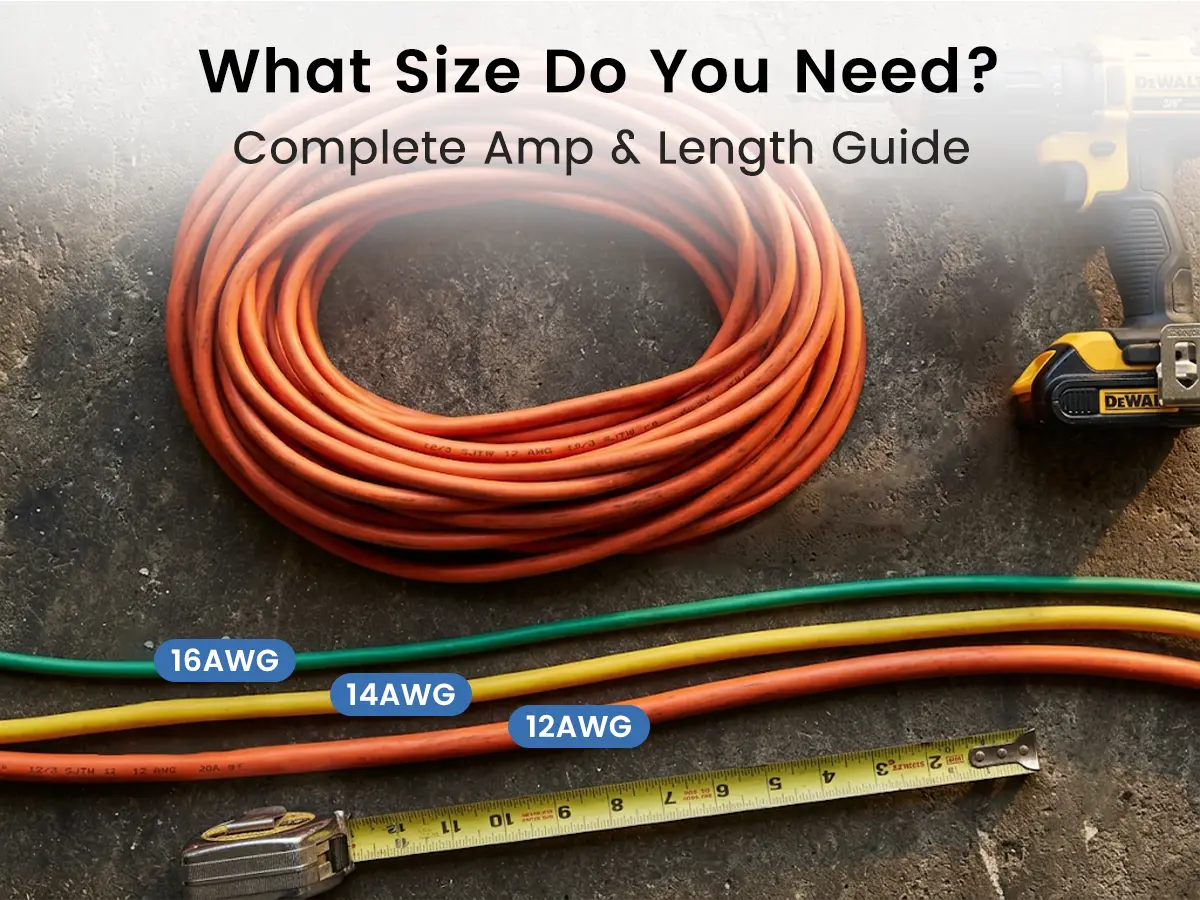
It feels backwards — but AWG works like a garden hose in reverse. Think of the number as a resistance rating: the lower the number, the bigger the opening, the less friction for current to flow through. A 12 AWG wire is physically thicker than a 16 AWG wire, so it carries more current with less heat buildup.
Extension Cord Gauge by Appliance: What Do You Need?
Most searches for "what gauge extension cord" are really "what gauge for this specific thing." Here's a device-by-device answer.
Space heaters typically draw 12.5A at 1,500W — right at the edge of what 14 AWG can handle. Use 12 AWG, and keep the run as short as possible. Heaters run continuously at full load, which magnifies the risk of undersized wiring.
Generator loads combine several appliances simultaneously. Use 10 AWG for runs over 50 ft, or 12 AWG for shorter distances. Startup surges can briefly double the running amperage.
Startup surge current is much higher than running wattage — an undersized cord can prevent the compressor from starting. Use 14 AWG minimum; upgrade to 12 AWG for longer runs.
Check the amp rating on the tool's nameplate first — startup current is often 1.5–2× the running figure. Use 14 AWG for short runs; 12 AWG for anything over 50 ft.
Most residential mowers, trimmers, and blowers are comfortable on a 14 AWG outdoor-rated cord. Commercial-grade equipment may need 12 AWG. Always use a cord rated for outdoor use (look for the SJTW jacket marking).
Low-draw devices like lamps, monitors, and phone chargers are perfectly safe on 16 AWG — the lightest common gauge. No need to upsize for these loads.
Level 1 EV charging can draw 12–16 amps for several hours. If your charger exceeds 12 amps, do not use a standard extension cord. If you must use one, ensure your EV charger is manually limited to 12 amps or less and use an ETL-certified 12 AWG extension cord. Always check your vehicle owner’s manual first; many manufacturers explicitly advise against using any extension cord for charging.
Indoor vs. Outdoor Extension Cord Gauge Guide
Gauge selection works the same way indoors and out — but outdoor cords are typically built one step heavier, with extra-thick insulation rated for moisture, UV exposure, and temperature swings. Look for the jacket code SJTW (or similar W-rated designation) for any outdoor use.
What Happens If You Use the Wrong Extension Cord Gauge?
- Voltage drop — tools underperform, motors strain, lights dim. The device pulls more current trying to compensate, making heat worse.
- Heat buildup — the wire itself gets warm or hot along its entire length, not just at the plug.
- Insulation damage — sustained heat softens and degrades the jacket over time, creating a latent hazard even after the cord cools down.
- Fire risk — in the worst cases, an undersized cord under continuous high load can ignite surrounding materials.
FAQ: Extension Cord Gauge
Quick answers to the questions we hear most often.
How many amps can a 12 gauge extension cord handle?
A 12 AWG extension cord is rated for up to 15 amps to meet safety standards. To maintain this capacity, it is recommended to keep the cord run within a reasonable length to minimize voltage drop.
What gauge extension cord do I need for 100 feet?
For most household loads, 12 AWG is the standard choice. For heavy continuous loads—like generators or heaters—10 AWG is recommended at 100 feet to stay within safe voltage-drop limits and prevent overheating.
Can I use a 16 gauge extension cord for a space heater?
No. A space heater typically draws 12.5 amps, which exceeds the safe continuous rating of a 16 AWG cord. Use at least 12 AWG. Running a heater on an undersized cord is a leading cause of extension cord fires.
Is a lower gauge number always better?
Yes, for capacity, a lower AWG number means higher current capacity. While using a thicker cord than required is safe, it may be bulkier and more costly than necessary. When in doubt, always size up for safety.
Does extension cord length affect wattage capacity?
Yes. Increased length adds resistance, which reduces the safe wattage capacity for the same gauge. For example, a cord's safe capacity drops significantly at 150 feet compared to 25 feet. Always check the capacity chart at your cord's full run length.
Browse Vantecable's full range of properly rated heavy-duty extension cords — sized and rated for the loads that matter.