
.png?w=1368&h=240)
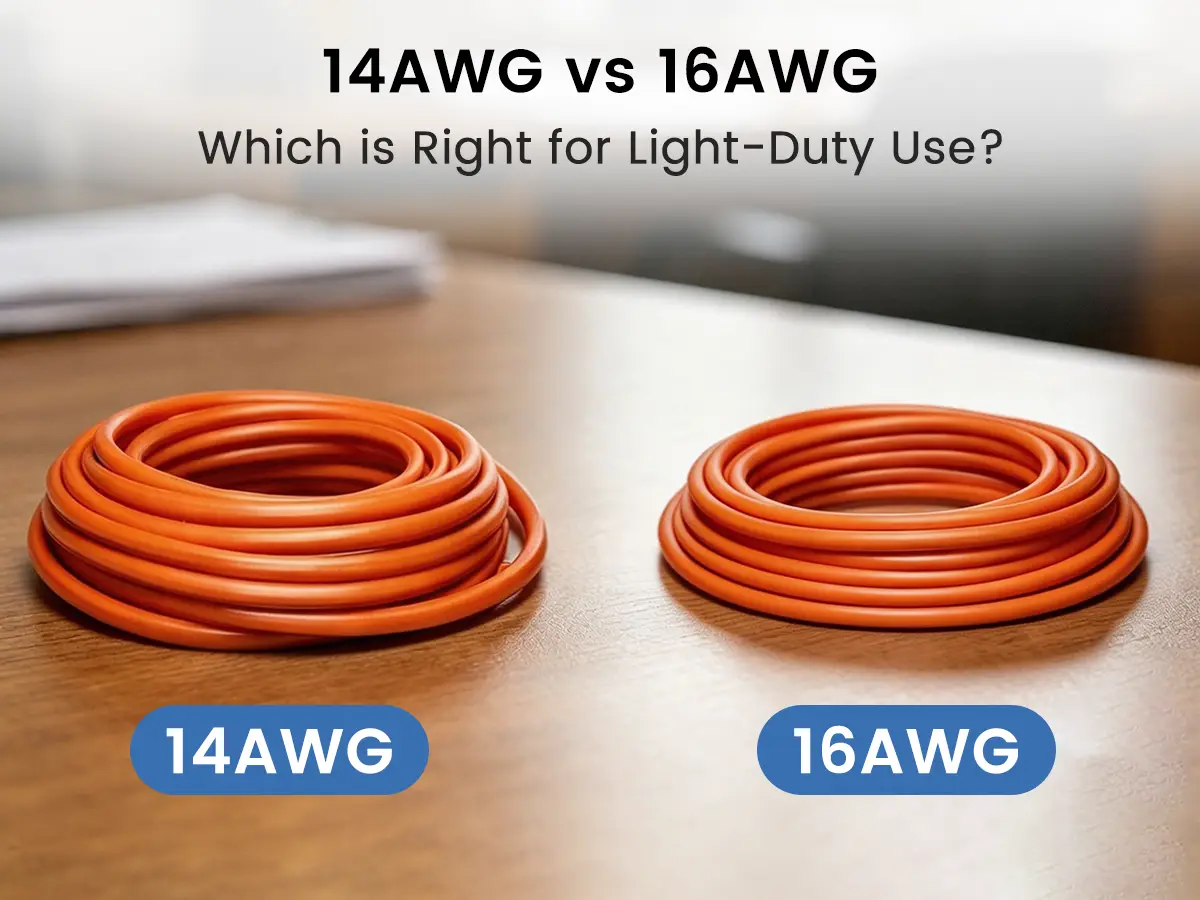
What is the difference between 14AWG and 16AWG extension cords?
The main technical difference is that 14AWG extension cord is thicker than 16AWG, resulting in lower resistance and a higher current carrying capacity of 15 amps, compared to 13 amps for 16AWG.
While 14AWG offers better heat dissipation and a lower voltage drop, it is still classified as a medium-load application and is not suitable for high-power industrial machinery or heavy continuous loads exceeding its 1875-watt capacity.
Safety standards stipulate that for high-demand applications or line lengths exceeding 50 feet, 12AWG or thicker wire remains a professional requirement to prevent overheating.
When choosing extension cable guage, many users find themselves deciding between 14AWG and 16AWG. These two gauges are often discussed as if one is “powerful” and the other is “weak,” but from an electrical engineering perspective, that framing is inaccurate. The real difference between 14AWG and 16AWG extension cords lies not in a dramatic jump in power capability, but in safety margin, voltage stability, heat behavior, and long-term reliability under real-world use conditions.
This article will objectively and professionally teach you how to choose the right extension cord for your daily life.
Understanding AWG in Extension Cords
AWG (American Wire Gauge) is a standardized system used in North America.
Understanding American Wire Gauge (AWG) requires a grasp of its inverse logarithmic scale: as the gauge number increases, the wire diameter decreases.
This system is based on the number of drawing operations required to produce a specific wire thickness; each successive draw through a smaller die reduces the diameter and increases the gauge number.
Technically, the ratio of any two successive gauge diameters is constant, defined by the geometric progression between No. 4/0 (0.4600") and No. 36 (0.0050").
This physical dimension directly dictates the conductor's resistance and thermal dissipation capacity.
A lower AWG signifies a larger cross-sectional area, which is mandatory for minimizing resistive heating and voltage drop in power transmission, ensuring the cable operates within its safe ampacity limits.
In practical terms:
-
16AWG conductor cross-section: approximately 1.31 mm²
-
14AWG conductor cross-section: approximately 2.08 mm²
This means 14AWG contains roughly 60% more copper than 16AWG. That physical difference directly affects electrical resistance, heat generation, and voltage drop.
Why Conductor Size Matters in Real Use
In practical applications, conductor size is the primary determinant of Voltage Drop and Thermal Management.
According to Ohm’s Law, a conductor's resistance is inversely proportional to its cross-sectional area. When a conductor is undersized for the intended load, the increased resistance converts electrical energy into wasted heat, causing a significant drop in voltage at the terminal end.
This inefficiency forces motorized appliances to draw higher current to compensate, leading to internal component stress and premature motor failure.
Furthermore, consistent operation near a cable's thermal limit accelerates the degradation of the PVC or rubber insulation, increasing the risk of short circuits.
Therefore, selecting the correct AWG is a critical engineering decision to ensure that the delivered voltage remains within the equipment's operational tolerance (typically +/- 5%) while maintaining a safe thermal margin.
A thicker conductor provides:
-
Lower electrical resistance
-
Reduced heat generation under load
-
Lower temperature rise in insulation
Therefore, 14AWG extension cords are more suitable for higher power applications than 16AWG extension cords, providing a more comfortable and safer experience for ordinary home use.
However, this does not mean that 14AWG is suitable for heavy-duty and high-power applications; such environments still require upgrading to 12AWG or 10AWG extension cords.
For more detailed information, please see our comprehensive guide.
14AWG Extension Cord
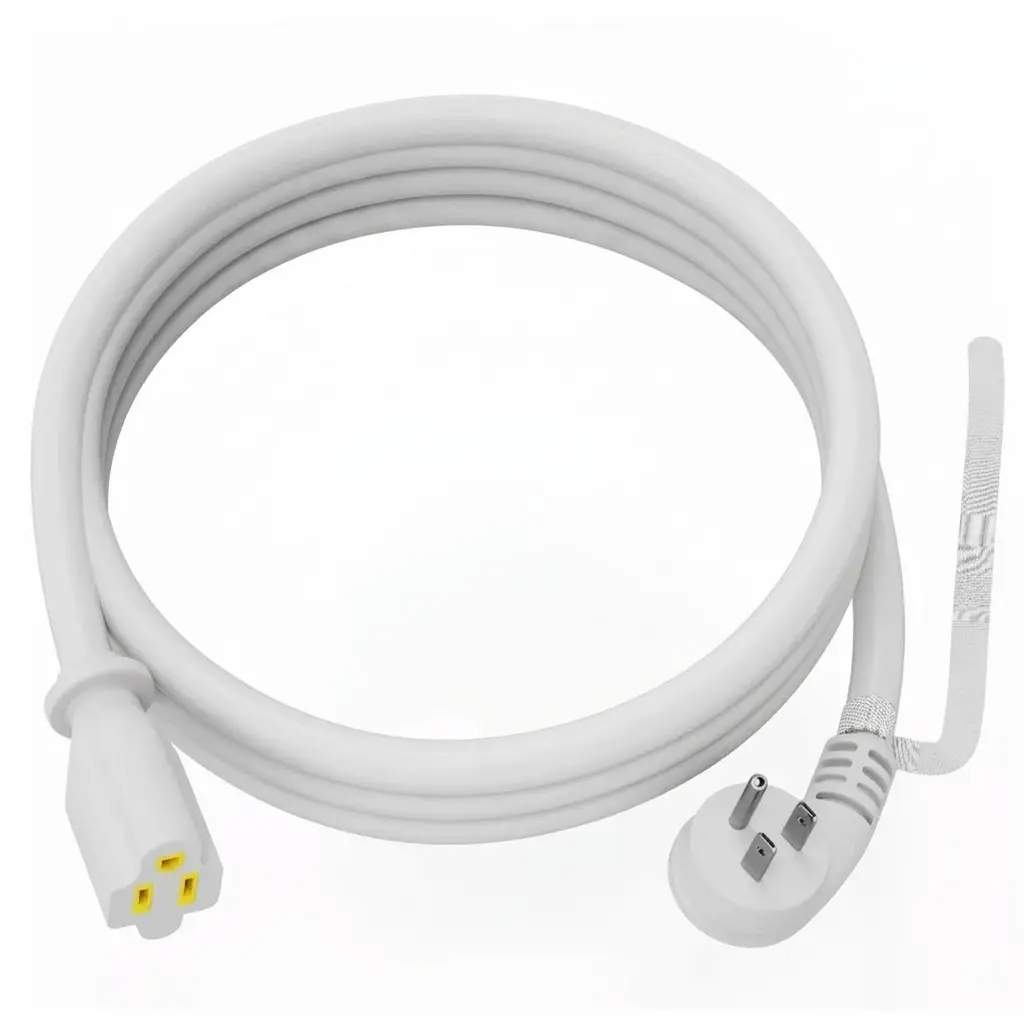
A 14AWG extension cord represents a significant step up in electrical safety and performance, featuring a conductor diameter of approximately 1.63 mm. Often classified as "Medium-Duty," this gauge is the baseline for users who require more than just basic power for lamps or small electronics.
With a standard rating of 15 Amps and a capacity of up to 1875 Watts, it aligns perfectly with the common household circuit breaker, ensuring the cord itself does not become the weakest link in your power chain.
Application
In real-world scenarios, 14AWG is the minimum professional recommendation for powering high-draw appliances such as portable air conditioners, miter saws, or large kitchen appliances.
Its thicker copper core effectively minimizes resistive heating and mitigates voltage drop—a critical factor when the cord length exceeds 25 feet.
While it offers superior thermal management compared to 16AWG, it is essential to remember that for continuous high-load operations or distances reaching 100 feet, evaluating an upgrade to 12AWG remains a necessary safety precaution.
Why Choose 14 AWG?
A 14AWG extension cord is the definitive upgrade for users who prioritize safety margins and operational stability.
Unlike thinner gauges, its increased copper cross-section handles higher electrical demands without excessive thermal buildup, making it the reliable choice for home workshops, garage environments, and high-traffic office settings.
If you are running a 12.5A portable space heater or a 15A circular saw at a distance from the outlet, a 14AWG cord ensures steady voltage delivery.
This prevents the equipment’s motor from straining due to under-voltage and eliminates the risk of the insulation melting under sustained load, providing a crucial layer of protection for both your tools and your property.
16AWG Extension Cord
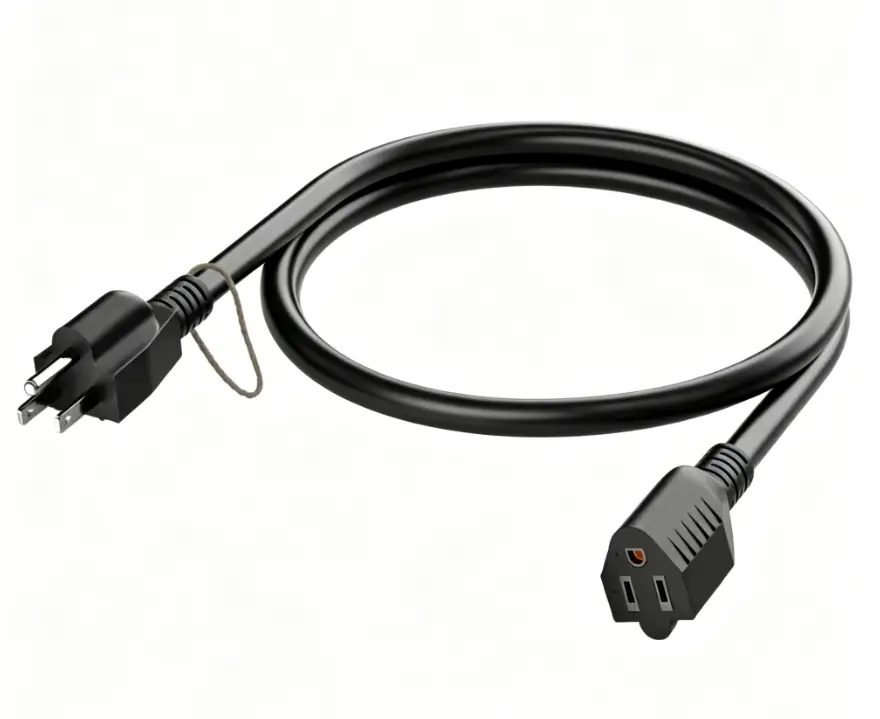
A 16AWG extension cord is a standard entry-level power solution designed for lightweight applications, featuring a conductor diameter of approximately 1.29 mm. Frequently categorized as "Light-Duty," this gauge is the optimal choice for users connecting basic household electronics or low-wattage office equipment.
With a typical rating of 13 Amps and a capacity of up to 1625 Watts, it is specifically built for localized indoor use where the total power demand remains well within the safety thresholds of standard residential circuits.
Application
In real-world scenarios, 16AWG is the primary recommendation for powering low-draw devices such as LED lamps, desktop fans, or small inkjet printers.
Because of its thinner copper core, it offers exceptional flexibility and portability, making it easy to route behind furniture or in tight home office setups. However, its resistive profile means it is less efficient at dissipating heat under heavy loads compared to thicker cables.
While it is perfectly safe for minor electronics, it is essential to avoid using 16AWG for high-wattage appliances like space heaters or vacuum cleaners. For any run exceeding 50 feet, evaluating an upgrade to 14AWG is a critical step to prevent significant voltage drop and potential thermal stress.
Why Choose 16 AWG?
A 16AWG extension cord is the practical choice for users who prioritize cost-effectiveness and flexibility for non-intensive tasks.
Unlike heavier gauges, its lightweight design allows for easy handling and storage, making it the go-to solution for temporary holiday lighting, bedroom electronics, and general indoor utility.
If you are setting up a charging station for mobile devices or a reading nook with a single floor lamp, a 16AWG cord provides sufficient power delivery without the unnecessary bulk or rigidity of industrial-grade cables. This ensures a clean, organized setup while maintaining reliable performance for your everyday low-power needs.
Comparison Table: Choosing Between 14AWG and 16AWG
| Performance Metric | 14 AWG (Professional/Medium-Duty) | 16 AWG (Residential/Light-Duty) |
|---|---|---|
| Current Capacity | Rated for 15 Amps (Ideal for 12-13A sustained) | Rated for 13 Amps (Ideal for 8-10A sustained) |
| Max Power Load | Supports up to 1875 Watts at 125V | Supports up to 1625 Watts at 125V |
| Internal Conductor | Thick copper core (~1.63mm); lower resistance | Thinner copper core (~1.29mm); moderate resistance |
| Voltage Stability | Superior; maintains power over 50-100 ft | Moderate; best kept under 25-50 ft |
| Device Compatibility | Power tools, refrigerators, space heaters | Table fans, LED lighting, laptop chargers |
| Durability & Weight | Robust insulation; heavier and less pliable | Compact insulation; highly flexible and portable |
| Safety Buffer | High; manages thermal heat effectively | Low; prone to overheating if used with motors |
| Optimal Environment | Garage, workshop, and outdoor construction | Home office, living room, and indoor utility |
16AWG is appropriate for:
-
Lamps and small electronics
-
Low-power household appliances
-
Short-distance, intermittent indoor use
14AWG is a better choice for:
-
Slightly higher loads within light-duty range
-
Longer cord lengths
-
Users who want additional safety margin
14AWG or 16AWG? Power Capacity & Performance
Current Capacity in Extension Cord Applications
Extension cords are classified as flexible cords, which experience more demanding conditions than fixed wiring. They may be coiled, exposed to higher ambient temperatures, or subject to contact resistance at plugs.
From a conservative engineering perspective:
-
16AWG: most suitable for continuous loads around 8–10 amps
-
14AWG: more comfortable at 12–13 amps for continuous use
This difference reflects thermal margin, not permission to exceed safe limits.
Power Handling: Comfort Zone vs Maximum Ratings
In a standard 120V system:
-
16AWG: typically appropriate for ~1000–1200 watts continuous use
-
14AWG: better suited for ~1400–1500 watts continuous use
Both gauges should avoid long-term operation at maximum rated load, especially with heating appliances. The advantage of 14AWG is reduced heat buildup at the same power level, not a different usage class.
Voltage Drop and Cord Length
As cord length increases, voltage drop becomes more noticeable.
-
16AWG experiences voltage drop more quickly over distance
-
14AWG maintains voltage more consistently over medium lengths (25–50 ft)
This matters most for tools and motor-driven equipment, where stable voltage improves performance and reduces wear.
Heat, Plugs, and Safety Margin
In real-world extension cord failures, problems often occur at the plug or receptacle, not the wire itself.
Because 14AWG operates further from its upper limits, it:
-
Generates less localized heat
-
Reduces stress at connection points
-
Provides better tolerance for daily or repeated use
Final Engineering Perspective
From an engineering standpoint, choosing the right gauge is less about maximum power and more about operating margin and real-world usage.
The difference between 14AWG and 16AWG extension cords is not about “high power versus low power.” It is about how comfortably and reliably the cord operates under normal conditions.
For many everyday applications, 16AWG is sufficient. When distance, usage time, or load increases, 14AWG provides added stability and peace of mind, without changing the fundamental application category.
Users dealing with higher continuous loads may also find it helpful to review our 12AWG vs 14AWG extension cord comparison.
FAQ: Common Questions About 14AWG and 16AWG Extension Cords
Q1: Is 14AWG really much stronger than 16AWG?
A: Not dramatically. From an engineering standpoint, 14AWG does not represent a different power class. The main difference is operating margin. At the same load, a 14AWG cord runs cooler and experiences less voltage drop.
Q2: Can 14AWG extension cords handle heavy appliances?
A: Not necessarily. While 14AWG performs better than 16AWG, it is still intended for light to moderate household loads. High-wattage or continuous-use appliances should be connected to dedicated circuits, not long extension cords.
Q3: Why does cord length matter more with 16AWG?
A: Because thinner conductors have higher resistance. As length increases, voltage drop becomes more pronounced with 16AWG, which can affect motor-driven devices. 14AWG maintains voltage more consistently over longer distances.
Q4: Is 16AWG unsafe for outdoor use?
A: No. Safety depends more on insulation, weather rating, and certification than gauge alone. A properly rated outdoor 16AWG cord can be safe. However, 14AWG offers greater tolerance for temperature variation and extended outdoor use.
Q5: Should I always choose 14AWG just to be safe?
A: Not always. For short distances and low-power devices, 16AWG is typically sufficient and more flexible. Choose 14AWG when you expect longer runs, higher continuous load, or frequent outdoor use.