

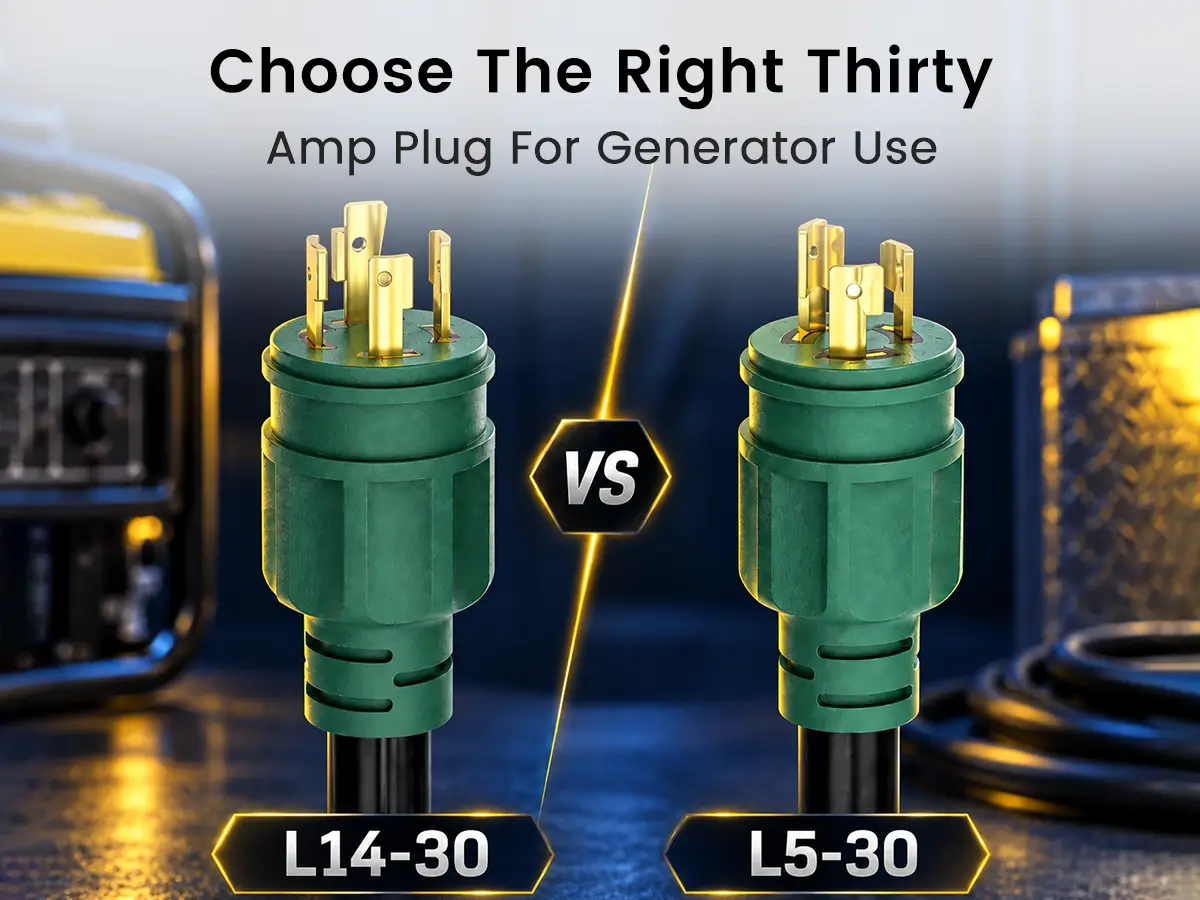
A 30 amp generator extension cord should match the generator outlet’s complete NEMA configuration. Choose an L5-30 generator cord for a compatible 125V three-wire connection and an L14-30 generator cord for a compatible 125/250V four-wire connection. Although both are rated 30A, they have different blade patterns, conductor counts, and voltage configurations, so they are not interchangeable.
L5-30 vs L14-30 Generator Cord: Key Differences
The two most common 30A locking generator cords look similar at a glance, but they serve different electrical configurations, and confusing them can prevent a cord from seating or locking correctly. Both configurations use the same twist-lock design described in our twist-lock plug guide, so the differences below come down to voltage, conductor count, and blade pattern rather than how the connector locks in place.
L5-30 Generator Cord: 125V and 10/3 AWG
The L5-30 generator cord uses an L5-30P plug on one end and an L5-30R connector on the other. It is rated for 30A at 125V and is built with 10/3 AWG cable, carrying a hot conductor, a neutral conductor, and a ground conductor. On the Vantecable product page, this configuration is rated at 3,750W. This cord is intended for generators and equipment with a matching L5-30 outlet, commonly found on single-voltage 125V portable generators used for job-site power and general backup applications.
L14-30 Generator Cord: 125/250V and 10/4 AWG
The L14-30 generator cord uses an L14-30P plug and an L14-30R connector, built for a 30A, 125/250V split-phase configuration. The cable is 10/4 AWG, adding a second hot conductor to the hot, neutral, and ground conductors found on the L5-30 cord. On the Vantecable product page, this configuration is rated at 250V and 7,500W. This cord is intended for generators, transfer switch inlet boxes, or equipment with a matching L14-30 outlet, and it is the configuration most often used when a generator needs to feed a home transfer switch that draws on both hot legs.
The table below compares L5-30 and L14-30 generator cords, focusing on the voltage, conductor count, and connector differences behind the same 30A rating.
| Feature | L5-30 | L14-30 |
|---|---|---|
| Connector | L5-30P to L5-30R | L14-30P to L14-30R |
| Current | 30A | 30A |
| Voltage | 125V | 125/250V |
| Product rating | 3,750W | 7,500W |
| Wire | 10/3 AWG | 10/4 AWG |
| Conductor | Hot, neutral, ground | Two hots, neutral, ground |
| Interchangeable | No | No |
How to Choose a 30 Amp Twist Lock Cord
Match the 30 Amp Generator Outlet
Choosing the right 30 amp twist lock cord starts with the outlet, not the cord. First, check the complete NEMA designation printed on the generator’s outlet, since “L5-30” and “L14-30” are both valid 30A locking configurations but describe different voltages and conductor counts. Next, confirm the connector on the other end, whether that is a transfer switch inlet box, a distribution panel, or a piece of equipment, so both ends of the run are verified before you buy a cord. Finally, confirm the voltage and current rating printed on the generator or inlet nameplate, and only then decide on cord length. A cord should never be selected by counting prongs alone or by matching the amperage number in isolation, since a three-pole and a four-pole 30A connector are built for different jobs. Always confirm the outlet designation in the generator manual before buying a cord; Generac’s cord guidance similarly recommends matching the power cord to the receptacle provided on the generator.
Choose Between L5-30 and L14-30
The outlet designation determines which cord fits, but the connected equipment must also support the same voltage configuration. An L5-30 connection supplies a 125V circuit, while an L14-30 connection can support a 125/250V split-phase setup. Do not use an unverified adapter or replace the plug to make one configuration fit the other; an adapter cannot create a voltage or conductor that the generator outlet does not provide.
How Many Watts Can a 30 Amp Generator Cord Carry?
The wattage figures attached to these cords come from two related but distinct calculations. The L5-30 product rating is based on 125V multiplied by 30A, giving 3,750W. A commonly referenced household 30A circuit conversion instead uses 120V multiplied by 30A, giving 3,600W; both numbers describe the same 30A rating, just calculated from a 125V nameplate voltage versus a 120V nominal service voltage. The L14-30 product rating is based on 250V multiplied by 30A, giving 7,500W. These figures represent the maximum rated capacity of the cord itself, and they do not mean a generator will continuously deliver that full amount. The actual power available in any setup depends on the generator’s own nameplate output, the protection built into its outlets, and the requirements listed in the connected equipment’s manual, so these wattage numbers should not be used on their own to decide whether a cord can power an entire home.
Choosing a 30 Amp Generator Cord Length
Cord length should cover the complete route from a safely placed generator to the connection point, with enough slack to avoid pulling on either connector. Longer cord runs introduce more resistance and a more noticeable voltage drop, so a single cord of the correct length is preferable to joining two shorter cords together. For cord lengths over 50 feet, follow the current rating stated on the applicable Vantecable product page and product label, since a length-based derating on one connector type should not be assumed to carry over to the other.
30 Amp Generator Cord Setup for Emergency Power
Choose one 30A generator cord based on the generator outlet, then add a 12/3 lighted extension cord separately for compatible 15A equipment; the two products serve different parts of the setup and are not meant to substitute for one another.
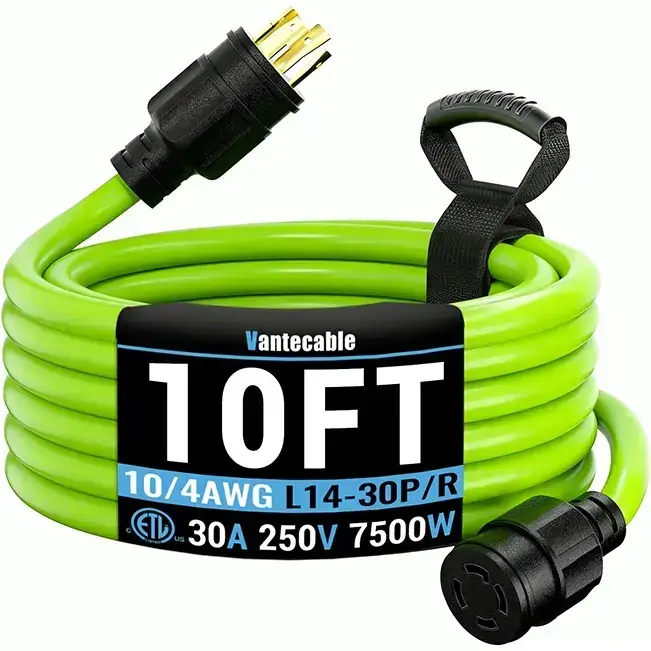
30 Amp Generator Extension Cord
Select the configuration that matches your generator outlet
For the separate 15A reach described above, use the 12/3 outdoor cord. The 12/3 cord serves compatible 15A equipment separately. It does not replace or directly extend the 30A locking generator cord.
30 Amp Twist Lock Cord Safety Checks
Inspect the Generator Cord Before Use
Before each use, inspect the cord jacket, blades, connector body, grounding components, and strain-relief points for cuts, cracked insulation, scorching, discoloration, or looseness. Stop using a damaged cord, avoid connecting or disconnecting it under load, and grip the connector body rather than pulling on the cable. OSHA generator guidance also advises users not to use frayed or damaged extension cords and to confirm that each cord is rated for its intended load.
Protect Outdoor Generator Cord Connections
An outdoor-rated jacket does not mean the plug connection itself can be submerged. Keep connections away from standing water, vehicle paths, door or window openings that could pinch the cable, and sharp edges that could cut through the jacket over time. The locking mechanism on these connectors is designed to prevent accidental disconnection, and it is not a substitute for keeping the connection point dry and protected.
FAQ
Can I use an L14-30 cord with an L5-30 generator outlet?
No. L5-30 and L14-30 have different voltage configurations, conductor counts, and blade patterns. Use the cord that matches the complete generator outlet designation.
Do I need a transfer switch with a 30 amp generator cord?
If the generator will supply a home’s permanent wiring, it must be connected through properly installed transfer equipment that prevents utility backfeed. A qualified electrician should select and install the equipment according to the generator, electrical panel, and local code. Compatible appliances may instead be connected directly to the generator as permitted by the manufacturer’s instructions.
Can a 30 amp generator cord power an entire house?
Not necessarily. It depends on the generator’s output, the connected loads, the transfer equipment in place, and how those loads are managed. A 30A cord rating alone does not determine whether an entire home can be powered.
Conclusion: Choose the Right 30 Amp Generator Extension Cord
An L5-30 generator cord is built for a matching 125V, three-wire connection, while an L14-30 generator cord is built for a matching 125/250V, four-wire connection, and the two are not interchangeable despite sharing the same 30A rating. Start by matching the complete NEMA designation on the generator outlet, then confirm voltage, wattage, and length before buying. The 12/3 yellow extension cord works alongside either 30A cord as a separate 15A reach, not as a replacement for it. Browse our emergency power cords to find the configuration that matches your setup.