

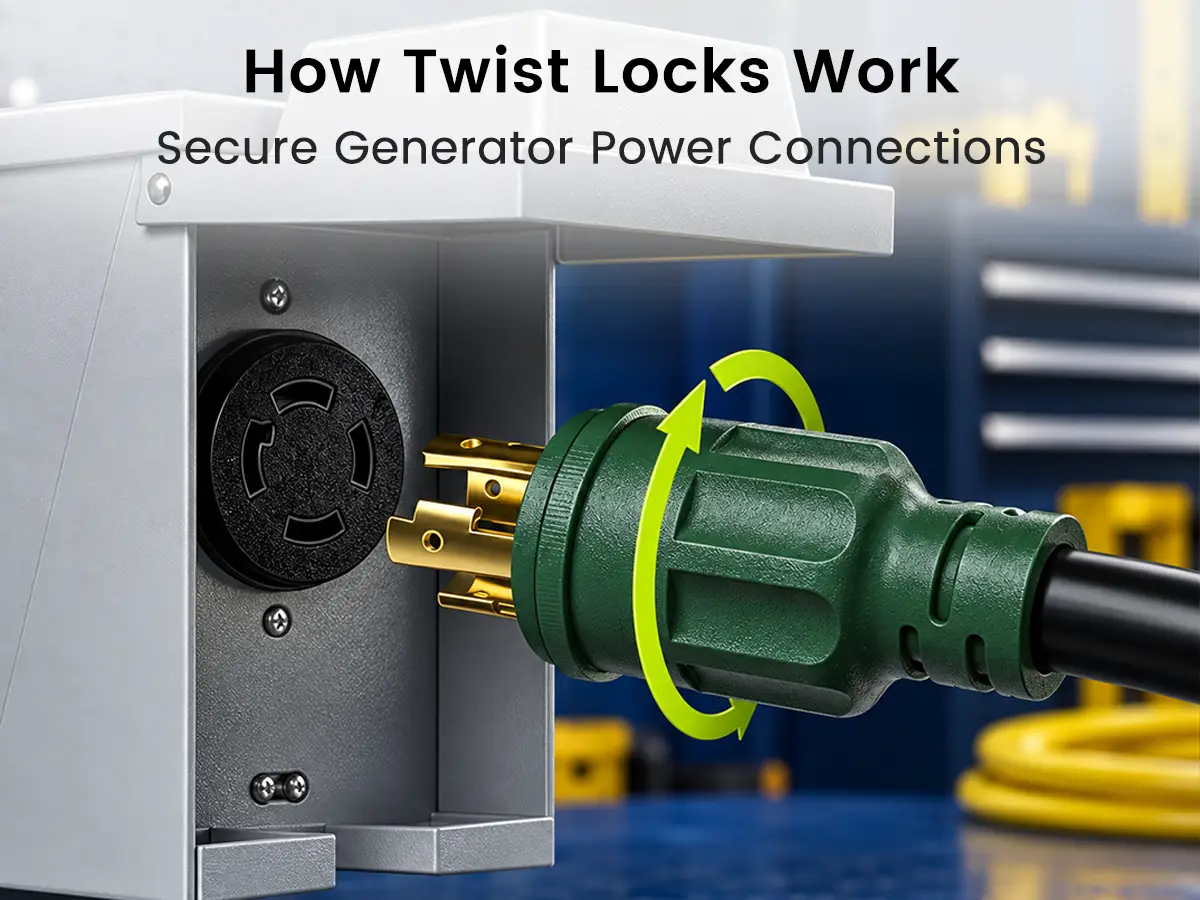
A twist-lock generator plug connects to a matching receptacle by pushing straight in and rotating in the indicated locking direction. This mechanical lock helps prevent the connection from being pulled loose while a generator is running.
During hurricane season, a secure generator connection becomes especially important when backup power may need to operate for hours. Understanding the locking motion helps you avoid forcing a misaligned plug or pulling one that is still locked. Browse our generator cords collection for compatible ETL Listed 30A options.
Insert, Twist, Lock — What’s Actually Happening
Push the plug straight into the receptacle until it seats fully. Do not twist while inserting, since the blades need to enter the receptacle correctly first. Once seated, rotate the plug in the locking direction indicated by the connector until it reaches a firm stop.
The reason this works is shape, not friction alone. A straight-blade plug relies mainly on contact pressure to remain seated. A locking generator plug adds mechanical retention after rotation, helping prevent the plug from being pulled straight out while it remains locked.
The exact amount and direction of rotation may vary by connector, so follow the markings on the plug and the generator manufacturer’s instructions rather than forcing it.
Why This Matters When a Generator Is Running
A running generator produces vibration, and movement of the generator or cord can place stress on the connection. A locking plug helps resist accidental pullout, although it does not make a damaged, worn or improperly connected plug safe.
Locking receptacles are common on higher-current portable generator outputs because they provide more mechanical retention than comparable straight-blade connections. NEMA locking configurations use an “L” in designations such as L5-30P and L14-30P.
Two common 30A generator plug types are L5-30 and L14-30. L5-30 is a three-prong, 125V configuration, while L14-30 is a four-prong, 125/250V configuration. They differ in conductor count and voltage configuration, not in the basic locking motion.

30 Amp 4-Prong Generator Extension Cord with Twist Lock (L14-30P/L14-30R)
30A / 250V / 7,500W · 10/4 AWG · 10–100 ft · ETL Listed
- Twist-lock design resists pullout (25A limit over 50 ft)
- 10/4 AWG pure copper, 2,500V tested
- IP65 weatherproof, −50°C cold rating
- Flexible vinyl resists cracking
If your generator has a three-prong L5-30 outlet, our L5-30 cord is the matching L5-30 plug option. Check the complete outlet designation rather than choosing by amperage alone.
How to Unplug It Without Forcing It
Because the plug is mechanically locked, pulling straight out strains the blades and receptacle housing. First shut down the connected equipment, remove the load and follow the generator manufacturer’s shutdown instructions.
Grip the plug housing, rotate it in the release direction until the resistance disappears, and then pull it straight out. If the plug remains stuck, disconnect the power and check for corrosion, debris or damage instead of twisting harder.
Before each use, inspect the cord, plug and receptacle for cracked insulation, deformation, loose parts or other visible damage. OSHA guidance similarly requires cord-and-plug-connected equipment and flexible cord sets used in covered workplaces to be visually inspected before use.
Twist-Lock vs. Straight-Blade Plugs — The Mechanical Difference
The table below compares straight-blade and locking plugs, focusing on how each connection remains seated.
| Feature | Straight-Blade Plug | Locking Plug |
|---|---|---|
| Connection method | Push straight in | Insert, then rotate to lock |
| What keeps it seated | Mainly contact friction | Mechanical retention after rotation |
| Behavior under movement | May pull out if disturbed | Helps resist accidental pullout |
| Typical use | Household appliances and compatible tools | Generators, job sites and temporary power equipment |
Common Twist-Lock Problems and How to Fix Them
The table below lists common locking-plug problems, their likely causes and the safer next step.
| Symptom | Likely Cause | What to Do |
|---|---|---|
| Plug will not reach the locked position | Blades are misaligned, or the plug is not fully seated | Push straight in first, then rotate without forcing it |
| Plug will not come out | It is still locked | Remove the load, rotate in the release direction and pull by the housing |
| Warm plug or burning smell | Loose, corroded or overloaded contacts | Cut power immediately and have the cord and outlet inspected before reuse |
Connector condition is only one part of generator-cord safety. The CPSC recommends using heavy-duty, outdoor-rated extension cords with adequate wire gauge, intact insulation and grounded plugs when connecting individual appliances to a generator.
Where Else You’ll See Twist-Lock Connectors
Locking connectors also appear in some RV generator and inlet setups. However, a generator’s L5-30 or L14-30 outlet does not directly match an RV’s TT-30 or 14-50 shore-power plug. Any adapter must be correctly rated and electrically compatible with both sides.
Our 30 Amp RV guide covers cord sizing for RV power setups. Construction sites and event crews also use locking connectors where cord movement could disturb an ordinary straight-blade connection.
For more information about matching cord gauge, length and load to a generator, see our complete generator cord guide.
FAQ
Can I use a twist-lock generator plug adapter for my RV?
Only when the adapter matches the generator outlet, RV plug, voltage, amperage and wiring configuration. Most RVs use a TT-30 or 14-50 shore-power plug, which does not directly match an L5-30 or L14-30 generator outlet.
Can a twist-lock generator plug be connected or disconnected while the generator is running?
Do not connect or disconnect the plug under load. Shut down the connected equipment, remove the load and follow the generator manufacturer’s shutdown procedure before releasing the connector.
Can I use an adapter between L5-30 and L14-30?
Only when the adapter’s wiring arrangement, voltage, amperage and intended application are compatible with both sides. L5-30 is a three-wire 125V configuration, while L14-30 is a four-wire 125/250V configuration. Never modify or force one connector into the other.
Why does my locking generator plug still feel loose after turning?
It may not be fully seated, or the plug or receptacle may be worn. Push it straight in before rotating. If it still feels loose, disconnect the power and have the connection inspected.
Does a locking generator plug make the connection waterproof?
No. The locking mechanism provides mechanical retention, not waterproof sealing. Outdoor suitability depends on the rating and condition of the complete cord-and-connector assembly.
Conclusion
A twist-lock generator plug uses a simple motion: push it fully into a matching receptacle, rotate it in the indicated direction to lock, and reverse the motion to release it after removing the load. The locking mechanism helps keep the connection secure during generator operation, but the plug configuration, voltage and amperage must still match.
For a more complete hurricane power setup, use a 30A L5-30 or L14-30 generator cord for the compatible generator-side connection, then use a 12/3 outdoor cord separately for compatible 15A equipment such as lights, fans and chargers. The two cords serve different roles, giving you more flexibility during an outage without treating the connection types as interchangeable.