

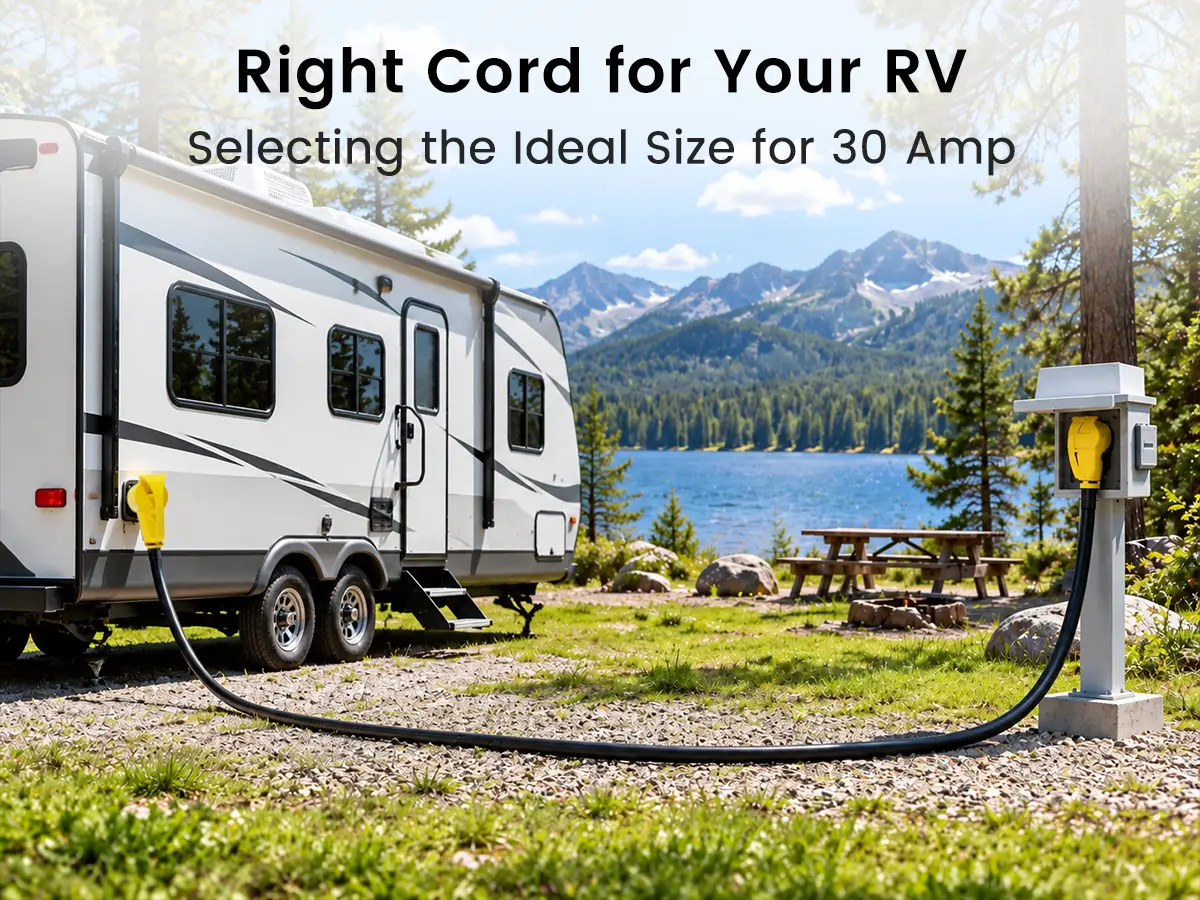
Direct answer: A 30 amp RV normally requires a purpose-built 10/3 AWG outdoor extension cord with TT-30P and TT-30R connectors. Use the shortest practical length to limit voltage drop.
Picking the right cord isn’t just about wire gauge. The gauge sets the baseline current-carrying capacity, but the length of the run, the actual load you’re drawing, the connector type, and the rating of the complete assembly — not just the wire inside it — all determine whether a cord is safe for your setup. This guide walks through each of those factors so you can choose a cord that matches how and where you camp, not just a generic “10 gauge is fine” answer.
30 Amp vs. 50 Amp RV Extension Cords at a Glance
| Feature | 30 Amp RV Extension Cord | 50 Amp RV Extension Cord |
|---|---|---|
| Plug Design | 3-Prong | 4-Prong |
| Wire Configuration | 3 Wires (Hot, Neutral, Ground) | 4 Wires (2 Hots, Neutral, Ground) |
| Max Capacity | 3,750W | 12,500W |
| Vantecable Best Seller | 10 Gauge / 30 Amp Series | 6 Gauge / 50 Amp Series |
The 12,000-watt figure for 50 amp RV service is the combined capacity of two 120-volt, 50-amp legs. Each leg remains limited to 50 amps.
Not sure which service your RV uses? Read our 30 Amp vs. 50 Amp RV Power Cord Guide.
What Size Extension Cord Does a 30 Amp RV Need?
Why 10/3 AWG Is the Standard Choice
A purpose-built 30 amp RV extension cord commonly uses three 10 AWG conductors, identified as 10/3 AWG. Wire gauge alone does not establish the rating of a finished cord: the connectors, insulation, jacket, length and certification of the complete assembly must also be suitable for 30 amp RV service.
10 AWG vs. 8 AWG for Longer RV Hookups
A thicker 8 AWG conductor has lower resistance than a 10 AWG conductor of the same material and length, so it can reduce voltage drop on a long run. There is no universal distance at which every 30 amp RV cord must change to 8 AWG. Choose a complete cord assembly rated for its intended current and length, and follow the cord and RV manufacturers’ instructions.
Why Cord Length Matters as Much as Wire Gauge
Asking “what gauge extension cord for RV” without also asking “how long” only answers half the question. A 10 gauge RV extension cord (often labeled 10/3 RV extension cord on the packaging) performs differently at 25 feet than it does at 100 feet, even though the wire itself hasn’t changed. Length adds resistance, and resistance is what causes voltage drop — covered in more detail below.
Understanding 30 Amp RV Electrical Service
120 Volts, 30 Amps and 3,600 Watts
A 30 amp RV service supplies one nominal 120-volt circuit with a theoretical maximum capacity of 3,600 watts (30A × 120V). The combined operating and starting demand of connected appliances must remain within the limits of the source, RV distribution system and cord assembly.
30 amps × 120 volts = 3,600 watts
What Is a NEMA TT-30 Connection?
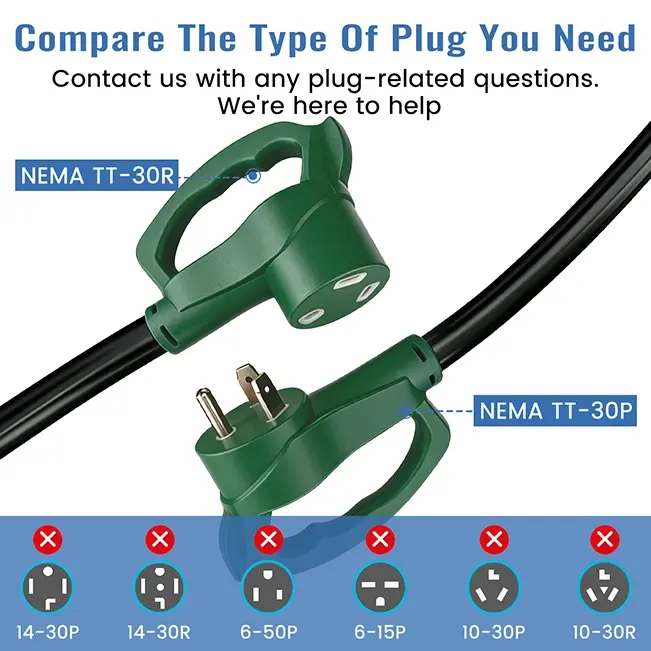
The TT-30 (“Travel Trailer, 30 amp”) is a 3-prong, 125-volt connector consisting of one hot blade, one neutral blade, and one round ground pin. It’s the standard connector for 30 amp RV service and is physically distinct from 125/250-volt configurations such as NEMA 10-30 and the locking NEMA L14-30. These connectors are not interchangeable with TT-30 and shouldn’t be adapted between one another. For the full technical specification, see Eaton’s NEMA TT-30 power device datasheet.
RV Power Cord vs. RV Extension Cord
These two terms get used interchangeably, but they serve different purposes:
- Shore power cord: The main cord that connects your RV’s power inlet to the campsite pedestal. It’s usually 25–35 feet and either hardwired to the RV or plugged into its inlet.
- RV extension cord: An additional length of cord used when the shore power cord alone can’t reach the pedestal.
What Does 10/3 Mean on an RV Extension Cord?
How American Wire Gauge Works
American Wire Gauge (AWG) is a standardized system for measuring conductor thickness. It’s used across most cords and household wiring sold in North America, which is why you’ll see it printed on nearly every RV cord’s packaging.
What the “3” in 10/3 AWG Means
The “3” refers to the number of individual conductors bundled inside the cord’s outer jacket. For a 30 amp RV extension cord, that’s typically one hot wire, one neutral wire, and one ground wire — three conductors total, each sized at 10 AWG.
Why a Smaller AWG Number Means a Larger Conductor
AWG numbering runs in reverse of what feels intuitive: the smaller the number, the thicker the physical conductor. A 10 AWG wire is thicker than a 12 AWG wire, and a thicker conductor generally allows more current to flow with less resistance and less heat buildup.
30 Amp RV Extension Cord Size by Length
15-Foot, 25-Foot and 30-Foot 30 Amp RV Extension Cords
A 15-, 25- or 30-foot cord is suitable for most standard campsite hookups when it reaches the pedestal without tension. Shorter cords are generally easier to carry, coil, store and inspect. They also produce less voltage drop than longer cords of the same gauge under an equivalent load.
50-Foot 30 Amp RV Extension Cords
A 50-foot 30 amp RV extension cord provides additional reach when the power pedestal is farther from your parking position. Because the electrical path is longer, voltage drop becomes more important when operating high-load appliances such as an RV air conditioner, microwave or electric water heater.
100-Foot 30 Amp RV Extension Cords
A 100-foot cord may be useful for a long driveway or a campsite with a distant power pedestal. At this length, monitor the voltage entering the RV under load and pay closer attention to actual current draw, connector condition and the number of connection points.
Vantecable 30 Amp RV Cord Options
| Length | Construction | Connector | Suggested use | Product |
|---|---|---|---|---|
| 15–25 ft | 10/3 AWG outdoor cord | TT-30P to TT-30R | Typical campsite or home hookup | View available lengths → |
| 50 ft | 10/3 AWG outdoor cord | TT-30P to TT-30R | More distant pedestal | View the 50 ft option → |
| 100 ft | 10/3 AWG outdoor cord | TT-30P to TT-30R | Long hookup with voltage and load management | View the 100 ft option → |
Voltage Drop in a 30 Amp RV Extension Cord
What Causes Voltage Drop?
Voltage drop increases with conductor resistance, current, and total circuit length. Every foot of wire adds a small amount of resistance, and that resistance becomes more significant as the cord gets longer or the load gets heavier.
How Heavy RV Loads Increase Voltage Drop
Compressor-driven appliances such as air conditioners can draw a brief starting current above their normal running current. That demand, combined with a long or undersized cord, can make voltage drop more noticeable. Microwaves and electric heating appliances can also place a substantial operating load on a 30 amp system.
How Low Voltage Can Affect RV Equipment
Sustained operation outside an appliance manufacturer’s permitted voltage range can cause poor performance, overheating or protective shutdown. Motors and compressors, including those in RV air conditioners, are particularly sensitive to inadequate voltage during starting and operation.
An air conditioner’s locked-rotor amperage (LRA) can be several times its normal running current for a brief period. The actual value varies by compressor and should be checked on the equipment nameplate. A compatible soft-start device may reduce starting demand, but it does not correct an undersized cord or inadequate supply voltage.
Estimated Voltage Drop by Cord Length
The estimates below use nominal 120-volt power, copper-conductor resistance values of approximately 1.24 ohms per 1,000 feet for 10 AWG and 0.778 ohms per 1,000 feet for 8 AWG, and the round-trip conductor length. They show the drop in the extension cord only; campground wiring, adapters, connector resistance and temperature can increase the total drop measured at the RV.
| Wire gauge | One-way cord length | Estimated drop at 15A | Estimated drop at 30A |
|---|---|---|---|
| 10 AWG | 25 ft | 0.9V / 0.8% | 1.9V / 1.6% |
| 10 AWG | 50 ft | 1.9V / 1.6% | 3.7V / 3.1% |
| 10 AWG | 75 ft | 2.8V / 2.3% | 5.6V / 4.7% |
| 10 AWG | 100 ft | 3.7V / 3.1% | 7.4V / 6.2% |
| 8 AWG | 50 ft | 1.2V / 1.0% | 2.3V / 1.9% |
| 8 AWG | 100 ft | 2.3V / 1.9% | 4.7V / 3.9% |
These are calculated estimates, not guaranteed field measurements. At a full 30-amp load, a 10 AWG run approaches a 5% cord-only drop at roughly 75 to 80 feet. At lower current, the drop is proportionally smaller. Measure voltage at the RV under load instead of relying on cord length alone.
How to Reduce Voltage Drop
The most reliable ways to manage voltage drop in an RV extension cord are to use the shortest cord that reaches the pedestal, avoid running multiple heavy appliances simultaneously on a long run, and choose a cord whose complete assembly is rated for the distance and load you actually use.
Can You Use a Regular Extension Cord for a 30 Amp RV?
Why Most Household Extension Cords Are Not Rated for 30 Amps
Most extension cords sold for household or light-duty use are built for 15- or 20-amp circuits and use thinner conductors than a 30 amp RV service requires. Using one for RV shore power puts it well outside its designed capacity.
Can You Use a 12 Gauge Extension Cord for an RV?
A typical 12 gauge household extension cord should not be used to carry the full load of a 30 amp RV service. Its plug, receptacle and complete assembly are normally intended for a lower-rated household circuit, not a TT-30 connection. Always follow the current rating marked on the finished cord.
Risks of Using 14 or 16 Gauge Cords
Fourteen and 16 gauge cords have even less current-carrying capacity than 12 gauge. Using them for RV shore power increases the risk of overheating, insulation damage, and voltage drop severe enough to affect sensitive RV electronics.
Connecting a 30 Amp RV to a 15 Amp Household Outlet
With a correctly rated 30 amp-to-15 amp RV adapter, often called a dogbone adapter, you can physically connect a 30 amp RV to a standard 15 amp household outlet in a pinch. But the adapter only changes the connection — it doesn’t increase capacity. Your RV is still limited to whatever the 15 amp household circuit can safely deliver, so you’ll need to reduce the load rather than treating it as a full 30 amp connection.
How to Choose a Safe 30 Amp RV Extension Cord?
Confirm the Complete Cord Is Rated for 30 Amps
Check the finished product’s rating, not just the wire gauge printed on the box. A cord can use 10/3 AWG wire and still fall short if the connectors or overall assembly aren’t rated to match.
Check for TT-30P and TT-30R Connectors
Confirm both ends use TT-30 connectors compatible with your RV’s inlet and the campsite pedestal. Mismatched connector types are a common — and avoidable — source of frustration at the campsite.
Choose Outdoor-Rated Cable Construction
Look for a jacket rating that includes a “W” designation (such as SJTW or STW), which indicates weather- and moisture-resistant construction suitable for outdoor use. Indoor-rated cords lack this protection and shouldn’t be substituted outdoors.
Check the Product’s UL or ETL Listing
A UL Listed or ETL Listed mark indicates that the product was evaluated to the applicable requirements identified by that certification body. Confirm the mark on the product and, when necessary, verify the listing in the certification body’s directory. Intertek explains the scope of the ETL Listed Mark.
Consider Grip Handles and Power Indicators
Molded grip handles make it easier to disconnect a cord without pulling on the wire itself, and built-in LED power indicators offer a quick visual check that the connection is live.
How to Connect a 30 Amp RV Extension Cord Safely
Inspect the Pedestal, Plug and Cord
Before connecting, check the pedestal outlet, both cord ends, and the full cord length for cracks, exposed wire, bent prongs, or scorch marks.
Turn Off the Breaker Before Connecting
Switch off the pedestal breaker before plugging in, then turn it back on once every connection is fully seated. This reduces the risk of arcing at the connector.
Fully Seat Every Connection
A loose or partially seated connection is a common cause of overheating at the plug. Push each connector in fully and confirm it’s secure before applying power.
Use a Matching RV Surge Protector
An extension cord solves a distance problem; it does not provide surge suppression or pedestal-fault monitoring. A matching 30 amp RV surge protector addresses the functions listed for that model. For broader protection, an RV electrical management system (EMS) may also disconnect power during sustained high- or low-voltage conditions; features vary by product.
Check the Connections for Abnormal Heat
After the RV has been running for a while, carefully check the plug and connector points for unusual warmth. A cord or connector that feels notably hot to the touch should be disconnected and inspected.
Frequently Asked Questions
Q1: Is 10 gauge wire enough for a 30 amp RV?
A1: Yes, when the complete 10/3 AWG cord assembly is specifically rated and listed for 30 amp RV service. Gauge alone is not enough to establish the rating — the connectors, insulation and overall construction must also be suitable.
Q2: When should you consider 8 AWG for a 30 amp RV?
A2: An 8 AWG conductor can reduce voltage drop compared with 10 AWG of the same material and length. There is no universal length threshold requiring 8 AWG, so use a complete listed assembly and follow its manufacturer’s rating. Measure voltage at the RV under load to guide the decision.
Q3: Can you use a 12 gauge extension cord for a 30 amp RV?
A3: No. Do not use a typical 12 gauge household cord to carry the full load of a 30 amp RV service. Use only the current marked on the complete cord assembly, and reduce the RV load to remain within the rating of the source, adapter and cord.
Q4: How far can you run a 30 amp RV extension cord?
A4: At a full 30-amp draw, 10 AWG copper produces about 4.7% cord-only voltage drop at 75 feet and about 6.2% at 100 feet. Actual results depend on supply voltage, temperature and connection resistance, so use the shortest practical cord and measure voltage at the RV under load.
Q5: Can you connect two 30 amp RV extension cords together?
A5: Yes, two matching 30 amp RV extension cords can be connected, but one cord of the required length is preferable. Joining cords increases total length, adds another connection point, and raises resistance and voltage drop. It does not automatically reduce the service to 15 amps.
Conclusion
For most 30 amp RV hookups, choose a complete 30-amp-rated 10/3 AWG outdoor RV extension cord with TT-30P and TT-30R connectors. Use the shortest length that reaches the pedestal without tension, and monitor voltage when using longer runs.
Ready to choose a cord? View the complete RV extension cord collection.