
.png?w=1368&h=240)
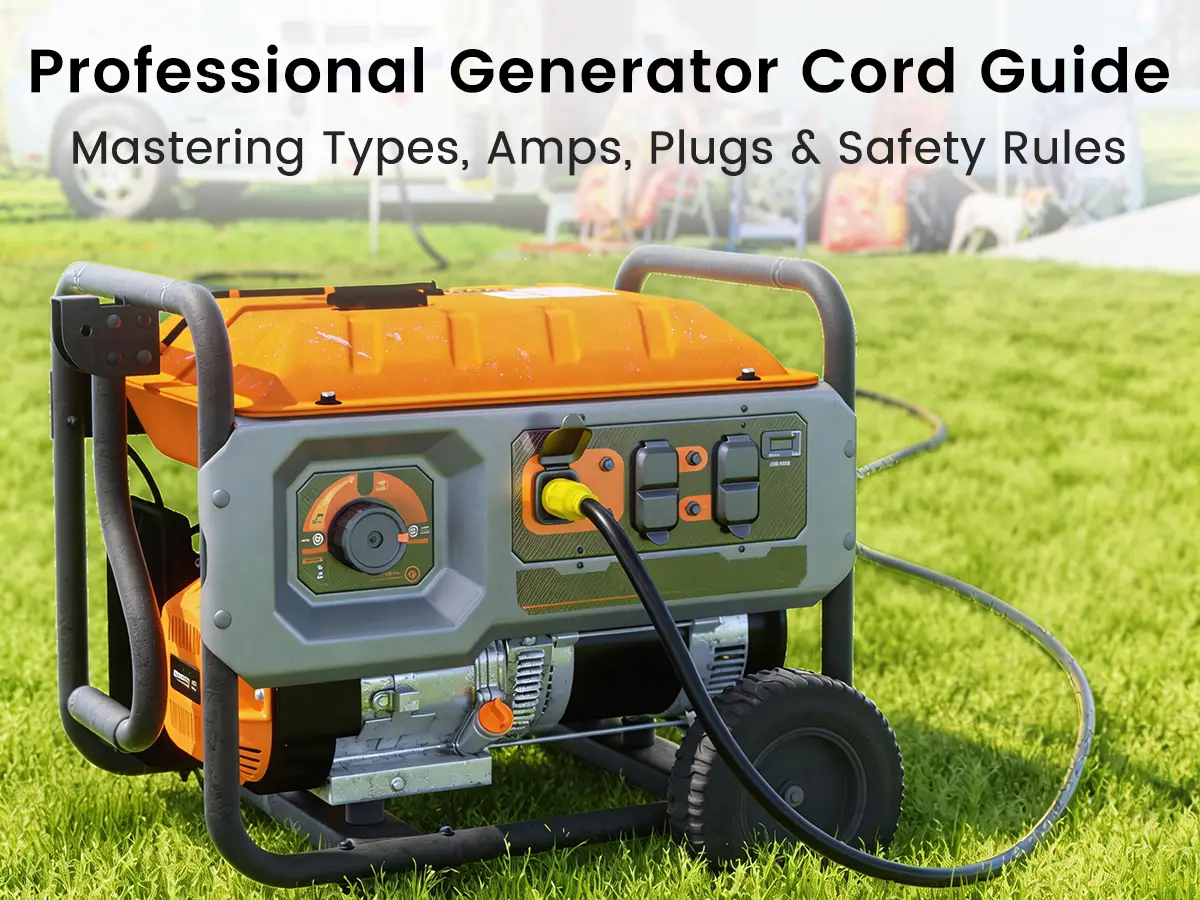
For homeowners across the United States, a portable generator is the ultimate insurance policy against the increasing frequency of grid failures, seasonal storms, and extreme weather events. However, the generator itself is only half of the equation. To safely and effectively bridge the gap between your outdoor power source and your indoor appliances, you need a high-performance generator extension cord.
Choosing the wrong cord is a mistake that can lead to catastrophic results. A standard indoor cord used for a lamp or a small fan simply cannot handle the massive electrical load required to surge a refrigerator or run a space heater. In this professional guide, we will move past the basics and dive into the technical requirements of generator power cord selection, NEMA plug configurations, and the critical safety protocols required to protect your home and family.
Technical Specifications: Gauge, Length, and Voltage Drop
When selecting an extension cord for generator use, the physical gauge of the wire is your most important metric. While the American Wire Gauge (AWG) system might seem counterintuitive, it is the fundamental measurement of how much current a wire can carry without melting.
Matching Amperage to Gauge
The thickness of the copper within your generator extension cord determines its capacity. For most residential portable generators, you will be looking at 10-gauge or 12-gauge wires. A 10-gauge cord is typically rated for 30 Amps, while a 12-gauge cord is rated for 20 Amps. Using a 12-gauge cord on a 30-amp outlet is a violation of safety standards and creates an immediate fire risk.
For a deep dive into the physics of wire thickness and how to read gauge ratings for all your household appliances, visit our guide: AWG Wire Gauge Explained: Choosing the Right Thickness.
The Impact of Length on Power Delivery
Electricity encounters resistance as it travels. In the US, where homes are often spread out, you might be tempted to buy a 100-foot cord to keep the generator far from the house. However, as length increases, voltage drops. If the voltage drops too low, the motors in your refrigerator or AC unit can burn out. If you must run a cord longer than 50 feet, it is a professional best practice to "upsize" the gauge (e.g., moving from a 12-gauge to a 10-gauge) to compensate for this loss.
NEMA Plug Architecture: Understanding the Standard
If you have looked at the control panel of a Champion, Westinghouse, or Predator generator, you’ve seen a variety of outlet shapes. These are standardized by the National Electrical Manufacturers Association (NEMA). Matching your generator extension cord to these outlets is a matter of both physics and safety.
The Importance of Twist-Lock (Locking) Plugs
Most high-capacity generator outlets (30A and above) utilize a locking design, indicated by the letter "L" in the code (e.g., L14-30P).
-
Vibration Resistance: Generators vibrate significantly while running. A standard straight-blade plug can wiggle loose over time, causing an electrical arc.
-
Secure Connection: A locking plug requires you to insert and twist, ensuring the connection remains solid throughout the duration of the power outage.
Common Residential NEMA Configurations
![[10ft to 100ft] 10 Gauge 30 Amp Generator Extension Cord 4 Prong, NEMA L14-30P/L14-30R,yellow,,Waterproof,ETL,flexible](https://img-va.myshopline.com/image/store/1754964108957/imagetools3-1.webp?w=300&h=300)
-
NEMA L14-30P / L14-30R: This is the "gold standard" for US home backup. It is a 4-prong locking configuration that supports both 120V and 240V, allowing you to power a manual transfer switch or an inlet box.
-
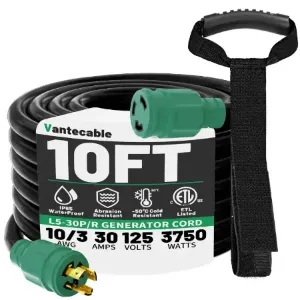
NEMA L5-30P: A 3-prong locking plug rated for 120V at 30 Amps. This is common on medium-sized inverter generators that don't support 240V loads.
![[6ft to 100ft] NEMA 14-50P to NEMA 14-50R 50 Amp RV/EV Extension Cord Outdoor with Grip Handle,yellow,Waterproof,ETL,flexible](https://img-va.myshopline.com/image/store/1754964108957/imagetools5.webp?w=300&h=300)
-
NEMA 14-50P: A heavy-duty 4-prong plug rated for 50 Amps. This is typically used for large standby generators or as a connection for RV shore power.
Environmental Resilience: The Jacket Rating
A generator power cord must be able to withstand the worst of nature—ice, snow, mud, and intense UV rays. The outer insulation, or "jacket," is what protects the copper conductors from the elements.
Professional Grade Protection
In the industry, we use a series of letter codes to identify what a cord can handle. For generator use, you should never settle for a cord that isn't rated for outdoor use.
Unsure what the letters on your cord mean? Read our comprehensive breakdown: SJTW vs. STW vs. SOW: Decoding Extension Cord Jacket Ratings.
For most American climates, we recommend an SJTW or STW rated cord. The "W" stands for weather-resistant, meaning the cord is treated to resist moisture and sunlight degradation, ensuring it won't become brittle and crack during a freezing winter storm.
Load Calculation: Starting vs. Running Watts
Before you plug in your extension cord for generator, you must perform a basic power audit. Overloading a cord is a primary cause of tripped breakers and overheated wires.
The Surge Factor
Many modern appliances, particularly those with compressors like refrigerators, freezers, and air conditioners, require a "surge" of power to start up. This is known as Starting Watts.
-
The Calculation: Your cord must be rated to handle the total Starting Watts of all connected devices, not just their running wattage.
-
Example: A refrigerator might run at 700 Watts but requires 2,200 Watts to kick the compressor on. If your cord is already near its limit, that surge will cause a voltage dip or a blown fuse.
Common Appliance Load Reference
| Appliance | Running Watts (Avg) | Starting Watts (Avg) | Recommended Cord (50ft) |
|---|---|---|---|
| Refrigerator/Freezer | 700W | 2200W | 12 AWG / 20A |
| Window AC (10k BTU) | 1200W | 3600W | 10 AWG / 30A |
| Sump Pump (1/2 HP) | 1050W | 2200W | 12 AWG / 20A |
| Portable Space Heater | 1500W | 1500W | 12 AWG / 20A |
Connection Strategies: Beyond Running Cords Through Windows
While many homeowners simply run a generator extension cord through a cracked window or an open garage door, this is neither the safest nor the most efficient method.
The Power Inlet Box Solution
The professional way to connect a generator to a home is via a Power Inlet Box. This is a weatherproof box mounted on the exterior of your home, wired directly to your transfer switch or interlock kit.
-
Safety: You don't have to leave windows or doors open, which prevents carbon monoxide (CO) from entering the house and keeps your home secure.
-
Simplicity: You use one heavy-duty 10-gauge or 6-gauge generator power cord to connect the generator to the inlet box, which then energizes the pre-selected circuits in your breaker panel.
Critical Safety Rules for Using Generator Cords
The Consumer Product Safety Commission (CPSC) warns that improper generator use is a leading cause of accidental death during emergencies. Follow these non-negotiable rules.
1. Never "Backfeed" Your Home
Backfeeding is the dangerous practice of using a "suicide cord" (a cord with two male ends) to plug a generator into a standard wall outlet. Never do this. * It bypasses your home's circuit breakers.
-
It sends electricity back into the utility lines, which can electrocute utility workers blocks away.
2. Manage Thermal Build-up
When electricity flows, it generates heat. Never use a generator extension cord while it is still coiled or looped. An energized, coiled cord acts as an induction heater, which can melt the insulation and lead to a fire. Always fully unroll the cord before use.
3. Carbon Monoxide (CO) Awareness
Your cord needs to be long enough to keep your generator at least 20 feet away from the house. CO is a colorless, odorless killer. Ensure the exhaust is pointed away from your home and that your cords are routed in a way that doesn't require keeping doors or windows open.
Maintenance and Long-Term Storage
A high-quality 10-gauge generator extension cord is an investment. Proper care ensures it is ready when the next storm hits.
-
Visual Inspections: Before every use, check the cord for cuts, nicks, or exposed copper. If the jacket is compromised, the cord is no longer safe for outdoor use.
-
Contact Care: Use a clean cloth to wipe down the plug prongs. If you notice oxidation or "green" corrosion, use a fine-grit sandpaper or electrical contact cleaner to restore a low-resistance connection.
-
The Over-Under Wrap: Avoid kinking the internal copper by using the "over-under" coiling technique. Store the cord in a cool, dry place, preferably hanging on a wide hook to avoid stress points on the insulation.
Conclusion: Don't Let a Cheap Cord Be Your Weak Link
When the lights go out, your family's safety and comfort depend on the integrity of your backup power system. A generator extension cord is the most critical link in that chain. By choosing a cord with the correct AWG rating, matching your NEMA plugs correctly, and following professional safety standards, you can weather any storm with confidence.
Ready to secure your emergency power setup?
-
Shop our Collection: Browse our Heavy-Duty Generator Extension Cords to find the perfect fit for your setup.
Don't wait until the next "Grid Down" alert. Audit your cords today and ensure your home is ready for anything.