
.png?w=1368&h=240)
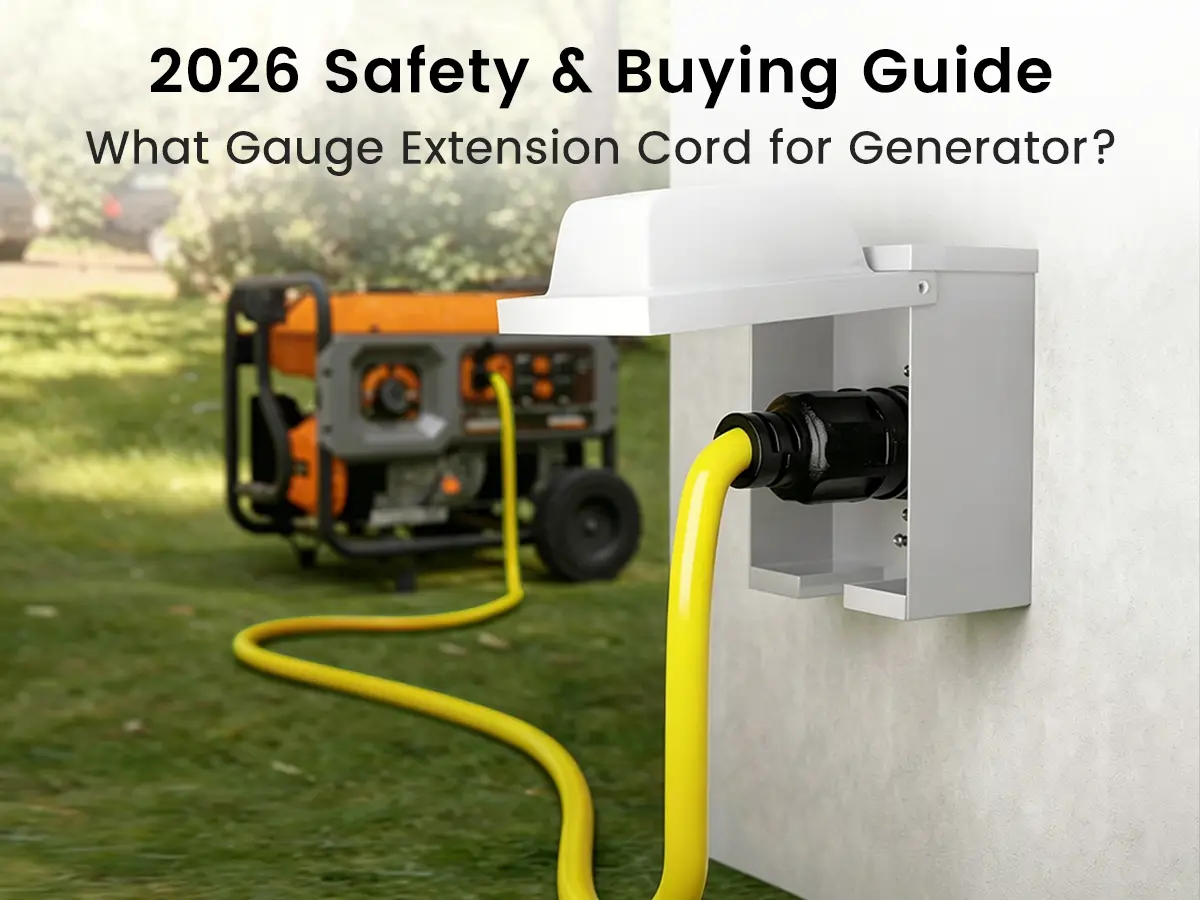
If you’re wondering what gauge extension cord for your generator is the safest choice, the short answer is: For most 30 Amp portable generators, you need a 10-gauge (AWG) cord. For 20 Amp loads under 50 feet, 12-gauge works. But if you’re running power over longer distances—especially 100 feet or more—the rules change. Choosing the wrong size doesn’t just risk a tripped breaker; it can melt your cord and destroy your appliances. In this 2026 guide, we’ll break down exactly how to match gauge to amps and distance, so you stay powered up and safe.
Why Does the Gauge Matter for Your Generator?
The relationship between a generator and its extension cord is governed by the physics of resistance and electrical load. When your generator pushes high amperage through a wire, the copper's cross-sectional area (the "gauge") determines how much resistance that current will encounter.
Using an under-sized gauge (like a 14 or 16 AWG) for a 30-Amp generator load creates a dangerous bottleneck. This resistance transforms electrical energy into thermal energy—literally turning your extension cord into a heating element. If the cord’s temperature exceeds its insulation rating (typically 60°C to 105°C for SJTW jackets), the jacket will soften, crack, or even ignite.
Beyond fire hazards, the most silent killer of appliances is Voltage Drop. For every foot of wire, some voltage is lost to resistance. If a 120V generator output drops to 108V by the time it reaches your refrigerator due to a thin cord, the motor will attempt to compensate by drawing more current (Amps). This creates a destructive cycle of heat that burns out sensitive compressors and circuit boards. Choosing a 10-gauge (AWG) heavy-duty cord is not just about power delivery; it’s about maintaining the "electrical pressure" required to keep your expensive backup systems running without internal damage.
The Quick Reference Chart: Generator Amps vs. Cord Gauge
Selecting the right gauge is not just about matching the plug; it’s about calculating the Amperage vs. Distance ratio. To ensure your generator operates at peak efficiency without risking a circuit trip, we have compiled this comprehensive Generator Cord Selection Chart based on NEC (National Electrical Code) safety standards.
| Generator Outlet (Amps) | Recommended Gauge (25-50ft) | Recommended Gauge (100ft) | Maximum Wattage (120V/240V) |
|---|---|---|---|
| 20 Amps | 12 AWG | 10 AWG | 2400W |
| 30 Amps | 10 AWG | 10 AWG (Pure Copper) | 3600W / 7200W |
| 50 Amps | 6 AWG | 6 AWG / 4 AWG | 6000W / 12000W |
The "80% Rule" for Continuous Loads
For long-term safety, professional electricians follow the 80% Rule: you should never run your extension cord at 100% of its rated capacity for more than three hours. For a 30-Amp generator, your continuous draw should stay around 24 Amps. If you plan to run heavy appliances like a portable AC or a well pump for extended periods, upgrading to a 10-gauge (AWG) heavy-duty cord provides the necessary thermal headroom to prevent overheating.
Pro Tip: If you are running a 100 ft extension cord, we always recommend stepping up to a thicker gauge (smaller AWG number) to compensate for voltage drop. For a 30 Amp generator at this distance, a 10 gauge generator cord is the non-negotiable standard for maintaining stable power. For 50 Amp whole-house backups, upgrading to a 6/3 + 8/1 AWG configuration ensures your high-load appliances receive the full voltage required without overheating the cable jacket.
The Length Factor: How 100 ft Affects Your Power
Distance is the silent enemy of portable power. When you increase the length to a 100 ft extension cord, you are inherently increasing the total resistance of the electrical circuit. This physical reality leads to Voltage Drop—the loss of electrical pressure between your generator and your appliances.
For a standard 120V/240V circuit, the National Electrical Code (NEC) recommends a maximum voltage drop of 3% for peak efficiency. If the wire is too thin for a 100-foot run, the voltage could drop significantly below its rating. This low voltage forces motors—like those in your RV air conditioner or home sump pump—to work harder, draw more current, and eventually burn out their internal windings.
Why 100 Feet Changes the Rules:
-
The Resistance Spike: Electricity encounters more "friction" the further it travels. At 100 feet, a 30 Amp load requires a high-quality 10-gauge (AWG) heavy-duty cord to maintain the necessary electrical pressure.
-
The 50 Amp Challenge: For 50 Amp whole-house backups, the stakes are even higher. Moving up to our 6/3 + 8/1 AWG configuration (as seen in our 50A series) is essential to ensuring that the 12,500W of potential power actually reaches your transfer switch without being lost as heat along the way.
-
Pure Copper vs. CCA: At 100 feet, material matters. Vantecable uses 100% pure copper to ensure the lowest possible resistance, providing "clean" power that protects your expensive sensitive electronics.
Decoding Generator Plugs
Having the right gauge is only half the battle; you also need the correct plug to interface with your generator's power panel. Based on our Vantecable product lineup , here is how to identify which heavy-duty connection you need:
1. How to Read a NEMA Plug Number
NEMA plug names may look complicated, but the naming system provides useful information.
For example: L14-30P
-
L = Locking, or twist-lock
-
14 = NEMA wiring configuration
-
30 = 30 Amp rating
-
P = Plug
A matching receptacle would normally be labeled: L14-30R where R means receptacle.
2. Quick Generator Plug Type Reference
| Plug Type | Amps | Voltage | Style | Common Uses |
|---|---|---|---|---|
| NEMA 5-15 | 15A | 125V | Straight blade | Household devices, light-duty tools |
| NEMA 5-20 | 20A | 125V | Straight blade | Higher-power 120V tools |
| NEMA TT-30 | 30A | 125V | Straight blade | RV power |
| NEMA L5-30 | 30A | 125V | Twist-lock | Generators, tools, RV applications |
| NEMA L14-20 | 20A | 125/250V | Twist-lock | Smaller 120/240V generator systems |
| NEMA L14-30 | 30A | 125/250V | Twist-lock | Home backup power, transfer switches |
| NEMA 14-50 | 50A | 125/250V | Straight blade | Large generators, RVs, high-power loads |
3. Vantecable Recommended Generator Cords
Once you’ve identified your generator’s NEMA outlet, choosing the right cord becomes much easier. Here are two Vantecable options for the most common 30 Amp and 50 Amp generator connections.
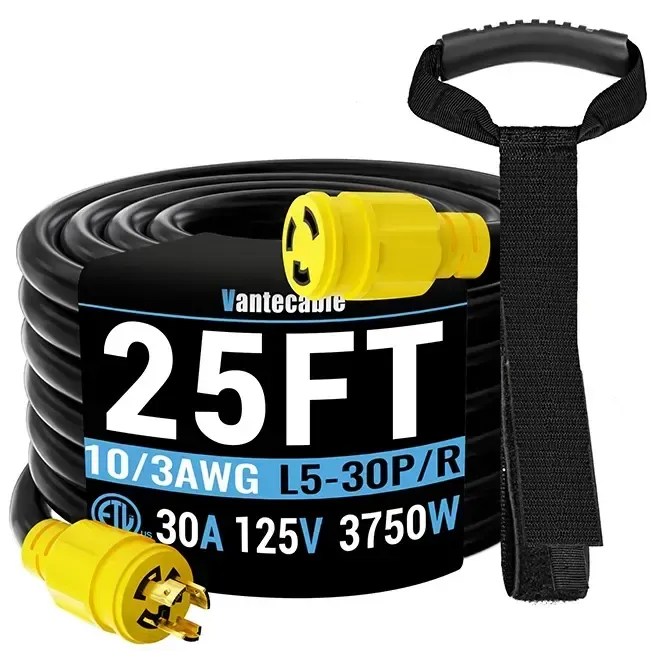
30 Amp L5-30 Generator Extension Cord
For generators with a NEMA L5-30 outlet, this heavy-duty Vantecable generator cord is designed for reliable home backup power, transfer switch connections, and portable generator setups.
- NEMA L5-30P twist-lock plug
- 30A · 125V
- Up to 3750W
- Heavy-duty 10/3 AWG construction
- Secure twist-lock connection
- Available in multiple lengths
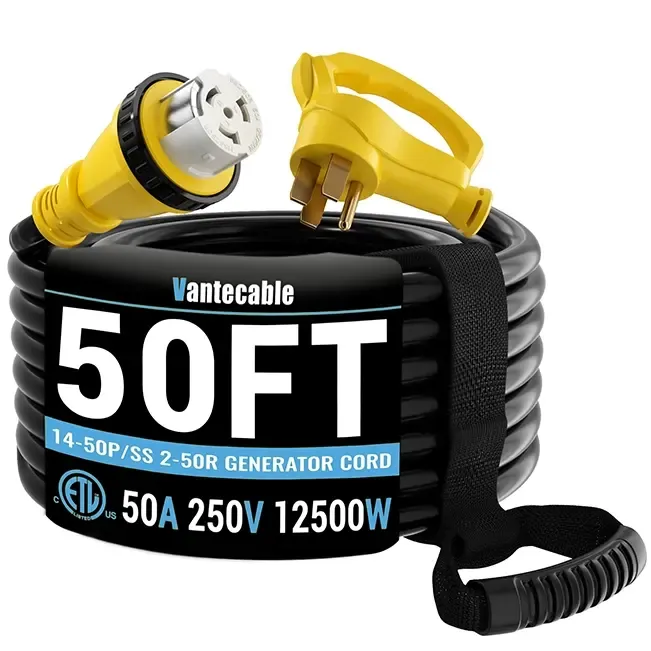
50 Amp 14-50 Generator Extension Cord
Need more power? Vantecable’s 50 Amp generator cord is built for high-output generators, larger backup power systems, RV applications, and other heavy-duty power needs.
- NEMA 14-50P plug
- 50A · 125/250V
- Up to 12,500W
- Heavy-duty 6/3 + 8/1 AWG construction
- Designed for high-output generators
- Available in multiple lengths
Outdoor Durability: Why You Need an SJTW Rating
A generator is most needed when the weather is at its worst—during blizzards, hurricanes, or torrential rain. As shown in our product specifications (see images), Vantecable cords are engineered with SJTW and STW jackets to withstand these extreme environments. But what do these letters actually mean for your safety?
1. Weatherproof & Waterproof (IP65 Rating)
Our generator cords feature a specialized PVC outer jacket that is oil, water, and UV resistant. Whether the cord is sitting in a puddle or exposed to direct summer sun for days, the insulation will not crack or become brittle. This is critical for preventing short circuits when running power from an outdoor generator into your home.
2. Extreme Cold Flexibility (-50°C)
Standard extension cords become stiff and impossible to uncoil when temperatures drop below freezing. As highlighted on our 10/4 AWG and 6/3+8/1 series packaging, Vantecable cords are rated for -50°C (-58°F). This ensures the cable remains flexible and easy to handle even in the dead of winter, allowing for a quick setup when you lose power in a snowstorm.
3. ETL Listed Safety
Safety isn't just a claim; it's a certification. You will notice the ETL Listed mark on all Vantecable products. This means our cords have been independently tested to meet stringent North American safety standards. When you are pulling 12,500 Watts through a 50 Amp cable, knowing the cord has passed rigorous heat and load testing provides the peace of mind every homeowner needs.
Vantecable Advantage: Our 6/3 + 8/1 AWG and 10 AWG series use 100% pure copper strands. Unlike cheaper Copper Clad Aluminum (CCA) cords that can overheat under heavy loads, our pure copper construction ensures maximum conductivity and long-term durability.
🤔Still Unsure? Make Your Decision in 3 Steps:
-
Step 1: Check the Plug. Is your generator outlet a straight-blade like a home outlet (usually 20A), does it need to be twisted to lock ("Twist-Lock," usually 30A), or is it a massive 3 or 4-prong plug (50A)?
-
Step 2: Measure the Distance. How much wire is needed from the generator to your home or appliance? If it exceeds 50 feet, you should default to the next thicker wire gauge.
-
Step 3: Choose the Material. Look for Pure Copper and avoid CCA (Copper Clad Aluminum). Vantecable provides ETL-certified safety cables designed for exactly these needs.
Summary: Buying the Right Cord for Peace of Mind
Choosing the right generator extension cord is about protecting your home and appliances during an emergency. By matching the correct AWG (gauge) to your generator's amperage and accounting for voltage drop over 100 ft, you ensure your backup system operates safely.
Vantecable provides the professional-grade solutions needed for high-capacity power, from our 10/4 AWG 30 Amp series to our ultra-heavy-duty 6/3 + 8/1 AWG 50 Amp cables. Engineered with ETL certification, IP65 waterproofing, and -50°C flexibility, our cords eliminate the "weak link" in your power setup, giving you true peace of mind when the lights go out.
Common Myths About Generator Cords (FAQs)
Q1: Do I need a 10 or 12 gauge extension cord?
A: It depends on the amperage of your generator's outlet and the distance. For a 20 Amp outlet, a 12 AWG cord is sufficient for short runs, but you must upgrade to a 10-gauge (AWG) heavy-duty cord for distances over 50 feet. If you are using a 30 Amp outlet, a 10 AWG cord is the mandatory minimum regardless of length to ensure safety and prevent the cable from melting.
Q2: What is the 20/20/20 rule for generators?
A: The 20/20/20 rule is a safety guideline: Never run a generator within 20 feet of your home, allow it to cool for 20 minutes before refueling, and ensure your extension cord is at least 20 feet long to keep the exhaust far away from windows and doors. Following this rule significantly reduces the risk of carbon monoxide poisoning and fire.
Q3: Is it safe to use an extension cord with a generator?
A: Yes, but only if the cord is properly rated for the load. You must use an outdoor-rated cable with an SJTW or STW jacket and a gauge thick enough to handle the total wattage. Using a standard indoor household cord with a generator is extremely dangerous and is a leading cause of electrical fires during power outages.
Q4: What gauge wire for a 13000 watt generator?
A: A 13,000-watt generator typically utilizes a 50 Amp outlet to provide its full capacity. For this load, you must use a 6 AWG wire (like our 6/3 + 8/1 series) for runs up to 50 feet. If you need to travel 100 feet at this power level, a 4 AWG cord is recommended to keep the voltage drop within safe limits.
Q5: Can I plug a 30 Amp cord into a 50 Amp generator outlet?
A: Not directly. You would need a UL-listed adapter, and you must be aware that the 30 Amp cord will become the "weak link." Even if the generator can provide 50 Amps, the cord is only rated for 30 Amps. For maximum safety and to utilize your generator's full potential, it is always best to match a 50 Amp outlet with a 50 Amp (6 AWG) Vantecable cord.