

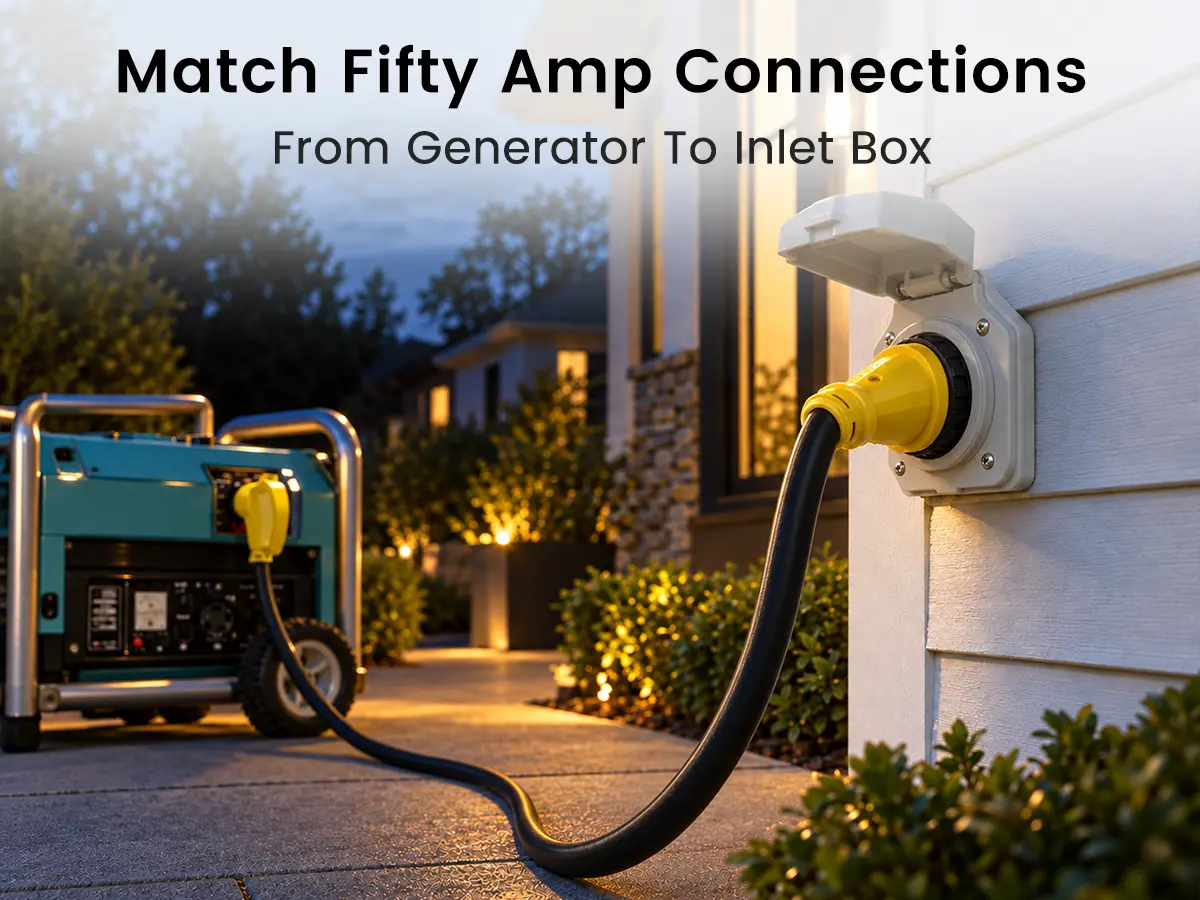
A 50 amp generator cord for a generator inlet box is only compatible when both ends match the equipment on either side of it: the 14-50P end must fit the generator’s 14-50R outlet, and the SS2-50R end must fit the inlet box’s SS2-50P inlet. Matching the amperage alone is not enough — the receptacle configuration on the generator and the inlet configuration on the box both have to line up before the cord will physically connect.
How a Generator Inlet Box Connection Works
A generator inlet box gives a portable generator a fixed, outdoor connection point instead of running a cord through a door or window. The full path from generator to house wiring has four parts in sequence: the generator’s 14-50R outlet, the cord’s 14-50P plug on one end and SS2-50R connector on the other, the inlet box’s SS2-50P inlet, and a transfer switch (or other approved transfer equipment) that controls how generator power enters the home’s electrical system.
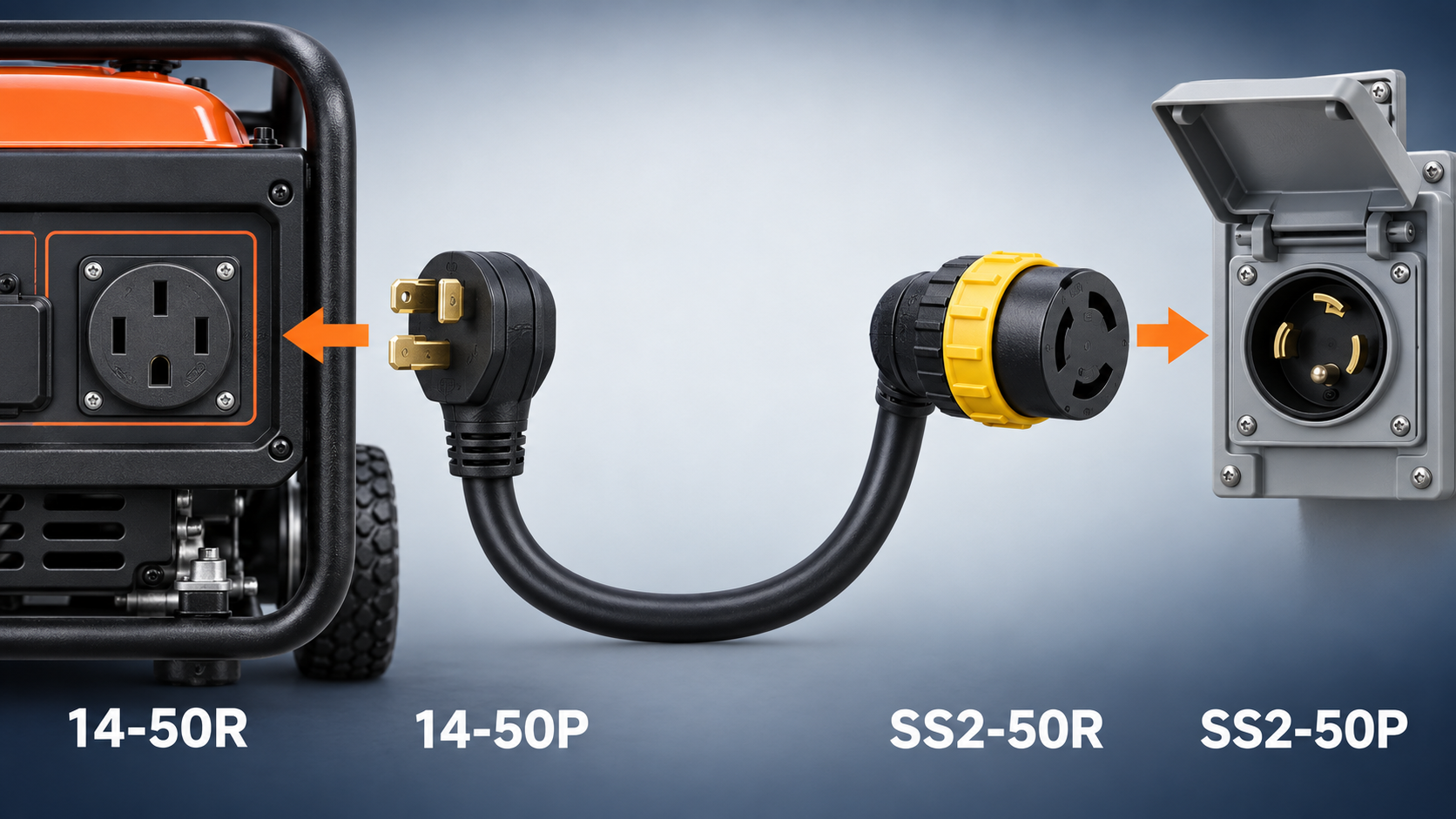
Labeled diagram: generator outlet → cord plug end → cord connector end → inlet box.
Generator Outlet Compatibility: 14-50R to 14-50P
On the generator side, the cord’s 14-50P plug inserts into the generator’s 14-50R outlet. This is a straight-blade, non-locking connection rated for 50A at 125/250V. This configuration is available on some portable generators designed for higher-capacity backup power or RV applications. Because the plug is straight-blade rather than twist-lock, it seats by inserting directly into the outlet — there’s no rotation involved on this end of the cord.
Inlet Box Compatibility: SS2-50R to SS2-50P
On the inlet-box side, the cord terminates in an SS2-50R connector that mates with the box’s SS2-50P inlet. Insert and rotate the connector as directed, then secure the locking ring if the connector includes one — some SS2-50 hardware uses a ring in addition to the twist-lock engagement to keep the connection seated in an outdoor installation exposed to wind or vibration. Both interfaces are rated 50A at 125/250V; the difference between the generator side and the inlet box side is in how the connector engages, not in voltage or amperage.
NEMA 14-50P to SS2-50R Compatibility Checklist
Before connecting a cord, it helps to confirm four things: that the generator’s outlet is in fact 14-50R, that the inlet box’s inlet is SS2-50P, that every piece of equipment in the chain is rated for 50A at 125/250V, and that the cord’s length covers the actual route between the generator’s safe operating location and the inlet box without stretching or requiring a splice.
The table below lists what each piece of equipment in the chain needs to be, so the whole run can be checked against it in one pass.
| Equipment | Connector Type | Rating |
|---|---|---|
| Generator outlet | NEMA 14-50R | 50A, 125/250V |
| Cord — generator end | NEMA 14-50P | 50A, 125/250V |
| Cord — inlet box end | NEMA SS2-50R | 50A, 125/250V |
| Inlet box inlet | NEMA SS2-50P | 50A, 125/250V |
| Transfer switch | Hardwired | Selected and installed for the specific electrical system |
Not every portable generator uses a 14-50R outlet. Generators built around a locking 30A outlet instead — L14-30R, for example — need a different cord and a different set of matching inlet hardware, covered in the 30 amp cord guide.
Confirm the generator’s complete receptacle configuration before selecting a cord. Generac’s cord guide provides additional guidance on selecting cords for portable-generator receptacles.
50 Amp Generator Cord Ratings
A cord built for this application is rated 50A at 125/250V in a four-wire configuration — two hot legs, a neutral, and a ground. Based on two 120V legs each carrying 50A, the nominal capacity works out to 12,000W. That number describes the rated capacity of the cord and connectors, not the amount of power a given generator will actually deliver: the real ceiling on any run is set by the generator’s running watts, its breaker, and how the connected loads are managed at any one time.
Choosing a 50 Amp Inlet Box Cord Length
Cord length should be based on the actual route between the generator’s safe operating location and the inlet box. Choose a cord long enough to reach without stretching the cable or placing strain on either connector, while avoiding substantially more length than the installation requires. Confirm the rating of each available length on the current product page and label, because longer versions may have different specifications.
50 Amp Generator Connection Set
For a system with a 14-50R generator outlet and an SS2-50P inlet box, this pairing covers the main 50A connection along with a separate lighter-duty cord for equipment that doesn’t need to run through the inlet box at all.
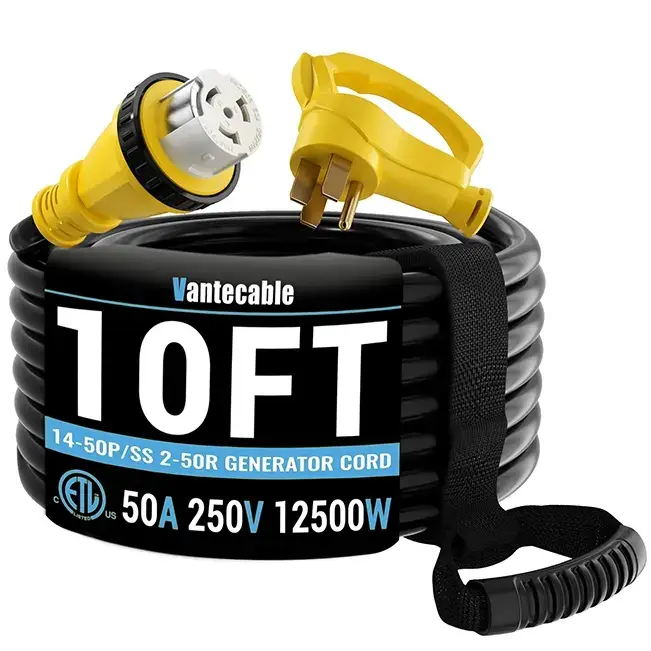
50 Amp Generator Cord Set
14-50P to SS2-50R — connects a 14-50R generator outlet to an SS2-50P inlet box
10ft = yellow connector, 15ft = green connector. Confirm specs & ETL Listed on the product page.
Both versions connect a compatible 14-50R generator outlet to an SS2-50P inlet box. Confirm the current specifications and ETL Listed marking on the selected product page before publishing.
A 25ft 10/3 outdoor extension cord with a lighted indicator is a useful companion for powering equipment separately from the inlet box connection — lights, chargers, or other loads plugged directly into the generator’s standard outlets. It is rated 15A and does not connect to the SS2-50 interface. It is an independent cord run limited to its 15A rating, not an extension of the main 50A connection. See the 12/3 outdoor cord for a matching separate-reach option.
Generator Inlet Box Safety and Transfer Switch Compatibility
A generator inlet box provides the outdoor connection point, but it does not isolate generator power from utility power. When supplying permanent household wiring, the inlet box must connect to a properly installed transfer switch or other approved transfer equipment. The transfer switch prevents generator power and utility power from feeding the electrical system at the same time, which is why backfeeding through a standard wall outlet is dangerous and should never be used as a substitute.
Before each use, inspect the cord for cuts, worn insulation, or exposed conductors, and confirm that it is rated for the connected load. The ESFI portable generator guidance likewise recommends using heavy-duty, outdoor-rated cords and inspecting them for damage before use.
A twist-lock connection prevents accidental disconnection, but it does not by itself make the connection watertight — outdoor connections should still be kept clear of standing water and covered when not in use.
FAQ
Does an SS2-50R connector fit an SS2-50P inlet?
Yes — SS2-50R is the female, twist-lock connector built to mate with an SS2-50P inlet. The two are designed as a matched pair at 50A, 125/250V.
Is a generator inlet box the same as a transfer switch?
No. A generator inlet box provides the outdoor cord connection, while a transfer switch controls whether the home receives power from the utility or the generator.
Can I connect a generator through a household 14-50 outlet?
A standard household 14-50 outlet is not a substitute for a generator inlet box and transfer switch, and backfeeding power through any wall outlet creates a serious shock hazard for utility workers and anyone else on the same circuit.
Can a 50 amp generator cord supply 12,000 watts?
12,000W is the nominal rating based on two 120V legs at 50A each. The amount actually available depends on the generator’s running watts and how the connected loads are managed.
Can the 10/3 extension cord connect to the SS2-50R end?
No. The 10/3 cord is a separate 15A cord for standard outlets and doesn’t have an SS2-50 connector on either end.
Conclusion
Confirm the 14-50R generator outlet, the 14-50P to SS2-50R cord, the SS2-50P inlet box, and a properly installed transfer switch before using the system. With those four points matched, browse the full emergency power cords collection for the right length and connector combination.