
.png?w=1368&h=240)
Embarking on a road trip across North America offers an unparalleled sense of freedom, but operating a modern recreational vehicle (RV) requires a solid understanding of localized shore power infrastructures. In the United States and Canada, electrical hookups at RV parks are strictly standardized, yet many travelers face severe connection issues, power surges, or hazardous electrical fires simply due to incorrect cable choices. Selecting the right RV power cord is not merely a matter of convenience; it is a critical safety protocol. This technical guide breaks down the physical properties of heavy-duty RV power extension cords, voltage drop mathematics, safety certifications, and maintenance requirements to keep your journey safe and completely powered.
Understanding 30 Amp vs 50 Amp RV Power Cords
The foundation of RV electrical safety rests on distinguishing between the two primary shore power systems utilized across North American campgrounds: 30 Amp and 50 Amp configurations. Connecting an RV to a power pedestal incorrectly or using an inadequate wire gauge can lead to catastrophic thermal overloads.
NEMA TT-30P Cords for 30 Amp RV Systems
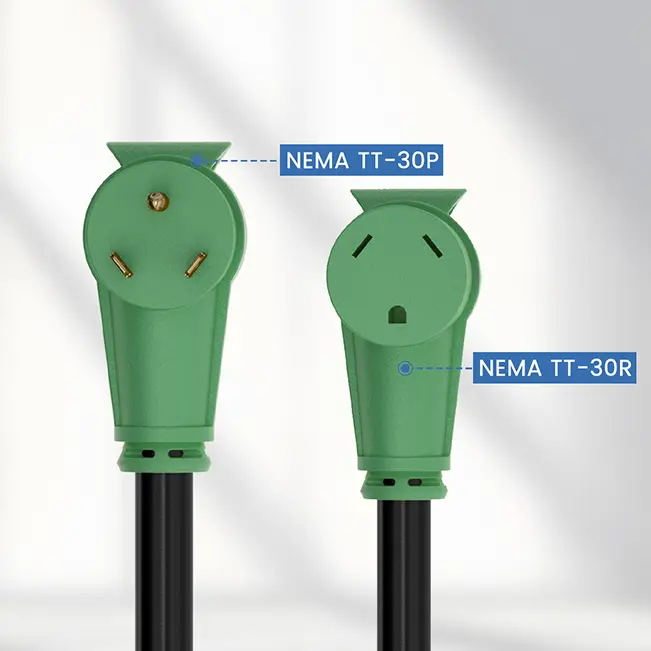
A standard 30 Amp RV electrical system utilizes a 120-volt single-phase AC configuration. The dedicated connector for this system is designated under the National Electrical Manufacturers Association as a NEMA TT-30 (TT stands for Travel Trailer). This plug features three prongs: a hot wire, a neutral wire, and a structural ground. The maximum power delivery of a NEMA TT-30 infrastructure is calculated as:
To safely conduct this current without overheating, standard North American manufacturing specifications mandate the use of 10 AWG (American Wire Gauge) copper conductors inside the cable. 30 Amp configurations are typical for class B motorhomes, pop-up campers, and medium-sized travel trailers running a single rooftop air conditioner.
NEMA 14-50P Cords for 50 Amp RV Systems
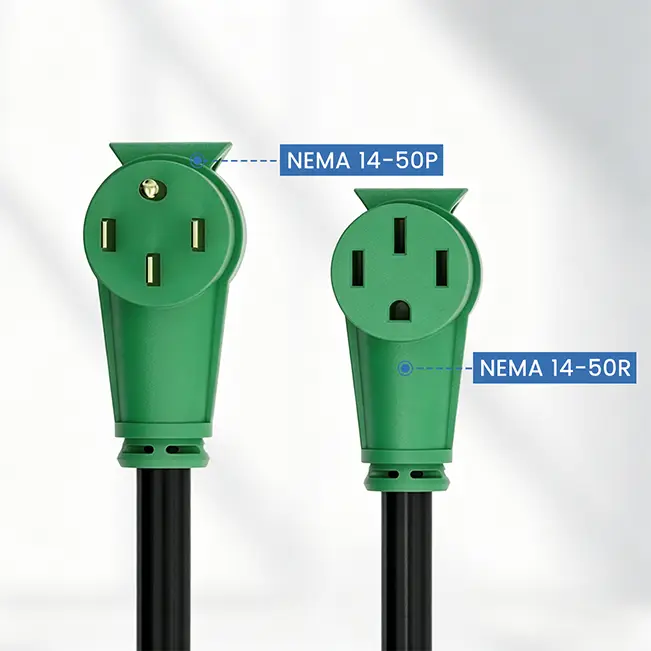
Contrary to intuitive assumptions, a 50 Amp RV system does not merely offer 20 Amps more than a 30 Amp system; it delivers over three times the total power capacity. A 50 Amp shore power connection utilizes a NEMA 14-50 plug configuration, which supplies a 120/240-volt split-phase service. It features four prongs: two independent 120-volt hot wires, one shared neutral wire, and one ground wire. The total power capacity of a NEMA 14-50 infrastructure is calculated as:
Because it carries up to 12,000 watts, a 50 Amp RV power cord requires much thicker 6 AWG copper conductors for the hot and neutral lines (with 8 AWG typically utilized for the ground wire). This heavy-duty system is essential for large Class A motorhomes and fifth-wheels equipped with multiple air conditioning units, residential refrigerators, and onboard washers/dryers.
The Physics of Voltage Drop in Long RV Extension Cords
When current flows through an electrical cable, the inherent resistance of the copper wire causes a drop in voltage over distance. According to the National Electrical Code (NEC), a voltage drop exceeding 3% to 5% under load is considered hazardous for motorized appliances like RV air conditioners. The formula for single-phase voltage drop is expressed as:
Where K represents the specific resistivity of copper, I is the current in amperes, L is the length of the cord in feet, and CM is the circular mil area of the conductor. If you run a standard 10 AWG 30 Amp extension cord beyond 50 feet, the voltage at your RV can drop below 108 Volts AC. This causes electric motors to draw more current to compensate, resulting in localized overheating, compressor failure, and melted plug casings.
You can use our voltage drop calculator to easily calculate the voltage drop of your device.
Selecting Essential RV Dogbone Adapters and Surge Protectors
Real-world travel often introduces discrepancies between your vehicle’s power rating and the available pedestal hookups at historical campgrounds or state parks.
The Safety Mechanics of RV Dogbone Adapters
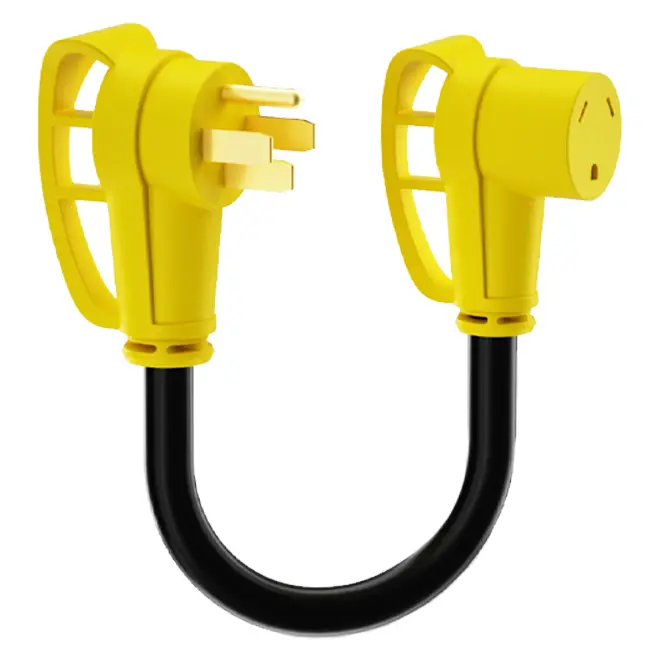
When a 50-amp five-wheeled caravan needs to be parked at a campsite that only provides 30-amp outlets, or a 30-amp caravan is parked at a campsite that only provides 50-amp outlets, an RV adapter is mandatory. The safest choice is a "Dogbone" adapter, named for its structural shape consisting of a heavy-duty cable molded between two solid connectors. A 30 amp male to 50 amp female or 50 amp male to 30 amp female dogbone safely bridges the physical gap by routing the single 120V hot line from the pedestal to both hot legs inside the 50A RV power cord. This limits the vehicle’s total electrical ceiling to 3,600 Watts, requiring strategic energy management (e.g., running only one AC unit instead of two), but prevents physical damage to the trailer's internal breaker panel.
Campground Power Risks and EMS Surge Protectors
Campground power pedestals are exposed to harsh outdoor elements and frequent wear, leading to hidden faults like open neutrals, reverse polarity, or severe voltage surges from nearby lightning strikes. In 2024, an RV electrical safety survey reported that over 42% of experienced RVers encountered ungrounded or miswired park pedestals at least once during their travels. Connecting a heavy-duty RV power line directly to a faulty pedestal can instantly fry your vehicle's onboard converter, residential appliances, and dual-zone climate systems. Utilizing a certified Emergency Management System (EMS) or a heavy-duty surge protector acts as a digital gatekeeper, cutting off power instantly if voltage parameters drop below 104V or spike above 132V.
Weatherproofing Standards and Safety Certifications
North American climates vary from freezing high-altitude mountain ranges to scorching desert highways, making physical jacket durability a premium requirement.
Demystifying the STW Designation on Heavy-Duty Cords
When reviewing technical specifications for premium RV extension lines, look for the official UL/NEC code printed directly on the outer PVC jacket. A professional-grade cord should carry an STW rating:
- S (Service Grade): Indicates a heavy-duty service cord engineered for robust mechanical deployment.
- T (Thermoplastic): Outlines the jacket material composed of durable, highly flexible thermoplastic polymers.
- W (Weather/Water Resistant): Certifies that the cable is rated for outdoor moisture, rain, snow, and continuous ultraviolet (UV) solar radiation without drying out or cracking.
The Importance of UL Listed and ETL Safety Certifications
Never purchase uncertified or unbranded electrical wiring for a high-load application. Independent testing laboratories like Underwriters Laboratories (UL) and Intertek (ETL) put cables through intense thermal load testing, dielectric voltage-withstand testing, and mechanical strain-relief evaluation. A certified UL-Listed or ETL-Listed RV extension cord guarantees that the copper purity, insulation thickness, and flamespread resistance comply fully with ANSI/UL 817 safety standards.
Furthermore, premium cords integrate ergonomic molded pull handles (such as patented PowerGrip designs) with built-in LED power indicator lights. This allows the operator to verify that the shore power current is live before carrying the line into a rain-slicked campsite, minimizing arc-flash and electrocution risks.
RV Cable Maintenance and Safety Checklist
Preventative maintenance is the absolute key to ensuring longevity and physical safety over years of rugged travel. Use the following operational protocol before and after every deployment:
| Component | Inspection Protocol | Corrective Action / Best Practice |
|---|---|---|
| Molded Plug Prongs | Check for green copper oxidation, carbon burn marks, or physical bending. | Clean prongs with fine emery cloth; apply dielectric grease to prevent corrosion. Replace plug if burned. |
| Cable Jacket Integrity | Inspect the entire length for deep abrasions, animal bites, or thermal bubbling. | Discard or professionally splice cables showing exposed inner insulation. Never use electrical tape on deep cuts. |
| Coaxial & Starlink Lines | Verify signal integrity; inspect F-pin connectors for structural bending. | Store in separate dust-proof bags. Avoid sharp 90-degree bends to prevent internal core crimping. |
| Storage & Coil Method | Evaluate physical memory kinks or internal twisting from improper wrapping. | Use the "Over-Under" coiling technique to maintain conductor alignment. Store in clean, dry bays away from standing water. |
Technical Field Case Study: During a summer field audit at an RV resort in Utah, a traveler experienced a total power failure on their 50 Amp fifth-wheel. Upon inspection, the 6 AWG cord had been tightly coiled in a small plastic container while drawing a continuous 40 Amp load to run dual AC units. The tight coiling created an inductive heating loop, trapping thermal energy and causing the outer STW jacket to melt into a solid block, destroying the internal copper insulation. This highlights the absolute necessity of fully uncoiling heavy-duty power lines during high-load operations.
By investing in Vantecable high-quality, certified STW cords with proper AWG ratings, and utilizing heavy-duty dogbone adapters and surge protectors, you establish an ironclad electrical safety net for your vehicle. Keep your connections dry, check your pedestal parameters, and enjoy a fully powered, worry-free North American adventure.