

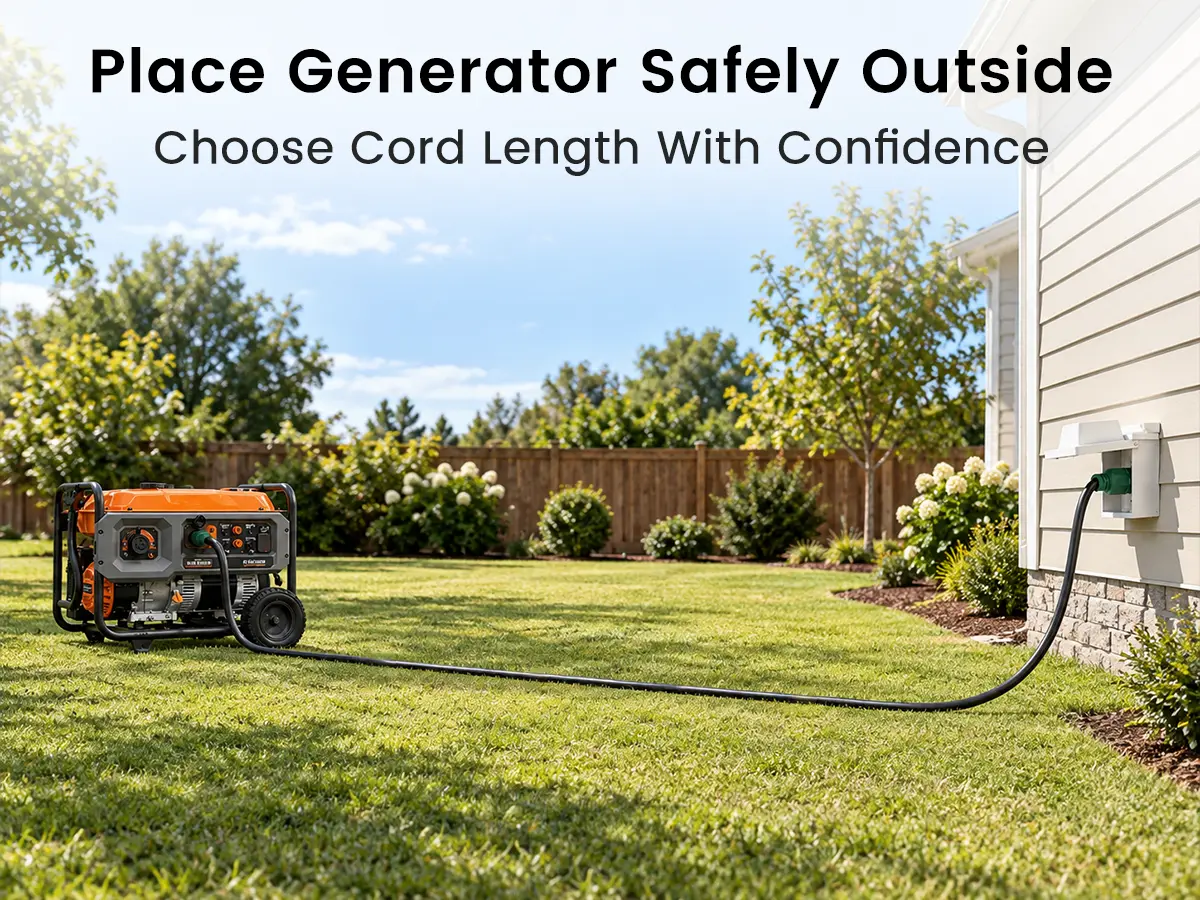
A power outage usually means one thing first: getting the generator out and figuring out where to put it. Generator distance from house is not a minor detail — it is a safety decision. The U.S. Consumer Product Safety Commission recommends operating a portable generator outdoors, at least 20 feet away from the house, with the exhaust directed away from windows, doors, and vents.
Why Generator Distance From the House Matters
Carbon monoxide is the reason the 20-foot rule exists. CO is colorless and odorless, and it builds up fast enough that a person can lose consciousness before noticing symptoms like dizziness or nausea. CPSC has estimated that gasoline-powered portable generators are associated with about 85 consumer carbon monoxide deaths in the United States each year, based on the agency’s reported data. The same report found that most of those fatal incidents occurred at residential properties. Most of the fatal incidents CPSC tracked involved generators used indoors or in partially enclosed spaces such as garages, basements, or porches — which is why the agency’s guidance is explicit that opening a door or window does not provide enough ventilation to make those locations safe.
The carbon monoxide risk, in real numbers. A NIST simulation study found that a generator positioned 15 feet from an open window may still allow dangerous levels of carbon monoxide to enter a home under certain wind and airflow conditions. The study reinforces an important point: the 20-foot distance is a minimum guideline, not a guarantee that every placement is safe. Exhaust direction, wind, nearby openings, and the home’s layout still matter.
Fire and heat clearance around the unit. Beyond CO, a running generator produces enough heat to ignite nearby combustible material, including dry grass, mulch, or stored fuel containers. Keeping the unit on a level, clear surface — away from siding, decking, and anything flammable — reduces that risk independently of the carbon monoxide distance requirement.
The Recommended Generator Safe Distance
Twenty feet is the number that shows up in CPSC’s own consumer alerts, and it is measured from the house’s doors, windows, and vents, not just the nearest wall. The agency’s guidance also tells consumers to keep any windows or openings in the generator’s exhaust path closed, since even a 20-foot buffer will not fully offset an open window sitting directly downwind of the exhaust.
That 20-foot figure is specific to portable generators — it isn’t the rule that governs every type of unit a household might run. Permanently installed standby generators follow a different set of rules: the manufacturer’s installation manual and local electrical or building code, which commonly set a minimum clearance from the structure along with a separate minimum distance from windows and fresh-air intakes. Those numbers vary by model and by jurisdiction, so a standby unit’s placement should always be confirmed against its specific installation manual rather than the portable-generator distance rule.
The table below matches common placement distances to the cord lengths that typically cover them, so you can check whether a cord will actually reach before you buy one.
| Generator Placement | Minimum Cord Length to Consider | Practical Note |
|---|---|---|
| About 20 ft from the house | 25 ft | Provides basic reach with limited slack |
| 25–30 ft from the house | 30–50 ft | Allows more flexible routing around doors and walkways |
| 40–50 ft from the house | 50 ft | Useful when the generator must be positioned farther from openings |
| 75–100 ft from the house | 100 ft | Confirm voltage drop, gauge, and generator output before use |
These are planning examples, not universal sizing rules. The final cord length should account for the generator’s position, the equipment connection point, routing around obstacles, and the cord’s voltage and amp rating.
How Cord Length Solves the Distance Problem
Placing a generator 20 feet or more from the house solves the safety problem, but it creates a practical one: the generator now needs a cord long enough to reach the house without losing meaningful power along the way. This is where generator cord length and wire gauge become part of the safety conversation, not just a convenience question.
Matching cord gauge to distance and amperage. Every extension cord has resistance, and resistance causes voltage to drop as current travels down the wire — the longer the run and the higher the amperage, the more the drop. A cord that is too thin for its length and load can run hot, underpower sensitive equipment like refrigerators or sump pumps, and in some cases trip a generator’s overload protection. The safe approach is to size the gauge to the full distance and amperage of the run, not just the generator’s rated output. For a closer look at how that math works, see our voltage drop calculator; for how gauge relates to a connector’s amp rating specifically, our 10-gauge ratings guide breaks that down in more detail.
Once the generator is positioned at a safe distance, the cord should be long enough to reach the connection point without forcing the generator closer to the house or creating unsafe routing. For compatible 30-amp generator outlets, this 10/3 twist-lock cord offers multiple length options for different placement distances.
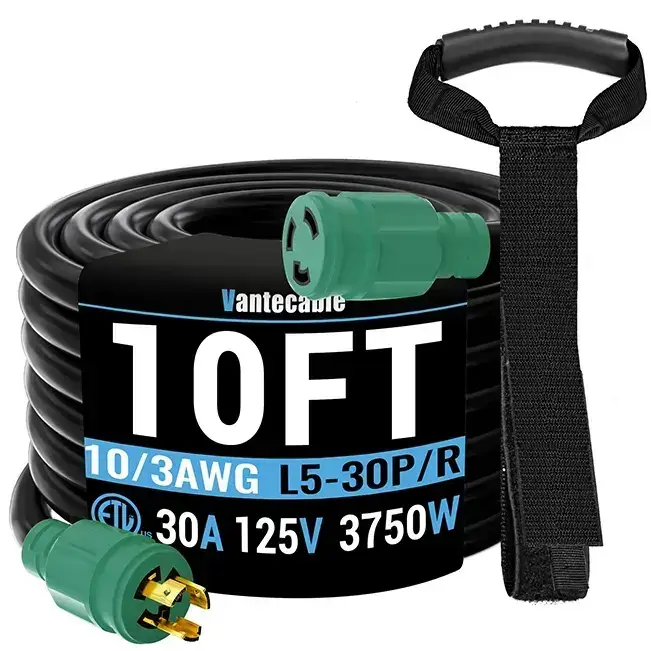
10/3 AWG Generator Extension Cord with Twist-Lock (L5-30P/L5-30R), 30A / 125V / 3,750W
Available in lengths from 10 ft to 100 ft, so you can match the cord to your actual generator-to-house distance without sacrificing gauge.
Buy 30A L5-30Choosing a Long Generator Cord for a 20+ Foot Run
Once distance and gauge are accounted for, the remaining decision is matching the cord’s plug configuration to the generator’s output. A 30-amp generator with a twist-lock L5-30 or L14-30 outlet needs a cord built for that same rating — a lighter household extension cord sized for a 20-foot run can still be undersized for the actual amperage, which raises the risk of overheating or nuisance tripping.
Which amp rating fits your generator’s output. Check the generator’s nameplate for its rated amperage and voltage before buying a cord. A 3,750-watt output on a 125V circuit may use a 30A L5-30 configuration, while a compatible dual-voltage setup may use a 30A L14-30 configuration at 125/250V — our L14-30 generator cord provides that four-conductor configuration. RV and larger backup systems may instead use a 50-amp connection such as NEMA 14-50P to SS2-50R. In every case, the plug, receptacle or inlet, voltage, and amp rating must match the equipment.
For RV and camper applications, apply the same selection process: match the cord to the generator outlet or RV inlet, then choose a length that covers the actual route without excessive slack.
Generator Placement Checklist Before You Run It
Before starting the generator, confirm the spot is at least 20 feet from every door, window, and vent on the house, with the exhaust facing away from the structure and away from any neighboring buildings someone could enter. Close windows and doors that sit in the exhaust path, even if they are on the far side of the 20-foot buffer. Do not route the generator cord through a closed window, door, or other opening in a way that prevents the opening from closing securely; if the cord needs to enter the home, use a properly installed inlet and transfer equipment evaluated for the installation, set up by a licensed electrician familiar with local code, rather than creating an improvised opening. Set the unit on level, dry ground clear of dry vegetation or stored fuel, and run the cord along a path where it will not sit in standing water or become a trip hazard. Test the home’s CO and smoke alarms before the outage hits, not during it. If a storm or hurricane is the reason for the outage, our guide to hurricane generator safety covers the additional precautions that come with running a generator in wind and rain.
FAQ
Can I run a generator in a garage with the door open?
No. CPSC guidance is explicit that opening the garage door does not provide enough ventilation to prevent a lethal buildup of carbon monoxide inside the space, and CO can also drift from the garage into the attached house. Portable generators should only be operated outdoors.
Does a longer generator cord reduce power output?
Length itself does not reduce output, but resistance in the cord does cause some voltage drop over distance, and that drop increases with both length and current draw. Sizing the wire gauge to match the full length of the run — not just the generator’s rated amperage — keeps that drop within a safe range.
Is farther always safer when placing a generator?
Beyond the 20-foot minimum, there is no required maximum distance, and pushing placement to 25 feet or more can further reduce CO risk in low-wind conditions. The practical limit is usually the cord: a longer run needs a heavier gauge to avoid voltage drop, so the right distance is the one your cord setup can safely support.
Conclusion
Generator placement comes down to two numbers working together: at least 20 feet of distance from the house, and a cord sized to cover that distance without losing power. Get the first number from CPSC guidance and the second from the generator’s nameplate and a properly rated cord, and the rest of the setup — surface, exhaust direction, alarm checks — falls into place around them. Vantecable carries ETL Listed (Intertek) emergency power cords sized for exactly this kind of run.