

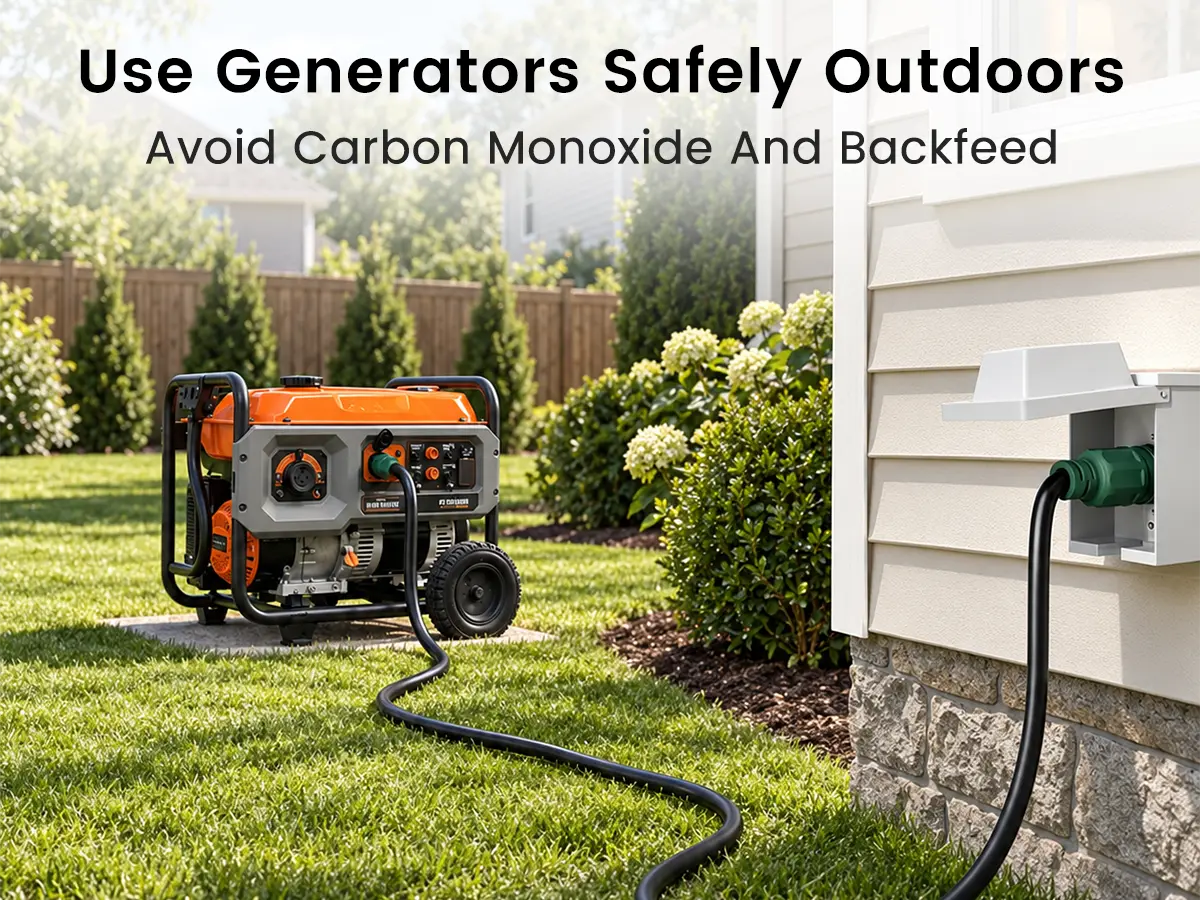
Portable generator safety during a hurricane comes down to five habits for running backup power: keep the generator outdoors at least 20 feet from the house, inspect the generator and every cord before use, connect only compatible equipment, add loads gradually, and never backfeed household wiring.
This guide covers each step in the order you’ll actually do it—placement, cord checks, backfeed prevention, load control, and refueling—so a storm outage doesn’t add carbon monoxide, shock, or fire risks. Before the storm, review your generator manual and match your outlets to the right hurricane season generator extension cords.
Portable Generator Safety Starts With a Safe Generator Setup
A safe generator setup is a sequence of actions, not just choosing a place to set the machine down. Before starting the generator, choose an outdoor operating location, check the ground and weather conditions, test indoor carbon monoxide alarms, inspect the generator and every cord, and decide which essential loads you will power first.
Start by reading the manufacturer’s operating instructions for your specific model. The manual should be the first reference for grounding, startup, weather exposure, refueling, maintenance, and output limits. Do not assume that a feature on one generator applies to another model.
Next, identify the devices that truly need backup power. During a hurricane outage, that may include selected refrigeration, lighting, communication equipment, or another essential appliance. Plan the loads before turning the generator on. This keeps the setup focused and helps prevent rushed, unsafe decisions in the dark or in poor weather.
A working carbon monoxide alarm inside the home is also part of the setup. It does not make unsafe generator placement acceptable, but it adds an important layer of warning if exhaust enters the building.
Portable Generator Placement: Choose the Location Before You Start
The first physical action in a safe generator setup is choosing where the generator will run. A portable generator must operate outdoors, not inside a home, garage, basement, shed, crawl space, or other enclosed or partly enclosed area. Opening a garage door does not make a garage safe for generator use, and CPSC advises against running a generator on a porch or in a carport because it is too close to the home.
The U.S. Consumer Product Safety Commission recommends operating portable generators outside, at least 20 feet from the home, with the exhaust directed away from doors, windows, vents, and other openings. Carbon monoxide is colorless and odorless, so people cannot rely on smell or visible smoke to know whether the air is dangerous.
Choose an open area that keeps the exhaust away from your own home, nearby buildings, and occupied outdoor areas. Set the generator on a stable surface, away from standing water, and leave the clear space around it that the manufacturer specifies.
For a fuller explanation of distance, air openings, and placement decisions, see How Far Should a Generator Be From the House?
Keeping a Generator Dry, Stable, and Ventilated in Hurricane Weather
Hurricane conditions create a difficult balance: the generator must stay outdoors for ventilation, but you also need to avoid unsafe wet conditions. Do not operate a generator in standing water or where rain can directly create an electrical hazard. Wet conditions increase the risk of shock or electrocution.
The correct weather protection depends on your generator model and its instructions. If your manual allows a cover, canopy, or other weather-protection accessory, use only what the manufacturer approves. Do not improvise with a sealed enclosure, tarp, or structure that blocks airflow or traps exhaust. A covering that keeps rain out but restricts ventilation creates another serious hazard.
Before starting, check the ground around the unit. Remove loose debris where possible, keep the generator stable, and route cords so they are not stretched across puddles, sharp edges, or high-traffic walkways. If the generator, cord, plug, or outlet has been exposed to floodwater or shows damage, do not assume it is safe to use.
Generator Cord Safety Begins With Checking the Whole Connection
Generator cord safety is not only about buying a heavy-duty cord. It means checking the entire connection path before electricity starts flowing: the generator outlet, the plug configuration, the cord, the connector, and the equipment receiving power all need to be compatible.
A cord cannot safely solve a mismatched outlet or an overloaded setup. Never force a plug into an outlet, modify a connector, or use an unknown adapter to make two incompatible connections fit. Check your generator’s outlet type and the equipment connection before the outage, when there is enough light and time to read labels and instructions.
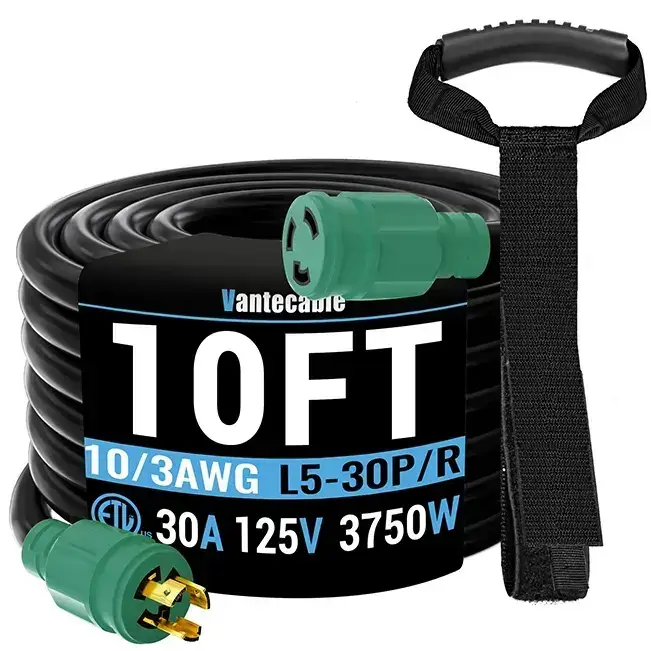
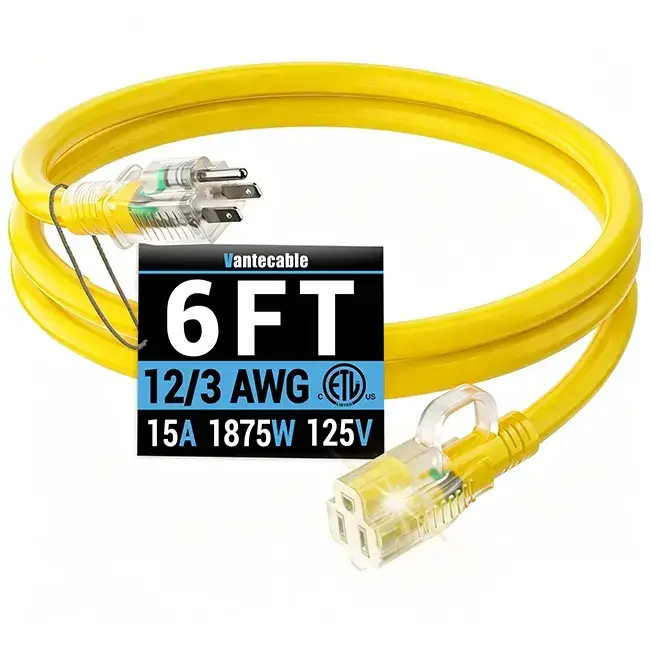
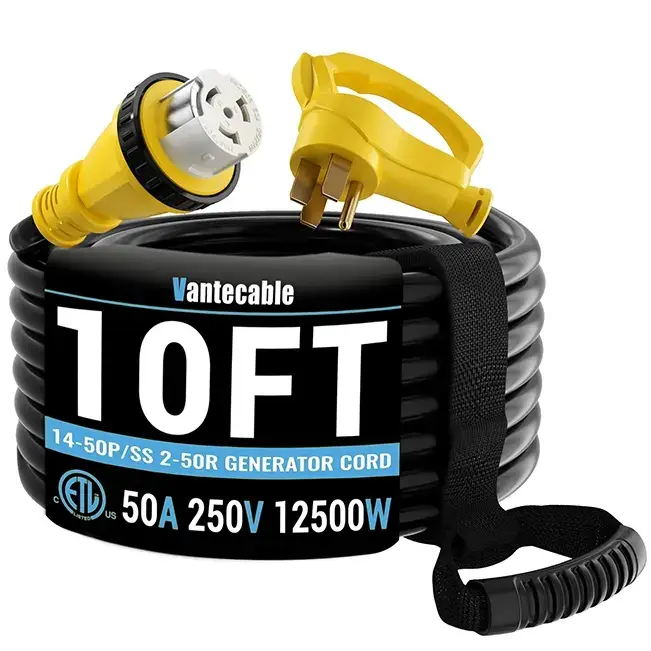
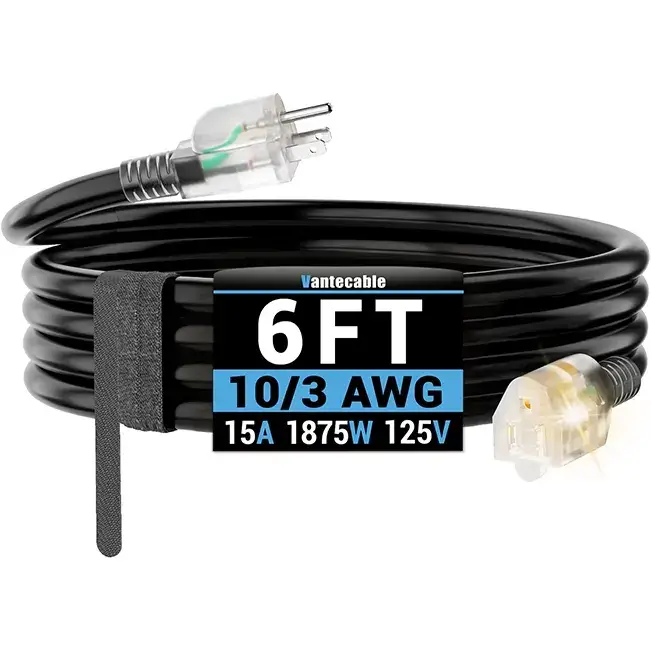
Vantecable’s storm-ready cords fall into two groups, and they do different jobs. The 30A and 50A twist-lock cords carry generator output to a matching inlet or piece of equipment. The 12/3 and 10/3 lighted cords are standard three-prong extension cords for individual devices. They are not substitutes for 30A or 50A generator cords.
Match the Cord to the Outlet
| Generator outlet or equipment | Recommended cord | Connector match | Product-page rating |
|---|---|---|---|
| L5-30R, 30A 125V locking outlet | 30A L5-30P to L5-30R, 10/3 AWG, STW | L5-30P to generator L5-30R; L5-30R to compatible L5-30P inlet | 125V / 3,750W |
| L14-30R, 30A 125/250V locking outlet | 30A L14-30P to L14-30R, 10/4 AWG, STW | L14-30P to generator L14-30R; L14-30R to compatible L14-30P inlet | Verify against product page before publishing |
| 14-50R, 50A outlet | 50A 14-50P to SS2-50R, 6+8 AWG, STW | 14-50P to generator 14-50R; SS2-50R to compatible SS2-50P inlet | 50A / 12,000W |
| Standard grounded 120V outlet and three-prong equipment | 12/3 SJTW lighted extension cord | 5-15P to 5-15R | 125V / 15A / 1,875W |
| Standard grounded 120V outlet and three-prong equipment | 10/3 SJTW lighted extension cord | 5-15P to 5-15R | 125V / 15A / 1,875W |
Each row is a separate connection, not a chain. A locking L5-30R or L14-30R connector will not accept a standard household plug, and you should never adapt or force one to fit. The lighted end on the 12/3 and 10/3 cords shows that power has reached the connector, but it does not confirm grounding, polarity, voltage quality, or whether the connected appliance is operating correctly.
The two combinations below pair a matched generator cord with a separately connected, compatible equipment cord. Choose each cord by its own outlet, connector, and load; these are paired shopping options for the same outage plan, not cords to connect end to end.
30A Generator Backup Cord Set
Choose the generator cord that matches your outlet, then add a 12/3 lighted cord for separately connected, compatible 15A equipment.
50A Generator Backup Cord Set
Choose the 50A generator cord option, then add a 10/3 lighted cord for separately connected, compatible 15A equipment.
Inspect Generator Cords, Plugs, and Connectors Before Every Use
Before every use, inspect the full length of each cord. Look for cuts, crushed sections, exposed conductors, damaged outer jackets, loose plugs, bent blades, cracked connector housings, melted areas, or signs of overheating. Do not use a cord that feels unusually warm, has a loose connection, or shows visible damage.
Check both ends of the cord, not just the end closest to the generator. The receiving end matters just as much, because a worn connector can create an unreliable or unsafe connection at the appliance. Use cords with the grounding pin intact, and never remove the ground pin to fit an older outlet.
Fully unroll a cord before it carries power. An energized cord left coiled or looped can trap heat and damage the insulation. Do not run cords under rugs, through doors that can pinch the cable, or through areas where vehicles may roll over them. Keep cord runs as direct as practical and avoid unnecessary connection points.
Look at the jacket rating, too. Vantecable’s 30A and 50A generator cords use STW jackets, while the lighted extension cords use SJTW jackets. For a detailed explanation of SJTW markings, ratings, and practical use, see Understanding SJTW Extension Cord Meaning: Ratings, Letters, and Practical Use.
Generator Safety During an Outage Means No Backfeeding
One of the most important rules of generator safety during an outage is never to backfeed electricity into household wiring. Do not plug a portable generator directly into a wall outlet. Do not use a double-male-ended cord. These methods can energize utility lines unexpectedly, creating a severe danger for utility workers and others nearby.
If you want to power selected hardwired household circuits, the system needs an appropriate transfer switch or another compliant connection method installed by a qualified electrician. A common approach is a power inlet box wired to a transfer switch or interlock kit, so you connect the generator to the house with one matching cord.
For portable use, connect compatible devices directly and follow the generator manufacturer’s instructions. Keep the system simple. Every additional adapter, extension, or unverified connection is another point that needs to be checked.
Generator Cord Safety Also Means Avoiding Cord Daisy Chains
Do not connect multiple extension cords end to end just to reach farther. Each additional connection can increase the chance of a loose plug, voltage loss, heat buildup, or exposure to water and damage. Use one correctly selected cord of the length you need.
If you need a longer run, choose one cord after checking the required length, load, connector type, and manufacturer guidance. This extension cord gauge chart explains how gauge, amperage, and distance work together.
This matters most during a hurricane outage, when cords may stay outdoors for long periods and visibility may be poor. Keep connections off wet ground where possible, protect them from traffic, and check them again if weather conditions change.
Portable Generator Safety During Operation Depends on Load Control
Once the generator is placed correctly and every connection has been checked, start the unit according to the manufacturer’s instructions and let it stabilize. Then connect only the planned loads and add equipment one item at a time.
Do not assume the generator can run every appliance in the house. Every generator has its own output capacity, and some appliances with compressors or motors draw substantially more power at startup than during normal operation. Check the generator manual and the equipment labels before use. If the generator overloads, trips a breaker, runs abnormally, or produces unusual heat or smell, disconnect loads and stop to investigate.
Start With the Loads You Need, Then Add More One at a Time
A safe generator setup is easier to manage when it is limited to necessary equipment. Rather than connecting every available device, prioritize the loads that matter during the outage and add them one at a time.
The 12/3 lighted extension cord and 10/3 lighted extension cord are for individual grounded three-prong devices, and each is limited to 15A and 1,875W. Check the equipment label and manufacturer documentation before you plug it in. A load that exceeds the cord’s rating needs a different compatible connection, not a forced adapter or overloaded cord.
Keep an eye on the generator while it is operating. Do not leave it running unattended for extended periods, especially during changing hurricane weather. Check that cords remain secure, dry, and away from walkways, children, pets, and moving vehicles.
If you are planning your household priorities before the storm, see Power Outage Checklist. That article supports the preparation stage, while this guide focuses on operating the generator safely once backup power is needed.
Generator Safety During an Outage Includes Safe Refueling
Never refuel a generator while it is running. Shut the generator down, disconnect loads if the manufacturer requires it, and allow the unit to cool before adding fuel. Gasoline spilled onto hot engine parts can ignite.
Hurricane outages can last for days, so expect to refuel more than once. Store fuel before the storm in an approved container, away from ignition sources, and follow the fuel type and storage instructions in the generator manual. Do not overfill the tank, and clean up any spilled fuel before restarting the generator.
If you need to refuel at night, use a flashlight rather than an open flame. Take the extra time to confirm the generator is off and cool. During an outage, rushing through refueling is one of the easiest ways to turn a manageable situation into a fire hazard.
Portable Generator Safety Checklist Before You Start
Use this quick check every time you start the generator during a hurricane outage. If anything lands in the last column, stop and fix it before continuing.
| Check | Confirm | Stop if |
|---|---|---|
| Location | Outdoors, at least 20 feet from the home, with exhaust pointed away from doors, windows, and vents | You can’t reach 20 feet, or the only spot is a garage, porch, or carport |
| Alarms | Indoor carbon monoxide alarms are working | An alarm sounds—get outside, then call 911 |
| Ground and weather | Stable ground, no standing water, no floodwater exposure | Water reaches the generator, cords, or connectors |
| Cords | Full length and both ends inspected, ground pin intact, cord fully unrolled | Cuts, loose plugs, heat, or a damaged jacket |
| Connections | Every plug and outlet matched and fully seated, with no daisy chain | You need an unknown adapter to make it fit |
| Loads | Planned in advance and added one at a time | A breaker trips or the generator overloads |
| Refueling | Generator shut down and cooled first | The generator is still running or hot |
And never plug the generator into a household wall outlet.
Portable Generator Safety FAQ
How far should a portable generator be from a house?
Portable generators should operate outdoors at least 20 feet from the home, with exhaust directed away from doors, windows, vents, and other openings. CPSC also advises against running one on a porch or in a carport. Always follow your generator manufacturer’s instructions and any applicable local requirements as well.
Is it safe to run a portable generator in a garage with the door open?
No. A garage is still an enclosed or partially enclosed area where carbon monoxide can build up. Run the generator outdoors only.
Can I connect two extension cords to reach my generator?
No—avoid it. Use one properly selected cord of the length you need. Connecting cords end to end adds connection points and can increase the risk of loose plugs, voltage loss, heat buildup, and moisture exposure.
Can I plug a portable generator into a wall outlet during an outage?
No. Plugging a generator into a household wall outlet can create dangerous backfeeding. Connect compatible devices directly, or use a professionally installed, compliant home connection system.
What cord connects a portable generator to a transfer switch or inlet box?
Match both ends. The plug must fit your generator’s outlet, and the connector must fit the inlet. Many home setups use a 30A L14-30 connection, but check the labels on your generator and inlet rather than assuming, and have a qualified electrician install or verify the transfer switch or inlet box.
What should I do if my generator gets wet during a hurricane?
Stop using it and follow the manufacturer’s instructions. Do not touch the generator or its connections while standing in water. Do not restart a generator that may have water damage until it has been assessed according to the manufacturer’s guidance or by a qualified service professional.
Conclusion: Portable Generator Safety Keeps Backup Power Under Control
Portable generator safety is about making deliberate choices before and during an outage. Place the generator outdoors and away from the home, keep exhaust directed away from openings, inspect every connection, avoid backfeeding, manage loads carefully, and refuel only after shutdown and cooling.
A generator can support essential backup power during a hurricane, but only when the setup is matched to the equipment and operated within safe limits. Review your connections before the storm, keep the setup simple, and use emergency generator extension cords only when the outlet, plug, and intended use are compatible.