
.png?w=1368&h=240)
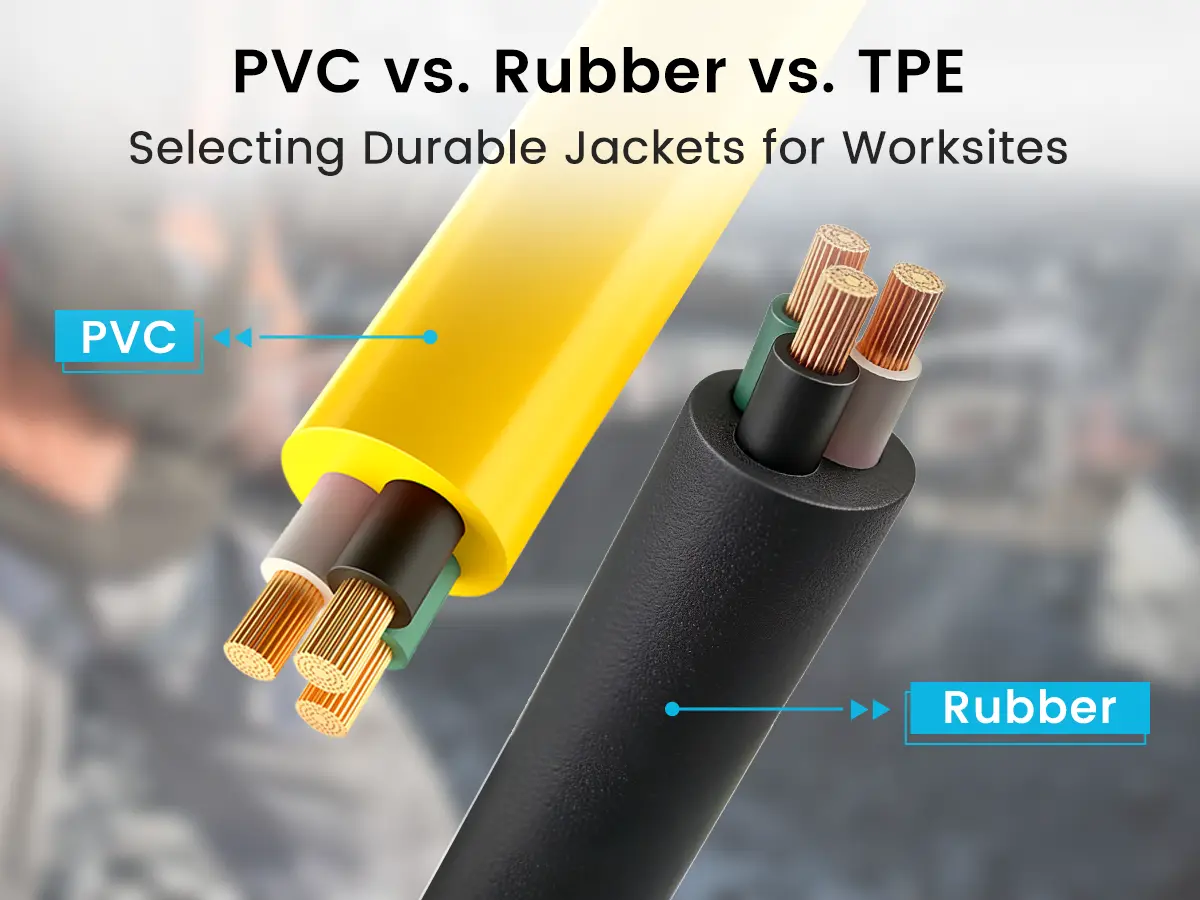
Introduction: The Protective Shield of Your Power Source
When selecting a heavy-duty extension cord—whether it’s a 10 AWG Vantecable cord for a construction site or a 12 AWG cord for high-powered tools—most users focus primarily on the wire gauge and the copper conductivity. However, the jacket material is the true "unsung hero" that determines the actual lifespan of your equipment.
The jacket is the only barrier between your power source and a world of sharp edges, heavy machinery, UV radiation, and chemical spills. At Vantecable, we specialize in the two most proven and reliable materials in the American market: High-Grade PVC and Vulcanized Rubber. Understanding the specific strengths of these materials ensures you get the maximum Return on Investment (ROI) for your gear while maintaining the highest safety standards on the job.
1. PVC (Polyvinyl Chloride): The Rugged, Abrasion-Resistant Leader
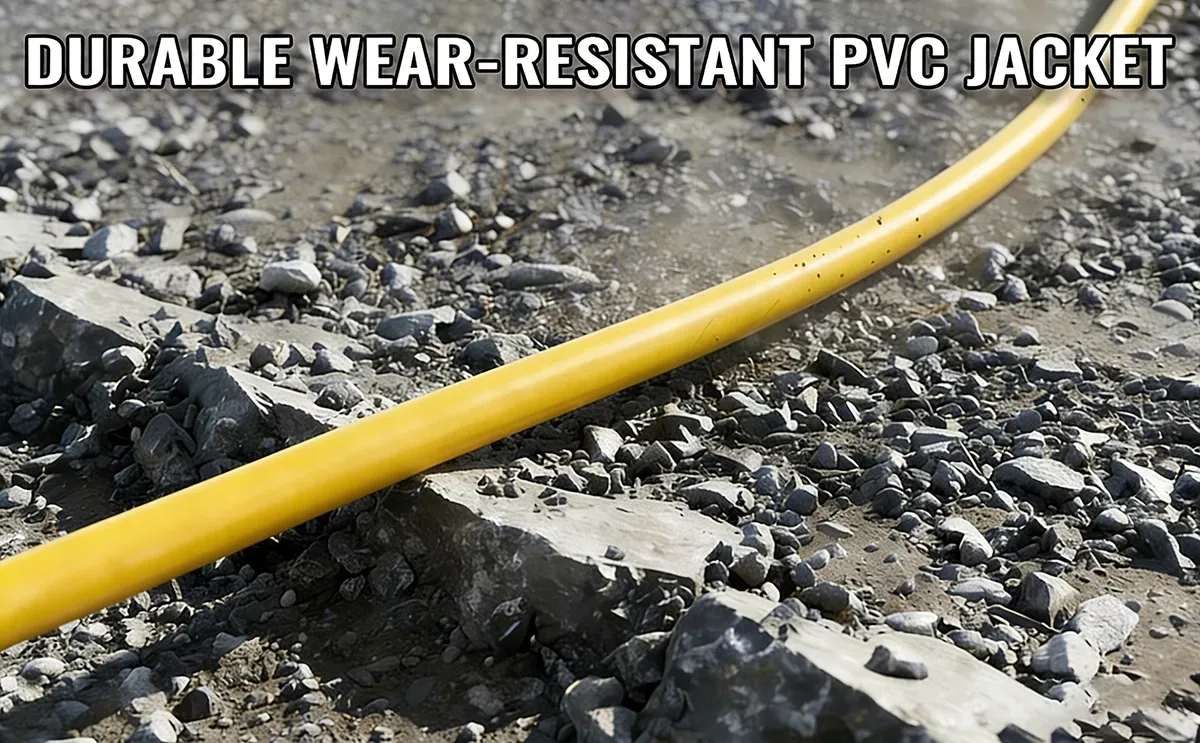
PVC is the industry standard for high-traffic construction sites and outdoor tasks. It is most commonly designated by ETL/UL codes such as SJTW or STW. As a synthetic thermoplastic polymer, it offers the best balance of physical protection and cost-efficiency.
Why PVC is the Best Value for Professionals
PVC is engineered to provide a "hard-shell" level of protection that softer materials simply cannot match.
-
Unmatched Abrasion Resistance: PVC’s hard outer shell is significantly tougher than rubber or TPE hybrids. It excels in environments where the cord is constantly dragged over rough concrete, gravel, or through dense brush.
-
Puncture Protection: Because PVC is more rigid, it acts as a high-density shield. This rigidity protects the internal 10/12 AWG copper conductors from being punctured or crushed by falling debris or sharp metal edges.
-
Safety and Visibility: PVC holds high-visibility safety pigments (such as Safety Orange and Neon Yellow) longer than other materials. This ensures worksite safety by preventing accidental trip hazards and making the cords easily identifiable to heavy machinery operators.
2. Decoding the ETL/UL Markings: What the Letters Mean for Your Safety
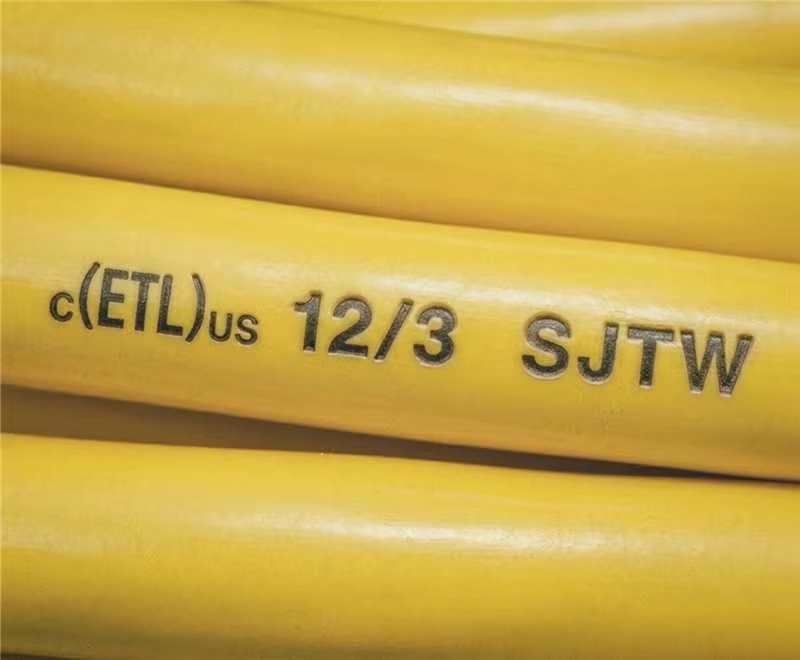
To the untrained eye, the letters printed on a cable jacket—SJTW, STW, SJOOW—might look like random soup. However, each letter is a critical indicator of the material's performance and is regulated by ETL/UL.
-
S (Service): This denotes a general-purpose service cord rated for 600 Volts.
-
J (Junior): This indicates a 300 Volt rating, which is the standard for most heavy-duty household and light construction extension cords (like our 12 AWG and 14 AWG series).
-
T (Thermoplastic): This confirms the jacket is made of high-grade PVC.
-
O (Oil Resistant): If you see one "O," the outer jacket is resistant to oil. If you see "OO," both the outer jacket and the inner conductor insulation are oil-resistant—a signature feature of our SJOOW Rubber cords.
-
W (Weather Resistant): This is the most vital marking for outdoor use. It signifies that the PVC or Rubber compound has been treated with UV inhibitors to withstand moisture and prolonged sunlight without degrading or becoming brittle.
We have another article specifically explaining the meaning of the letters on the jacket of extension cords.
3. Rubber (Thermoset Elastomers): The Indestructible Industrial Choice
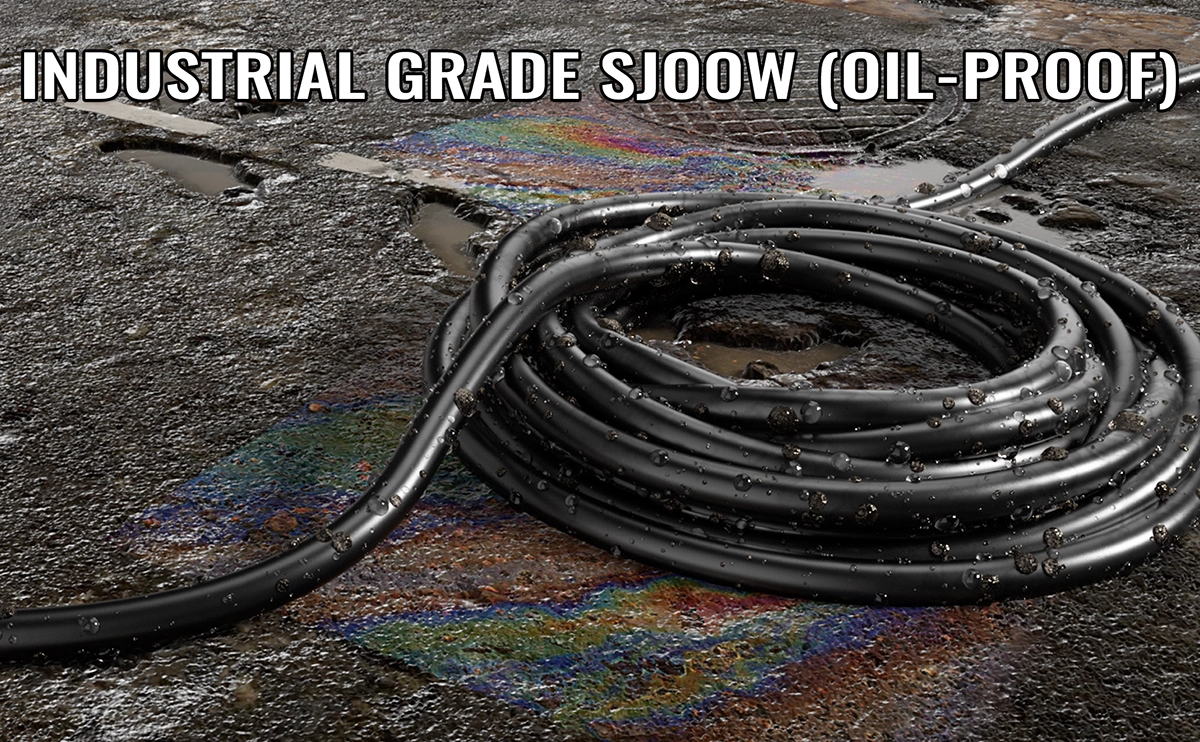
For environments exposed to oils, chemicals, and extreme heat, our SJOOW and SOOW Rubber cords represent the ultimate professional solution. Unlike plastic-based materials, Vantecable’s rubber is vulcanized—a chemical process that creates a permanent molecular bond.
The Power of Vulcanization
-
Chemical and Oil Immunity: This is where vulcanized rubber leaves all other materials behind. It is completely inert to gasoline, motor oil, hydraulic fluid, and acids. In an auto shop or near a heavy-duty generator, where fuel spills are common, a rubber jacket is non-negotiable.
-
Superior Thermal Dissipation: In high-amperage applications (like running a 5000W generator), the copper core generates significant internal heat. Rubber dissipates this heat more efficiently than plastics, preventing the insulation from degrading or melting over years of service.
-
Zero-Flex Memory: Rubber does not "remember" its coiled shape. Whether it is -40℃ or 105℃, a rubber cord stays perfectly limp and flat on the ground. This creates a safer, professional worksite layout without the "coiling" hazards seen in cheaper cords.
4. The Truth About TPE (The Lightweight Alternative)
You may see TPE (Thermoplastic Elastomer), often labeled SEOW, marketed as a "high-tech" hybrid. While it is lightweight and performs well in cold, it comes with significant trade-offs for the serious professional.
-
Surface Softness and Tearing: TPE is much softer than PVC. In a real-world construction environment, this softness is a liability. It is far more prone to "nicking," tearing, or being gouged when pulled through wall studs or over sharp debris.
-
The Cost Penalty: TPE is often significantly more expensive than high-grade PVC, yet it fails to provide the true chemical resistance found in vulcanized rubber.
-
Vantecable’s Engineering Choice: We focus on the "Extreme Ends" of the spectrum—Hardened PVC for maximum abrasion protection and Vulcanized Rubber for chemical immunity. We believe these two materials offer superior protection for our customers compared to "middle-ground" TPE hybrids.
5. Under the Microscope: ETL Standards and Vantecable Testing
Every Vantecable SJTW and SJOOW cord is engineered to exceed ETL safety benchmarks. We don't just follow standards; we stress-test our products for the American job site.
-
The Crush Test: We simulate thousands of pounds of pressure from heavy machinery to ensure the jacket never fails. Our Rubber jackets "bounce back" to their original shape, while our PVC provides a rigid barrier against internal short circuits.
-
The Cold Bend Test: We freeze our cords to their minimum rated temperatures and wound them around a mandrel to ensure zero cracking.
-
UV Exposure and Aging: Our high-grade PVC is treated with UV inhibitors to prevent sun-bleaching and brittleness. This ensures that a cord used in the Arizona sun will remain as safe as one used in the shade.
6. Case Study: Maximizing the Lifespan of Your Vantecable
Scenario A: The Hardworking Contractor (Why PVC Wins)
A contractor on a residential site in Florida needs a 100ft 12 AWG cord that won't tear when pulled through rough framing. Our SJTW (PVC) cords are the preferred choice. The hard surface slides easily over wooden beams and resists the "scuffing" that would ruin a softer TPE or rubber cord. It provides the best return on investment for high-wear, high-friction tasks.
Scenario B: The Generator & Machine Shop (Why Rubber Wins)
In a shop floor covered in lubricants and metal shavings, a Vantecable SJOOW (Rubber) cord is the only safe option. While standard plastics would swell, soften, and eventually crack when exposed to oil, our vulcanized rubber remains intact, providing decades of reliable service in the most hostile industrial conditions.
7. Thermal Fatigue and Dissipation: Protecting Your Copper Core
A critical factor often overlooked is Thermal Fatigue. When you run high-wattage equipment (such as a 5000W portable generator or a commercial space heater) through a 10 AWG cord, the copper conductors generate heat. This is not just a safety concern; it is a material endurance test.
In cheaper, low-quality PVC jackets, this internal heat can cause "leaching" of the plasticizers over time. This makes the cord feel oily or sticky, eventually leading to a jacket that is brittle even in summer. Vantecable’s Industrial Rubber (SJOOW) series is specifically designed for high thermal dissipation. The vulcanized rubber allows the heat to escape more efficiently, ensuring that the insulation surrounding your 10-gauge copper remains flexible and safe, preventing internal shorts even after hundreds of hours of high-load operation.
8. Technical Comparison Table (PVC vs. Rubber)
| Feature | Vantecable Premium PVC (SJTW) | Vantecable Industrial Rubber (SJOOW) |
|---|---|---|
| Primary Protection | Maximum Abrasion & Puncture | Maximum Chemical & Heat Resistance |
| Best Environment | Construction, Home DIY, Gardening | Generators, Auto Shops, Factories |
| Flexibility | Great for high-traffic areas | Ultimate (Zero Memory) |
| Durability | Rigid Shielding | Flexible Endurance |
| Value / ROI | Highest for General Pro Use | Long-term Industrial Investment |
9. Frequently Asked Questions (FAQ)
Q: Can I use a PVC (SJTW) cord for my portable generator?
A: Absolutely. Vantecable’s 10 AWG SJTW cords are specifically engineered for portable generator use. Our heavy-duty PVC jackets are treated with advanced UV stabilizers and moisture-resistant compounds, making them ideal for outdoor emergency power and job site use. They offer superior abrasion resistance compared to softer materials and are much lighter to handle, which is a significant advantage when deploying heavy-gauge 10 AWG cables in a hurry.
Q: Why does my PVC cord feel stiff in the morning and soft in the afternoon?
A: This is due to the thermoplastic nature of PVC. It reacts to ambient temperature. While our PVC is optimized for flexibility, this is a natural characteristic. For "Zero-Memory" performance that stays limp at any temperature, our Rubber series is the premium alternative.
Q: Is 10 AWG only available in Rubber?
A: Not at Vantecable. We offer 10 AWG in both Rugged PVC and Industrial Rubber, allowing you to choose based on whether your primary threat is abrasion (PVC) or chemical exposure (Rubber).
10. Maintenance: How to Extend Your Cord’s Life
Regardless of the material, proper care will double the life of your Vantecable:
-
Cleaning: Use mild soap and water. Never use petroleum-based cleaners on PVC.
-
Storage: Use the "over-under" coiling method. This prevents internal wire twisting and extends the life of the copper conductors.
-
Inspection: Periodically check for 'necking' near the plug. If you see the internal colored wires, it’s time to replace the cord for safety.
Conclusion: Get the Right Vantecable for Your Job
At Vantecable, we don't believe in "one size fits all." We believe in "Right Tool, Right Job."
If you need a rugged, high-visibility, and affordable workhorse that can handle the daily grind of a construction site, choose our SJTW PVC series.
If you need a cord that is impervious to oil, heat, and extreme temperatures, choose our SJOOW Rubber series.
Invest in quality. Invest in safety. Choose Vantecable.