


How Do You Plan Temporary Power From Source to Load?
Plan temporary power as a traceable path: source, distribution or feeder where present, branch protection, flexible cord and load. Write one line per run that names the upstream point feeding it, such as “Run 4: Panel B, breaker 6,” so every cord on site traces back to a known source and protective device.
What Must Be Settled Before Any Cord Is Laid?
Settle four items before layout: whether a permit is required and who holds it; what the authority having jurisdiction (AHJ) requires; which code edition and local amendments apply; and who is responsible for the system. Release and inspection forms differ by locality, so check your own jurisdiction instead of assuming another city’s rules carry over.
Name one person to maintain the temporary power system, update the route map and lock off unfinished areas until sign-off. A separate shift owner can run the daily check described later in this guide, and the two roles can be held by the same person.
Caution: Have a qualified electrician set up or alter the temporary system. Flexible cords are a temporary power method, not a substitute for permanent building wiring, and this guide does not cover permanent wiring design or equipment rewiring.
What Do Source, Feeder, Branch and Flexible Cord Mean on a Jobsite?
Map each run through the stages that apply: source, distribution or feeder where present, branch protection, flexible cord and load.
The source is where power enters the site: a temporary service pole, a generator or a transformer that steps higher voltage down. A feeder carries power from the source to downstream distribution equipment. A branch is the circuit leaving a distribution point or generator outlet, with its own overcurrent protection and, where required, GFCI protection. The flexible cord is the last link, carrying power from a branch outlet to a tool, light or trailer.
A small generator-fed setup may have no separate feeder, but every cord still needs a traceable source, outlet and protective device.
Try this crew test: pick any cord, then identify the outlet or branch supplying it, the protective device serving that branch and the source behind it. If you cannot trace the run to a named source and its protection, do not energize it.
For construction work, OSHA requires either GFCI protection or an assured equipment grounding conductor program. Under the GFCI option, 120V, single-phase, 15A and 20A receptacle outlets used by employees and not part of the permanent wiring need approved personnel protection. Your adopted code and AHJ may add requirements.
OSHA’s GFCI guide explains how these devices work and where they fall short. Record which protection method applies to each run and where each GFCI sits, whether it is a breaker or portable device, so the shift check can find it. Feeder-level overcurrent protection remains the qualified electrician’s responsibility under the applicable code.
How Do You List Loads and Pick a Source for a Small Site?
List every load by area, user and operating hours, then identify the period when the most equipment is likely to operate at once. Concurrent demand affects source, distribution and branch-circuit planning.
On a small renovation with two saws, a compressor, temporary lighting and a site trailer, the critical period may be the morning startup when several motor loads overlap.
Read each tool’s nameplate, total the equipment expected to run simultaneously on each branch, and give those figures to the qualified electrician responsible for sizing the system. Do not estimate the required capacity from the number of tools alone. A compressor’s starting demand may matter more than a simple equipment count. Startup current is a common reason breakers trip, and our breaker tripping guide explains what to check.

30 Amp Twist-Lock Generator Cord
Choose the connector configuration that matches your generator and equipment: 10/3 L5-30 for 125V or 10/4 L14-30 for 125/250V. Factory-finished locking connectors help resist accidental separation in compatible temporary power setups.
30A · STW · 10–100 ft · ETL Listed (Intertek)
Match Your Generator Cord →How Do You Lay Out Zones and Choose Cords for Each Run?
Build the plan in two layers on one site sketch: zones and routes first, followed by the cord and connectors assigned to each run. A run is not complete until both layers have been recorded.
How Do You Map Work Zones and Cable Routes as the Project Changes Phase?
Draw work zones, storage areas, the site trailer, walkways and vehicle lanes on one sketch. Route cords along the perimeter or zone edges instead of through the middle of a traffic lane.
On a renovation that moves from demolition to framing and finish work, the saws leave the demolition area and the work lights follow the crews. At each phase change, redraw the zones and remove or reroute any run that no longer serves an active area.
Review the map whenever a feeder or load moves. Date the sketch, post it where the crew can see it and have the temporary power owner update it. A route that is not on the map should be added to the record or removed from service.
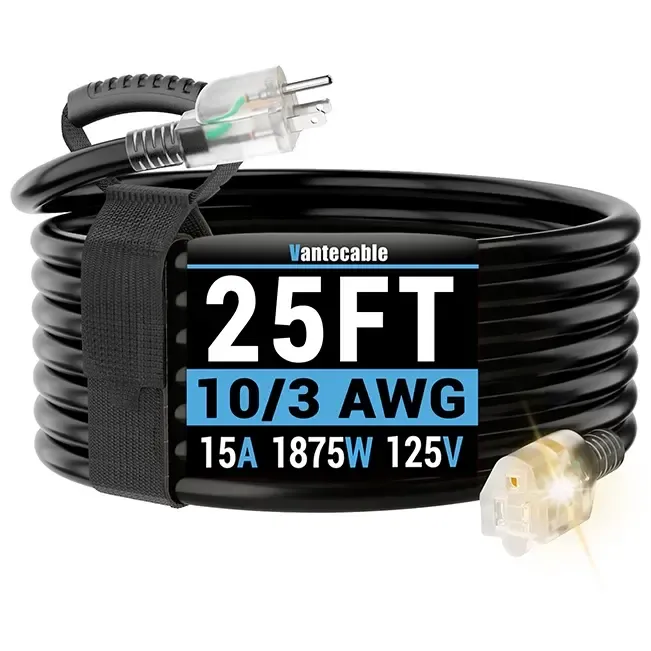
10/3 Heavy-Duty Outdoor Extension Cord
Bring power closer to compatible 120V tools and temporary lighting with 10 AWG conductors and a grounded three-prong connection. The LED lighted end shows when power has reached the working end, while the SJTW jacket supports temporary indoor and outdoor use.
10/3 AWG · 15A/125V/1,875W · SJTW · LED Lighted End · ETL Listed (Intertek)
Choose Your Cord Length →How Do You Check a Cord’s Marking and Rating Before It Goes on Site?
Read the jacket and both connector ends before assigning a cord to a run. Rate the complete assembly instead of the wire alone.
Gauge does not establish the finished cord’s amp rating by itself. The cable, plug, connector, receptacle and supply each carry a rating, and the lowest applicable rating governs the assembly.
| What to read | What it confirms |
|---|---|
| Cord type, such as SOOW | Identifies the flexible-cord family; it does not by itself approve the finished assembly for a particular run |
| Conductor size and count, such as 12/3 | Provides one input for matching the cord; compare it with the marked rating, load and connector configuration |
| Voltage and temperature markings | Shows whether the published ratings fit the circuit and expected site conditions |
| Outdoor or wet-location marking | Identifies the jacket’s exposure rating; plugs and connectors need their own suitability check |
| Connector type and configuration | Shows whether the finished cord fits both the source and load |
The weather ratings guide explains what outdoor and wet-location markings mean. If anything is unmarked or the ratings conflict, keep the cord off the site until a qualified person confirms its suitability.

10/3 SOOW Bulk Cable
Build a compatible flexible equipment lead in the length and connector configuration the project requires. The flexible stranded conductors support repeated handling, while the SOOW construction provides oil and water resistance for suitable portable-power applications.
10 AWG · 3 Conductors · 600V · 30A · 25–150 ft · ETL Listed (Intertek)
View 10/3 SOOW Cable →For a generator cord, also confirm that the connector matches the generator outlet and load end. Check the nameplate or product data for the exact length and variant. Do not apply a certification or specification from one model to a different configuration.
Before anyone plugs in, record the run ID, upstream source, cord type and length, connector at each end and zone served. A cord that is missing from the run record is not ready for site use.
How Do You Protect Cords at Walkways, Sharp Edges, Vehicle Paths and Wet Areas?
At every hazard, reroute first, lift or separate the cord where an approved method allows it, and add a protector only when a crossing cannot be avoided. Record the hazard, the corrective action and its map location.
What Do You Do Where Cords Cross Foot Traffic?
Route around the walkway first. Keep the run away from areas where equipment or materials move frequently, since rerouting removes both the trip hazard and the risk of crushing the cable.
If a crossing is unavoidable, create one deliberate crossing, mark it on the route map and install a cable protector that covers the complete crossing. Check the protector manufacturer’s instructions for its permitted loads. A protector made for foot traffic may not support carts, lifts or other wheeled equipment.
How Do You Keep Cords Out of Vehicle Lanes?
Keep temporary power equipment and cords clear of vehicle traffic. If a run enters a vehicle lane, change the route or move the feed point before considering a protective cover.
If a lift must pass near a run, move the run to the opposite side of the building or change the outlet location. Update the route map and inform the operator.
If a crossing truly cannot be removed, the site lead should approve it as an exception. Use only a protection system rated by its manufacturer for the expected vehicle type, or control vehicle movement at the crossing.
How Do You Route Cords Around Metal and Sharp Edges?
Avoid routing cords across metal decking, rails, plates or sharp framing edges. Reroute first.
When contact cannot be avoided, use a support or cable-protection method approved for that location and install it according to its instructions. OSHA requires flexible cords to be protected from damage and sharp corners and projections to be avoided.
Check every point where the jacket could bend sharply, rub or become pinched. Change the route whenever the cable could be damaged.
Where Should Connections Sit in Wet Areas?
Keep plugs, connectors and receptacles off wet ground on a stable support approved for the location. Keep slack cord clear of standing water.
Do not suspend a connection by its cord or allow cable weight to pull on the plug. Where moisture exposure cannot be avoided, use connectors and enclosures identified for that condition.
Wet connectors can leak current, a risk described in OSHA’s flexible cord guidance. Confirm that receptacles and other equipment in wet areas meet the requirements enforced by the AHJ.
How Do You Run a Pre-Shift Check and Close Out Temporary Power?
Assign one owner per shift, check every recorded run before work starts and take failed cords out of service through the same process every time.
What Should the Pre-Shift Check Cover, and Who Owns It?
Name one owner per shift, such as the site safety lead or electrician’s foreman, and assign a backup. Before work starts, walk the runs in run-record order and log the date, runs checked and problems found.
| Check | What to look for |
|---|---|
| GFCI devices | Check each device’s status and test it as its manufacturer and the site electrical safety program specify; a site using an assured equipment grounding conductor program follows that program’s test and record schedule |
| Cords and connectors | Cuts, crushed sections, exposed conductors, missing ground pins, cracked connector bodies and heat marks |
| Panels | Labels match their circuits and covers are closed |
| Route | The route matches the map; a moved cord, unrecorded run or incorrect label requires a record update |
Opening an enclosure belongs to the qualified electrician and is not part of the shift inspection.
What Do You Do With a Damaged Cord?
Stop using it, tag it, isolate it and remove it from the work area. The tag should record the date, location, defect and finder’s name.
Move the cord to a marked quarantine area or off site. A tagged cord left beside usable equipment can be picked up again. Record the run ID and replace it with a cord that has passed inspection.
A visible conductor, a cut into the inner insulation, or a damaged or overheated connector requires immediate removal. When the condition is uncertain, remove the cord from service.
Crews should not cut out the damaged area and install a new end themselves. A designated qualified person should determine whether the cord can be restored to its approved condition or must be replaced. Repeated damage at one crossing points to a routing problem that also needs correction.
Caution: Never tape, wrap or patch a cord while it is energized or in use. Disconnect it and remove it from service.
How Do You Demobilize and Hand Off Temporary Power?
Take the system down in reverse order: disconnect loads and branch cords, remove feeders, then remove the source connection. Upstream electrical work belongs to the qualified electrician.
Coil and inspect each cord as it comes in. Send damaged cords to the designated quarantine area.
Remove temporary wiring as soon as the construction or purpose it served is complete. Confirm any additional timing requirements with the AHJ. Lock off access to unfinished areas or disconnect service to areas with incomplete wiring.
Finish with a one-page handoff that records:
- Final run records
- Panel labels as left
- Locked areas and key holders
- Cords removed or quarantined
- Completion date
- Responsible signatures
Temporary Power FAQ
How Long Can You Run Temporary Power?
Temporary power may remain only while it serves the work for which it was installed. On a renovation, for example, it may remain through the construction phases it supports.
OSHA requires temporary wiring to be removed immediately when the construction or purpose it served is complete under 29 CFR 1926.405. Your permit and adopted local code may add limits, so confirm them before energizing the system.
How Much Does Temporary Power Cost?
There is no single temporary power price. A generator-fed renovation and a utility-fed temporary service use different equipment and fee structures.
A generator setup includes the generator, fuel, hookup work, cord runs and protection. A utility-fed installation may add a temporary pole or service equipment, utility connection charges, permits and inspections. Request quotes for the actual site and include every required run and protective device.
Can You Use an Extension Cord to Run Power to a Shed?
Yes, a cord rated for the equipment and conditions may supply short-term work at a shed. It cannot replace permanent wiring when the shed needs ongoing electrical service.
Conclusion: Review Your Cord Inventory and Route Plan
Plan the temporary power path once, then verify it before every shift. Compare your cord inventory and run records with the inspection checklist, and flag any run missing an upstream source, protection method or responsible owner.
Before a heavy-duty extension cord, SOOW cable assembly or generator cord goes on site, read the markings for that exact product. Confirm conductor count, complete-product rating, temperature marking, connector configuration and AHJ requirements.
Vantecable’s generator extension cords provide factory-finished configurations for compatible generator connections. Check the specification for the exact model before ordering.
Need cords for a jobsite or renovation? Send us your required voltage, amperage, connector configuration, cord type, length and project quantity. We’ll help you compare compatible Vantecable products and prepare a practical cord list for your project.
- Confirm gauge and connector type
- Compare cord options
- Request project quantities