

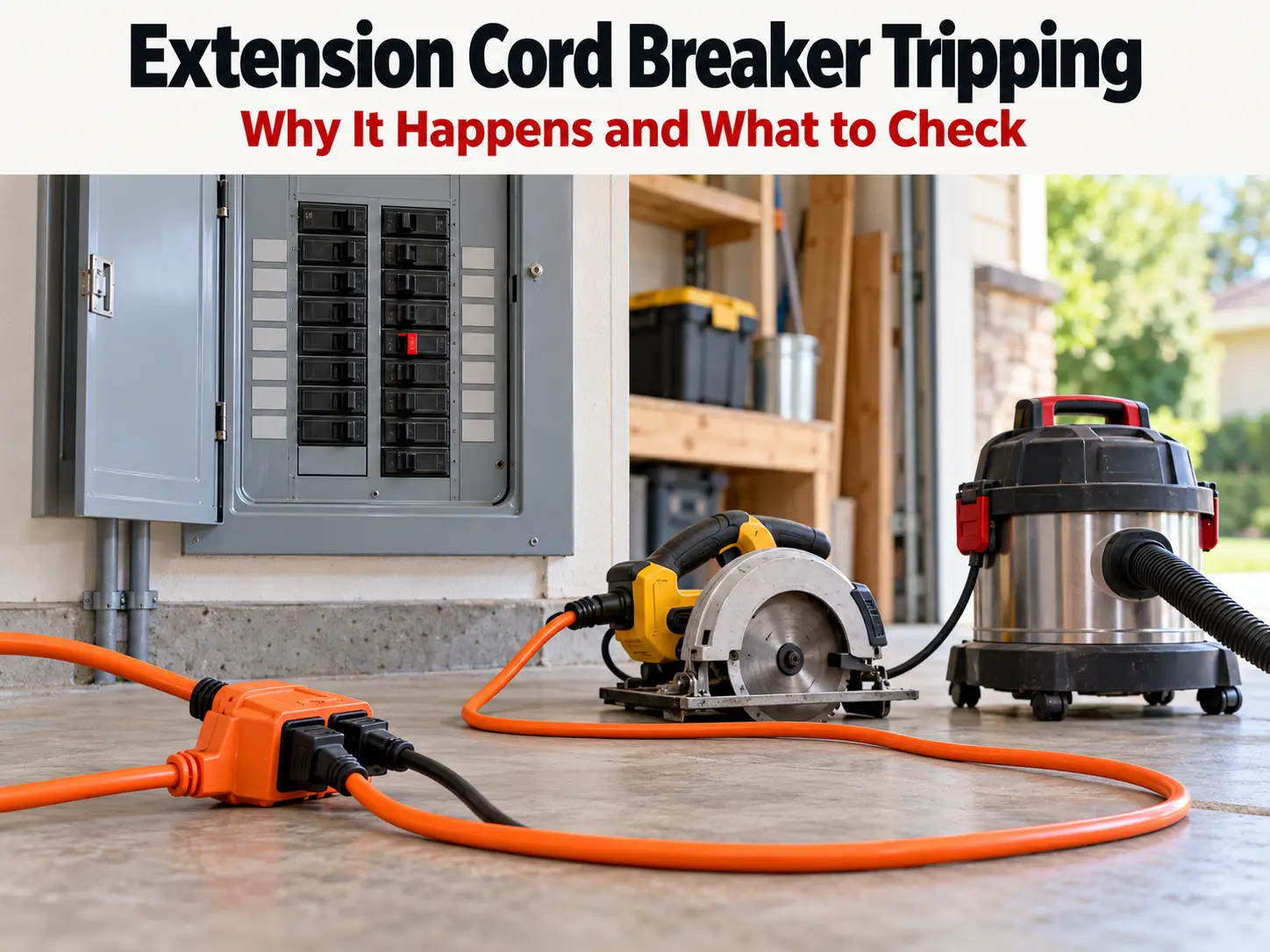
Breaker tripping when a third device is connected may indicate a circuit overload, a startup-related issue or a fault in the cord or equipment. A triple-tap cord has three connection points, but all three share the cord’s total rating. Other devices on the same circuit also count toward the circuit load.
Find the Right Outdoor Cord
Explore cord lengths, wire gauges and outlet layouts for your outdoor setup.
Is It GFCI Tripping or a Circuit Overload?
A standard circuit breaker opens when an overcurrent triggers its protective mechanism, such as during a sustained overload or short circuit. GFCI tripping is a different event: a GFCI responds to an imbalance between outgoing and returning current, and it can trip even when the connected load is small. OSHA’s GFCI guidance describes how this protection works.
Either type of protection may serve the outlet you are using, so a loss of power alone does not show which device acted or whether the cause was an overload.
The table below shows what to record when power stops, without assuming that every interruption is an overload.
| What you can confirm | What it tells you | What to record |
|---|---|---|
| A panel breaker shows a trip indication | A panel protective device operated | Its label, model and diagnostic indication |
| A GFCI receptacle shows a trip indication | GFCI protection operated | Connected equipment and downstream outlets |
| Equipment stops, but no trip is confirmed | The interruption has not been identified | Cord indicator status and equipment messages |
One GFCI can protect several downstream outlets, so the number of dead outlets does not identify which device acted.
Why Can Three Devices Cause a Circuit Overload?
How Do Three-Outlet Extension Cords Share One Rating?
Add the nameplate input current of devices that will run together. Compare that total with the cord’s rating, then include other equipment on the same circuit when checking circuit load. For motor-driven equipment, also check the manufacturer’s startup and extension-cord requirements.
Vantecable’s 12/3 and 10/3 lighted triple-tap cords are rated 15A / 125V / 1875W for the cord as a whole. That figure is the limit for all three outlets together, not for each outlet. It does not establish what a particular wall circuit can deliver, which depends on the supplying circuit and its requirements. The cord’s rating and the circuit’s capacity are separate limits, and either one can be exceeded first.
Can Devices on Other Outlets Cause Circuit Overload?
Yes. Every device on the same circuit adds to the load, even if it is not plugged into your cord. The two receptacles of a standard wall outlet commonly share one circuit, so a space heater in the other receptacle may count toward the same total. Check the circuit arrangement rather than assuming they share it.
Outlets in the same room or nearby rooms may also share that circuit. The breaker panel directory can help identify the arrangement, but it may be outdated or incomplete, so do not rely on it alone.
Assume a 120V supply and four devices with nameplate input ratings of 1,500W, 400W, 150W and 100W. This simplified example uses loads whose input watts can be added directly; for motor-driven equipment, check input current and startup requirements instead.
The three devices on the triple-tap cord use 650W combined. A 1,500W space heater plugged directly into another wall outlet on the same circuit brings the circuit’s total to 2,150W—about 17.9A at 120V.
That exceeds a 15A circuit’s rating, even though the extension cord itself is carrying only 650W. The circuit may therefore trip while the cord remains within its own rating. Moving the cord to another outlet helps only if that outlet is on a different circuit with enough available capacity.
The table below lists what to add up and where to find each figure.
| Item | Where to find it | What to do with it |
|---|---|---|
| Devices on the cord | Nameplate or manual | Add the input current of those that run together |
| Other equipment on the same circuit | Nameplate, plus the circuit arrangement | Include it in the circuit load |
| Cord rating | Marked on the cord or product page | Keep the combined cord load within it |
| Breaker rating | Marked on the breaker | Use it when checking the circuit’s load requirements |
Why Does Your Extension Cord Keep Tripping the Breaker Immediately or Later?
If the breaker trips as a device is plugged in or switched on, check the combined load, the device’s startup requirements and any signs of cord or equipment damage. OSHA’s flexible cord guidance lists common ways cords get damaged.
If the breaker trips after a few minutes, the circuit may be overloaded, another device may have switched on, or the cord or equipment may have developed a fault. Equipment that cycles automatically, such as a freezer or a sump pump, can add load after the setup has been running. Check its input rating and startup requirements in the manual.
If the cord, plug or outlet becomes unusually hot, discolored or smells like burning, stop using it. The causes of heat in a cord are covered in our guide to extension cord overheating.
Why Is Your Outdoor Outlet Tripping Even with a Small Load?
Outdoor outlet tripping can happen with a small load for two reasons: other devices may be overloading the same circuit, or moisture or damaged insulation may be triggering GFCI protection. The devices connected to your extension cord are only part of what you need to check.
First, account for other equipment on the same circuit. If a GFCI has tripped, check for moisture and damage as described below.
Could Moisture Explain GFCI Tripping Outdoors?
Yes. Water at a plug connection, inside a connector or inside a device can let current leak, and a GFCI can shut off power as a result. SJTW jacketing and an outdoor-use marking describe the cord, not the connection point, so a plug-to-receptacle connection should not be treated as watertight or safe to leave in standing water.
If a connection is wet or sitting in water, disconnect the power from a dry, safe position before touching the cord, and keep it out of use until it has been checked. See our guide to wet extension cord safety for what to do after a cord has been wet.
Can a Damaged Extension Cord Cause a Trip?
Yes. Damaged insulation can create a short circuit or ground fault that triggers the corresponding protective device, even under a light load. Loose or damaged connections can also overheat.
With power disconnected, inspect the cord and equipment leads for cuts, crushed sections, damaged connectors or scorch marks. Remove damaged equipment from service.
What Should You Check Before Reconnecting an Extension Cord?
If the combined load exceeds the cord or circuit rating, reduce it before reconnecting, for example by leaving the highest-draw device unplugged or moving it to a confirmed different circuit with sufficient available capacity. Keep wet or damaged cords disconnected. If the breaker trips again or the cause is unclear, stop using the setup and contact a qualified electrician.
Do not bypass protective devices or install a higher-rated breaker to stop the trips.
How Do You Choose a Multi-Outlet Extension Cord for Your Setup?
A multi-outlet extension cord solves where devices sit and how many connection points you need. It does not add capacity to the circuit and does not prevent trips by itself.
When Should You Choose a Lighted Triple-Tap Extension Cord?
A lighted triple-tap extension cord fits a temporary setup with three nearby connection points, provided each device allows extension-cord use and the combined load stays within the cord and circuit requirements. Choose the conductor size and cord length according to each device’s manual and the cord’s marked rating.

Vantecable 12/3 Lighted Triple-Tap Extension Cord
Three outlets with a lighted end so you can see the run has power.
12 AWG · SJTW · Three outlets · Power indicator · 15A / 125V / 1875W total · ETL Listed
From $17.63
Get the 12/3 CordThe 10/3 lighted triple-tap cord has thicker conductors than the 12/3 version, but both have the same total rating: 15A / 125V / 1875W. Choose between them based on cord length and the equipment’s wire-gauge requirements. Switching to 10/3 does not let the same circuit power more devices.

Vantecable 10/3 Lighted Triple-Tap Extension Cord
Thicker conductors for longer runs, with the same three outlets and lighted end.
10 AWG · SJTW · Three outlets · Power indicator · 15A / 125V / 1875W total · ETL Listed
From $27.99
Get the 10/3 CordThe indicator at the triple-outlet end shows that power has reached the connector; it does not check load, grounding or GFCI protection. Our lighted cord indicator meaning guide explains the light in more detail.
FAQ: Extension Cord Breaker Tripping
Will a Thicker Extension Cord Stop Breaker Tripping?
Not necessarily. A thicker cord may be appropriate for the equipment and run length, but it does not increase the supplying circuit’s capacity or repair a fault. If the breaker keeps tripping, reduce an identified overload or have the setup checked.
Can You Connect Another Splitter to a Triple-Tap Extension Cord?
Extra outlets do not add capacity. Do not chain cords or splitters to accommodate more devices; choose a suitable layout and follow the product instructions.
Is an Extension Cord Safe If the Breaker Doesn’t Trip?
Not necessarily. The cord’s rating may be lower than the breaker’s, and damage or a poor connection can still be hazardous. A breaker that has not tripped is not proof that the cord is safe.
Conclusion: What Should You Do About Extension Cord Breaker Tripping?
Treat a trip as a prompt to check, not to reset and try again. Identify what tripped, compare the combined load with the cord rating and the circuit requirements, and check for damage or moisture. If you need three nearby connection points and the load fits, a lighted triple-tap cord is one option. If the breaker keeps tripping or the cause is unclear, stop using the setup and contact a qualified electrician.
Safety note: This article describes general troubleshooting practice, not a substitute for the equipment manufacturer’s instructions or local electrical codes. Do not bypass protective devices or install a higher-rated breaker to stop a trip. If a breaker trips again or the cause is unclear, have the circuit checked by a qualified electrician.