

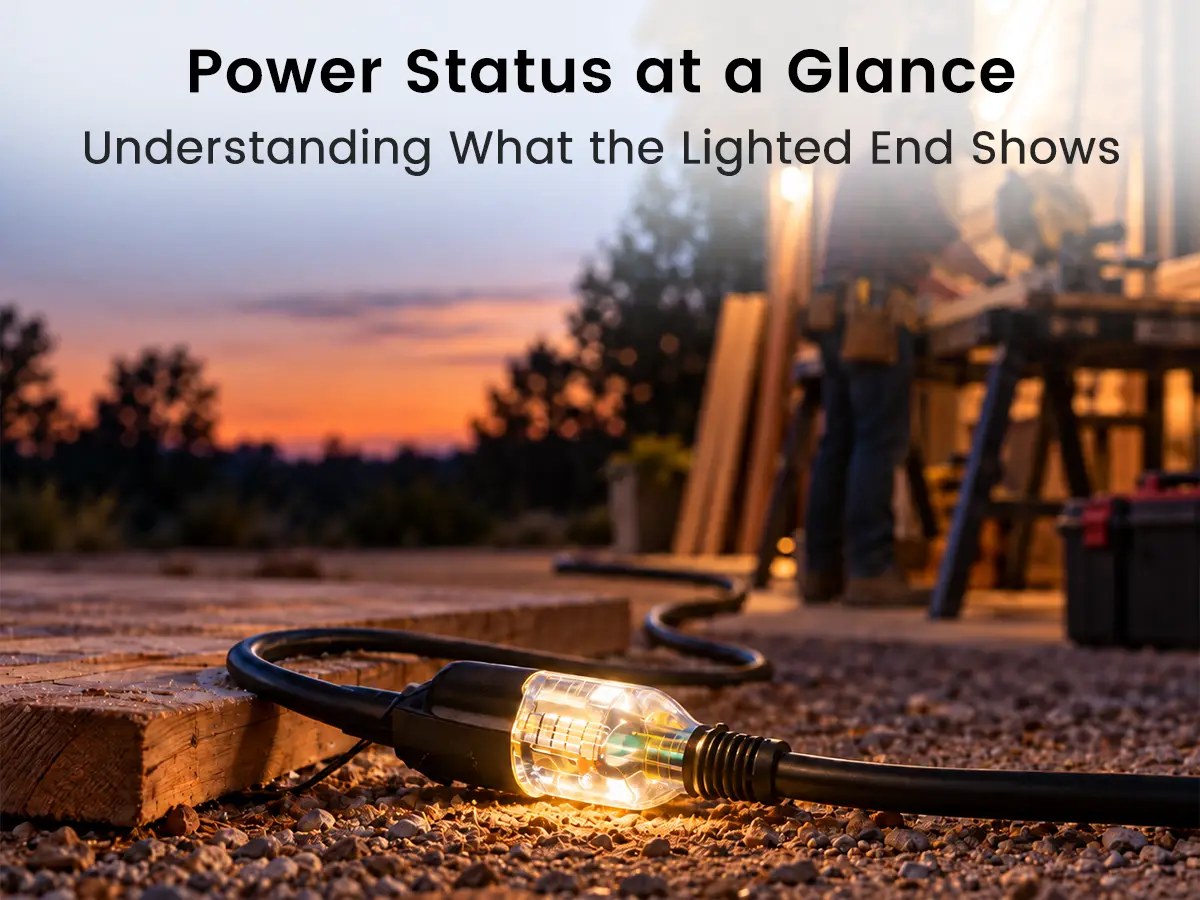
When you are working outdoors, at a jobsite or during a power outage, it is not always easy to tell whether electricity has reached the far end of an extension cord. A lighted connector provides a quick way to check the power status before troubleshooting the connected equipment.
The lighted end on a 10 AWG outdoor extension cord shows whether power has reached the connector. A steady light normally means the connector is energized. If the light is off, the outlet may have no power, the breaker or GFCI may have tripped, the plug may be loose, or the indicator may have failed. A flickering light can point to an intermittent connection that should be checked before further use. The indicator does not confirm grounding, polarity, voltage quality or whether the connected equipment is working properly. This guide explains what each light condition means, how the indicator works and what to check when the light does not behave normally.
How an Extension Cord with Lighted End Detects Power
A standard power indicator light extension cord contains a small indicator within or near its female connector. When the male plug is connected to an energized outlet and power reaches the lighted end, the indicator illuminates.
The light therefore answers one basic question: has electrical power reached this end of the cord?
That information can be useful when the source outlet is distant, behind equipment or outside the user’s direct line of sight. Instead of immediately assuming that a tool has failed, the user can first look at the cord’s indicator.
However, the indicator should not be treated as a test of the entire electrical system. A normal power light generally does not measure voltage, monitor voltage drop or determine how much current is available under load. It also does not prove that the connected tool is switched on or operating correctly.
What a Power Indicator Light Extension Cord Does Not Test
Unless the product is specifically designed and labeled with additional diagnostic functions, a standard lighted end does not verify correct outlet polarity, ground continuity, GFCI operation, available amperage, voltage level, voltage drop, the condition of the connected tool or the condition of every section of the cord. It should therefore be treated as a basic power-status indicator, not as a substitute for visual inspection, load calculation or appropriate electrical testing.
LED Extension Cord Meaning: Three Common Indicator States
A lighted connector normally has three conditions that may be noticed during use: steadily illuminated, completely off or intermittently illuminated. Each condition provides useful information, but none should be interpreted without checking the power source and physical connections.
The table below explains what these common indicator conditions usually mean and the appropriate next step.
| Indicator status | What it usually shows | Possible causes | Recommended action |
|---|---|---|---|
| Steady light | Power has reached the lighted connector | The outlet is energized and the cord is connected | Confirm the equipment rating and inspect the connection before operating the device |
| No light | Power has not reached the indicator, or the indicator is not working | Dead outlet, tripped breaker or GFCI, loose plug, damaged cord or failed indicator | Disconnect the load, check the source and inspect the cord before reuse |
| Flickering or intermittent light | Power at the connector may be intermittent | Loose connection, worn receptacle, cord damage, unstable supply or indicator failure | Stop using the cord, disconnect power and inspect the complete setup |
Steady Light on an Extension Cord with Lighted End
A steady light usually means that power from the source has reached the lighted connector. It does not necessarily mean the connected tool or appliance is operating correctly.
For example, the light may remain on when nothing is connected to the cord, when the connected tool is switched off, when the equipment has an internal fault, or when the connected equipment requires more power than the circuit or cord is designed to provide.
Before connecting equipment, compare its nameplate requirements with the voltage, amperage and wattage limits printed on the extension cord. The lowest-rated part of the setup—including the wall receptacle, plug, connector, extension cord and connected device—limits the complete system.
A steady indicator should never be interpreted as permission to exceed the cord’s labeled rating.
No Light on a Power Indicator Light Extension Cord
If the indicator does not illuminate, do not immediately conclude that the internal conductors are broken. Several conditions can produce the same result.
Begin by switching off and disconnecting the attached equipment. Unplug the extension cord and check whether the breaker or GFCI protecting the outlet has tripped. If appropriate, verify the outlet with a known working device or a suitable electrical tester.
Next, inspect the cord from end to end for loose or bent plug blades, cracks in the plug or female connector, cuts, abrasion or crushed areas in the jacket, burn marks, discoloration, exposed conductors, or connections that do not fit securely.
If the outlet is energized and the cord still supplies power but the indicator remains off, the indicator itself may have failed. That does not make the condition suitable to ignore. Follow the product instructions and discontinue use if there is any sign of damage, overheating or abnormal operation.
Do not open a molded plug or attempt to repair a damaged section with tape.
Flickering LED Extension Cord Indicator
A power indicator that repeatedly dims, flashes or changes when the plug or cable moves should not be treated as normal.
Possible causes include a plug that is not fully inserted, a worn receptacle, a loose connection, physical cord damage, an unstable power source or failure of the indicator component. The light alone cannot identify which cause is responsible.
Stop using the connected equipment and disconnect the extension cord from power. Inspect the outlet, plug blades, female connector and cable jacket. If the light changes when a connection or section of cable is moved, remove the cord from service rather than continuing to reposition it until it works.
Electrical connections should remain secure without pressure, bending or manual adjustment.
Why Use a 10 AWG Outdoor Extension Cord with Lighted End?
The lighted end adds practical visibility and basic power-status information to an outdoor extension cord. This is especially useful where the source outlet and equipment are separated by a long distance.
At a jobsite, for example, the indicator can show whether power has reached the work area before the operator begins checking the tool. During emergency generator use, it can help confirm that the cord’s remote end is energized. Around a garage, yard or campsite, it can make the connector easier to locate after dark.
A lighted connector can be particularly useful on a black cord because the cable and connector may be difficult to see in a low-light environment. However, the light only improves the visibility of the connector. It does not make the full length of the cable visible or eliminate a tripping hazard.
Cords should still be routed away from doors, walkways, vehicle paths, sharp edges and standing water. Connections should be kept secure, elevated where necessary and protected from conditions not permitted by the product instructions.
For a broader inspection and placement checklist, see these outdoor extension cord safety tips.
Common Uses for a Heavy-Duty 10 Gauge Extension Cord
A 10/3 cord contains three 10 AWG conductors. The heavier conductors can be helpful in demanding applications and over longer distances, but gauge alone does not determine whether a cord is suitable for a particular device.
The table below summarizes several practical applications for a lighted 10/3 outdoor cord and the checks that should be completed before use.
| Application | Benefit of the lighted end | What to confirm before use |
|---|---|---|
| Jobsite tools | Shows whether power has reached the work area | Tool nameplate rating, outlet protection, cord condition and total load |
| Emergency generator power | Helps confirm power at the remote connector | Generator instructions, outdoor rating, plug compatibility and connected load |
| Camping and RV accessories | Helps locate and check a connector after dark | Individual appliance rating and compatible plug type |
| Garage and outdoor projects | Simplifies checks when the outlet is distant or out of sight | Dry connections, safe cable placement and correct electrical rating |
10 AWG Extension Cord for Jobsite Tools
Jobsite equipment may be used far from the nearest permanent receptacle. A 10 AWG outdoor extension cord can provide the required reach, while the illuminated end allows the operator to confirm that power has reached the working area.
The correct cord cannot be selected from wire gauge alone. Check the tool’s voltage and amperage, the extension cord’s complete nameplate rating and the required distance. Equipment containing a motor may also draw more current during startup than during normal operation.
If a tool does not start while the indicator remains steadily illuminated, switch off and disconnect the tool before investigating. The illuminated indicator shows power at the cord end; it does not show that the tool is functional or receiving suitable voltage under load.
Power Indicator Light Extension Cord for Emergency Generators
During an outage, a lighted connector can help users identify whether generator power has reached the end of a cord supplying a compatible appliance. This is useful when cords extend between an outdoor generator and an approved operating area.
Only connect equipment in accordance with the generator manufacturer’s instructions. Check the generator output, extension cord rating, plug configuration and combined load before operation.
Never use an extension cord to feed generator power into a home through a wall receptacle. This practice can energize household wiring unexpectedly and create a serious risk for occupants and utility workers.
Portable generators also produce carbon monoxide. The U.S. Consumer Product Safety Commission advises operating them outdoors and keeping them away from doors, windows and vents. Consult the CPSC portable generator guidance before setting up emergency power.
Lighted Extension Cord for RV and Camping Accessories
A standard grounded extension cord with lighted end may be useful for compatible individual 120V accessories around a campsite, such as certain tools or temporary equipment used independently of the RV’s main shore-power connection.
It should not be presented as a substitute for a dedicated TT-30 or NEMA 14-50 RV power cord. Those systems use different connectors and are designed around specific RV electrical services.
Before powering an accessory, confirm:
- The appliance’s voltage and current requirements
- The cord’s labeled electrical rating
- Plug and receptacle compatibility
- The condition of the cord and outlet
- Protection from traffic, moisture and physical damage
If the goal is to connect the RV itself to a campground pedestal, use a dedicated RV cord matching the RV service and pedestal receptacle.
How to Choose a 10/3 Outdoor Extension Cord with LED Indicator
Start with the connected equipment rather than choosing by wire gauge alone. Check the device nameplate for voltage, amperage or wattage, then compare those requirements with the ratings printed on the cord.
The term “10/3” describes the conductor configuration: three 10 AWG conductors. It does not automatically mean that every 10/3 extension cord can be used on a 30-amp circuit. The complete cord assembly—including its plug, receptacle, jacket, length and certification—determines how it may be used.
A standard grounded cord with NEMA 5-15 connectors, for example, must be used according to the rating of that complete connector and cord assembly. It should not be described as a 30-amp extension cord merely because it contains 10 AWG conductors.
Cord length also matters. Electrical resistance increases with distance, producing greater voltage drop under load. A heavier conductor can help limit voltage drop, but users must still follow the ratings supplied for the specific product and equipment.
Before purchasing, verify:
- Required cord length
- Plug and receptacle configuration
- Maximum volts, amps and watts
- Outdoor-use jacket designation
- Certification shown for the selected product
- Operating environment
- Equipment manufacturer instructions
For more information about conductor size, see the Vantecable 10 gauge vs. 12 gauge cord guide.
Vantecable 10 AWG Outdoor Extension Cord with Lighted End
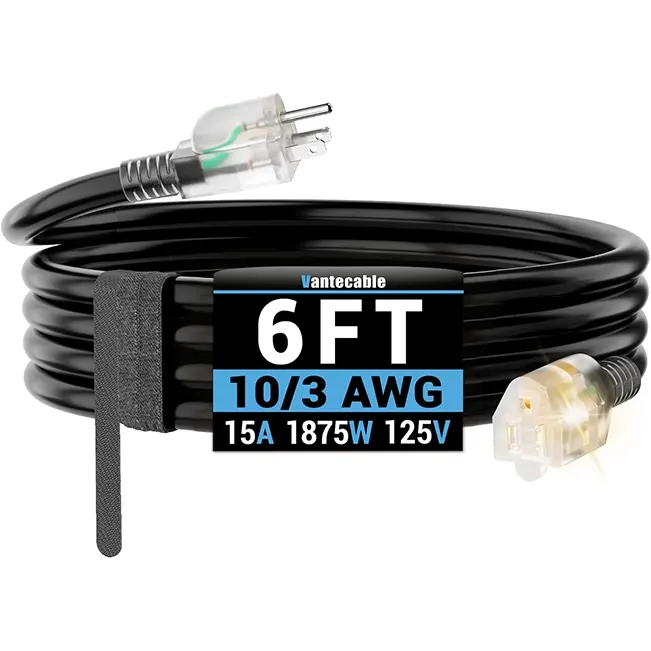
The Vantecable black 10 AWG outdoor extension cord combines a 10/3 conductor configuration with an SJTW jacket, grounded three-prong connectors and an LED lighted end. Multiple lengths are available for different outdoor, workshop and jobsite layouts.
The illuminated connector provides a quick visual indication when power reaches the working end. The black jacket provides a clean, professional appearance in garages, workshops, outdoor projects and temporary power setups.
Always select the cord according to the specifications displayed for the exact length and variant being purchased. Before use, compare the product rating with the connected equipment and inspect the plugs, connector and cable jacket.
FAQ About Extension Cords with Lighted Ends
Q1: Does a Lighted Extension Cord Show That the Appliance Is Working?
No. The indicator normally shows that power has reached the lighted connector. An appliance may still be switched off, incorrectly connected, overloaded or affected by an internal fault. Check the device separately if it does not operate.
Q2: Can an Extension Cord with Lighted End Stay Lit When Nothing Is Connected?
Yes. The light is designed to indicate that the cord’s connector is energized. It can remain illuminated even when no tool or appliance is connected.
Q3: Does a Power Indicator Light Extension Cord Confirm Grounding?
A standard single power indicator generally does not confirm ground continuity or correct polarity. Only a product specifically designed and labeled with a ground-monitoring or diagnostic function should be used for that purpose.
Q4: Why Is the LED Extension Cord Indicator Off If the Cord Still Supplies Power?
The indicator component may have failed even though the conductors are still supplying power. Disconnect and inspect the cord and consult its product instructions. Do not continue using it if there is heat, discoloration, a loose connection or any other sign of damage.
Q5: Can a 10 AWG Outdoor Extension Cord Be Left Outside Permanently?
An outdoor-use rating does not automatically make an extension cord suitable for permanent outdoor wiring. Extension cords are generally intended for temporary power. Disconnect the cord when it is no longer needed and store it clean, dry and loosely coiled according to the manufacturer’s instructions.
Conclusion: Understanding Your 10 AWG Lighted Extension Cord
A steady light on a 10 AWG outdoor extension cord usually means power has reached the illuminated connector. No light may indicate a dead outlet, tripped circuit protection, loose connection, damaged cord or failed indicator. A flickering light may indicate an intermittent condition and should be investigated before the cord is used again.
The LED makes power status easier to check, particularly at night or when the outlet is far from the work area. It does not replace correct cord selection, physical inspection, GFCI protection or compliance with the ratings printed on the product.
Choose the required length and connector configuration from Vantecable’s 10 gauge extension cord collection, then confirm that the selected product matches the equipment and operating environment.