

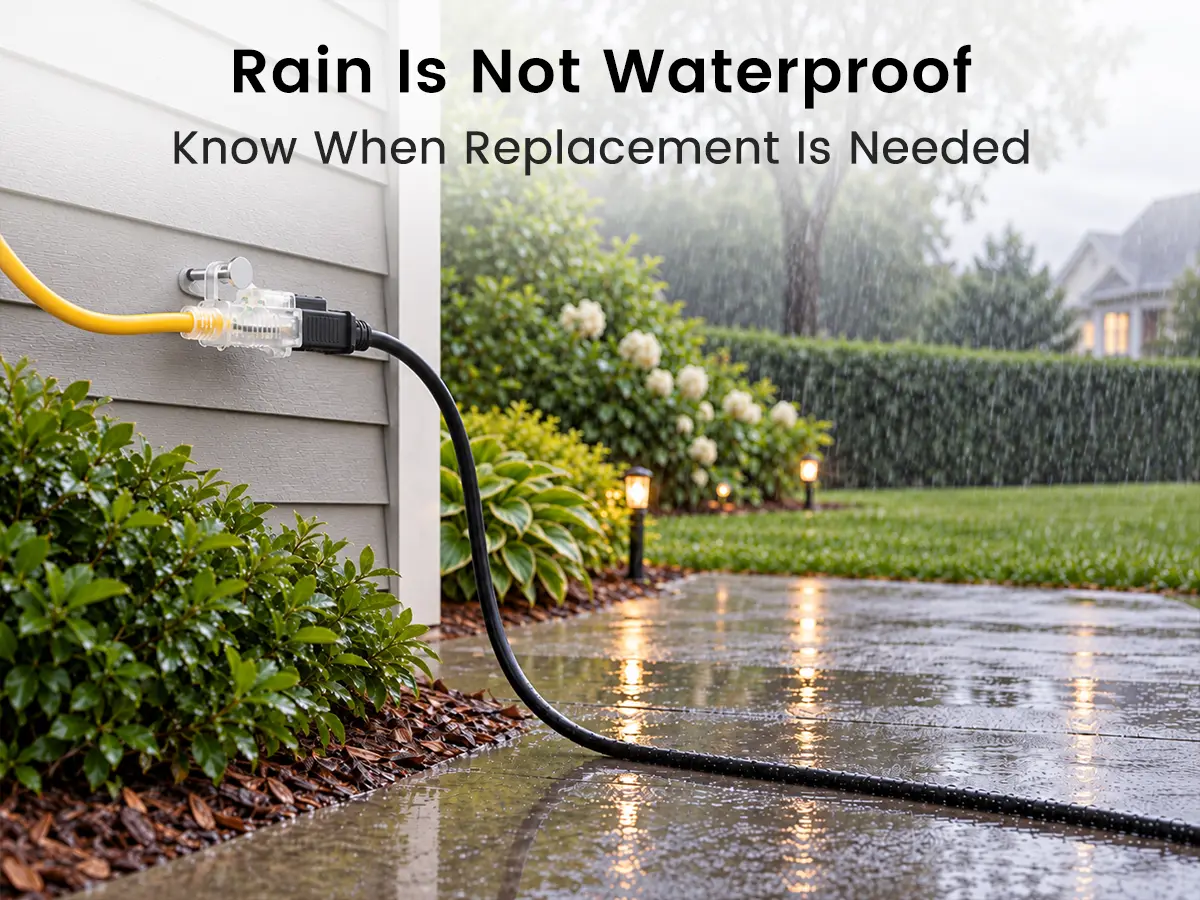
An outdoor-rated extension cord may tolerate limited rain exposure, but its plug connections should never sit in water. Can extension cords get wet and still be safe to use? Only within limits: a cord that is energized, submerged, or exposed to floodwater should have its upstream power shut off before anyone approaches it, and the cord should be removed from service until it can be properly evaluated. Being rated for outdoor use is not the same as being waterproof, and the distinction matters most in the minutes right after a cord gets wet, not before.
What to Do When an Extension Cord Gets Wet
The response matters more than the diagnosis in the first few minutes. If a wet extension cord is involved, work through these steps in order:
- Do not touch a wet connector or any cable lying in standing water.
- Shut off the upstream power source from a dry, safe location—at the breaker, the generator, or the outlet it feeds from.
- Only unplug the cord and any connected equipment after the power is confirmed off.
- Determine where the water reached: only the intact outer jacket, the plug or receptacle contacts, or whether any part of the cord was submerged.
- If there is any sign of water intrusion or physical damage, stop using the cord until it has been inspected.
OSHA’s guidance on flexible cords warns that moisture entering a cord connector can create a leakage path and increase the risk of electric shock. That risk is why the sequence above starts with staying away from the connector rather than inspecting it first.
Extension Cord in Rain vs. Submerged in Water
Not every wet cord carries the same risk, and treating light rain exposure the same way as a flood soak either wastes a usable cord or keeps an unsafe one in service. The table below compares surface rain exposure, connector water entry, and floodwater submersion, so a straightforward decision can be made about whether the cord goes back into use, needs inspection, or should be replaced.
| Situation | Recommended Action |
|---|---|
| Rain on the intact jacket only; plugs and receptacles remained dry | Disconnect power, dry the cord, and inspect the full length before reuse |
| Water entered a plug or receptacle | Remove the cord from service; do not reconnect it based only on its outward appearance |
| A connector or cord was submerged in standing water or floodwater | Replace the cord rather than relying on surface drying |
An extension cord in rain with its jacket intact and its connectors dry is a different situation from an extension cord submerged in water, even if both cords look the same once they dry off. For a detailed explanation of weather-resistant jackets and outdoor cord markings, see our weather ratings guide.
When to Replace a Wet Extension Cord
Knowing when to replace a wet extension cord comes down to what the water reached, not how the cord looks afterward. A cord or connector that was submerged, or that came into contact with floodwater, should be replaced rather than dried and reconnected, since floodwater often carries contaminants and debris that a visual check will not catch. The same applies to a flood-damaged extension cord with corroded or discolored plug pins, or a jacket that has cracked, swollen, or become stiff—these conditions may compromise the cord’s insulation or electrical connections.
A lighted-end cord that shows condensation inside the indicator housing has taken on moisture at a point that is difficult to dry completely and should not go back into service on the assumption that the light still works. If the upstream GFCI or circuit breaker trips repeatedly when the cord is connected, disconnect the cord and check the receptacle, cord, connected equipment, and surrounding moisture before restoring power. The cause could be any one of those, not the cord by default.
A cord that produces a burning smell, visible scorch marks, or unusual heat after the moisture issue has otherwise been resolved should be pulled from service immediately—those symptoms point to a different failure mode. If the cord becomes unusually warm after the moisture issue is resolved, stop using it and review the possible causes in our overheating guide; the mechanics of undersized wire gauge and voltage drop are covered there rather than repeated here.
How to Prevent Extension Cord Water Damage
Most water-related cord failures trace back to a handful of avoidable habits rather than a single bad storm. Using a cord rated for outdoor conditions, keeping plug and connector points raised off the ground and away from standing water, and checking the jacket and connectors before and after heavy rain can reduce the risk of water intrusion and electrical faults.
Running the circuit through GFCI protection where available adds a layer of protection against shock, though it does not replace proper cord care or keeping connections out of water. An indoor-rated cord should not be pressed into outdoor service just because it is the one within reach. If you are unsure whether a cord is suitable for outdoor conditions, our indoor cord guide walks through what separates the two.
Outdoor Cord Options for Wet-Weather Preparation
Choosing an ETL Listed extension cord for outdoor use is the right starting point for planned outdoor power. An outdoor rating helps the cord withstand specified environmental exposure, but it does not make the plug connection submersible or safe in standing water—every connection along its length still needs to stay out of water regardless of the cord’s rating.
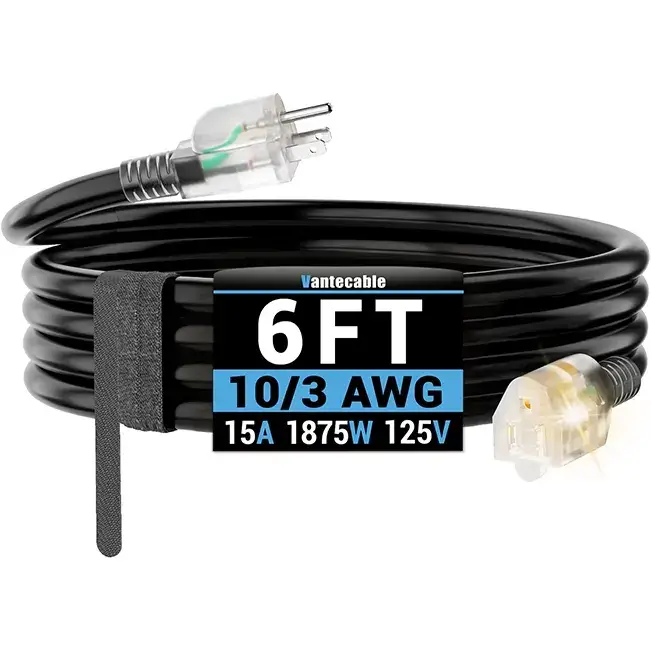
10/3 Heavy Duty Lighted Extension Cord
10/3 AWG · SJTW · 15A / 125V / 1,875W · Lighted plug · ETL Listed · Not for submerged use
Shop 10/3 Cord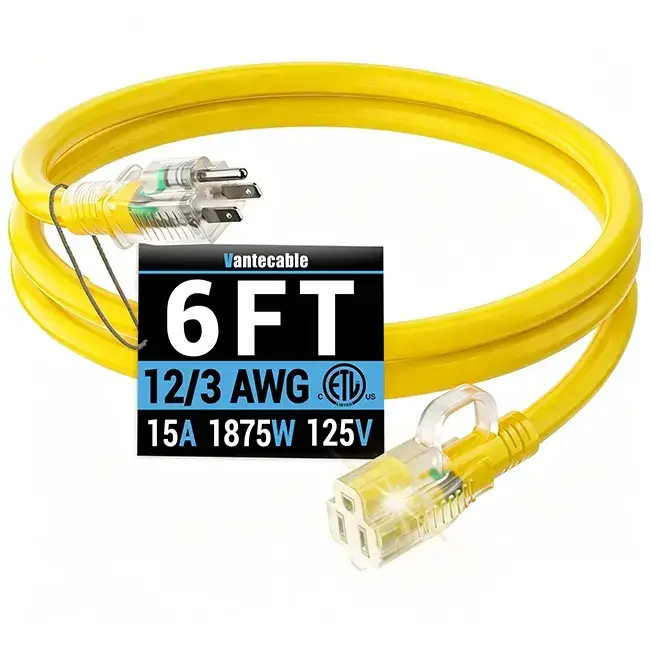
12/3 Heavy Duty Lighted Extension Cord
12/3 AWG · SJTW · 15A / 125V / 1,875W · Lighted plug · ETL Listed · Not for submerged use
Shop 12/3 CordFAQ
Can I use an extension cord after it has dried?
It depends on what got wet. A cord that only had surface rain contact on an intact jacket may be considered for reuse after it is de-energized, fully dry, carefully inspected, and confirmed acceptable under the manufacturer’s instructions. A cord whose plug, receptacle, or any other part was submerged should not be assumed safe just because it looks and feels dry—internal corrosion and contamination are not always visible from the outside.
What should I do if the GFCI or breaker trips when I connect the cord?
Leave the power off, disconnect the cord and connected equipment, and check each part in turn—the receptacle, the cord, the equipment, and any surrounding moisture—before restoring power. Repeated tripping without an obvious cause is a reason to have the circuit evaluated rather than keep resetting it.
How can I tell whether water entered a lighted connector?
Look for condensation or fogging inside the clear housing around the indicator light, discoloration at the base of the pins, or a light that flickers or behaves inconsistently. Any of these may indicate moisture inside the connector rather than just on its surface.
Can I wrap an outdoor connection in a plastic bag?
A plastic bag is not a reliable weatherproof enclosure and may trap condensation around the connection. Keep the connection elevated and use a cover or enclosure specifically designed and rated for the application.
Does a lighted connector mean a wet extension cord is safe to use?
No. A lighted connector only indicates that electrical power is reaching that end of the cord. It does not confirm that the connector is dry, undamaged, or protected by a GFCI. If moisture is visible inside the housing or the light flickers, disconnect the cord and remove it from service.
Conclusion
Surface rain on an intact jacket is different from water entering a connector or submerging the cord in floodwater. Shut off power before approaching a wet cord, inspect every connection rather than the jacket alone, and replace the cord when water entry or damage cannot be ruled out. Browse our emergency power cords for planned outdoor and backup-power applications.