

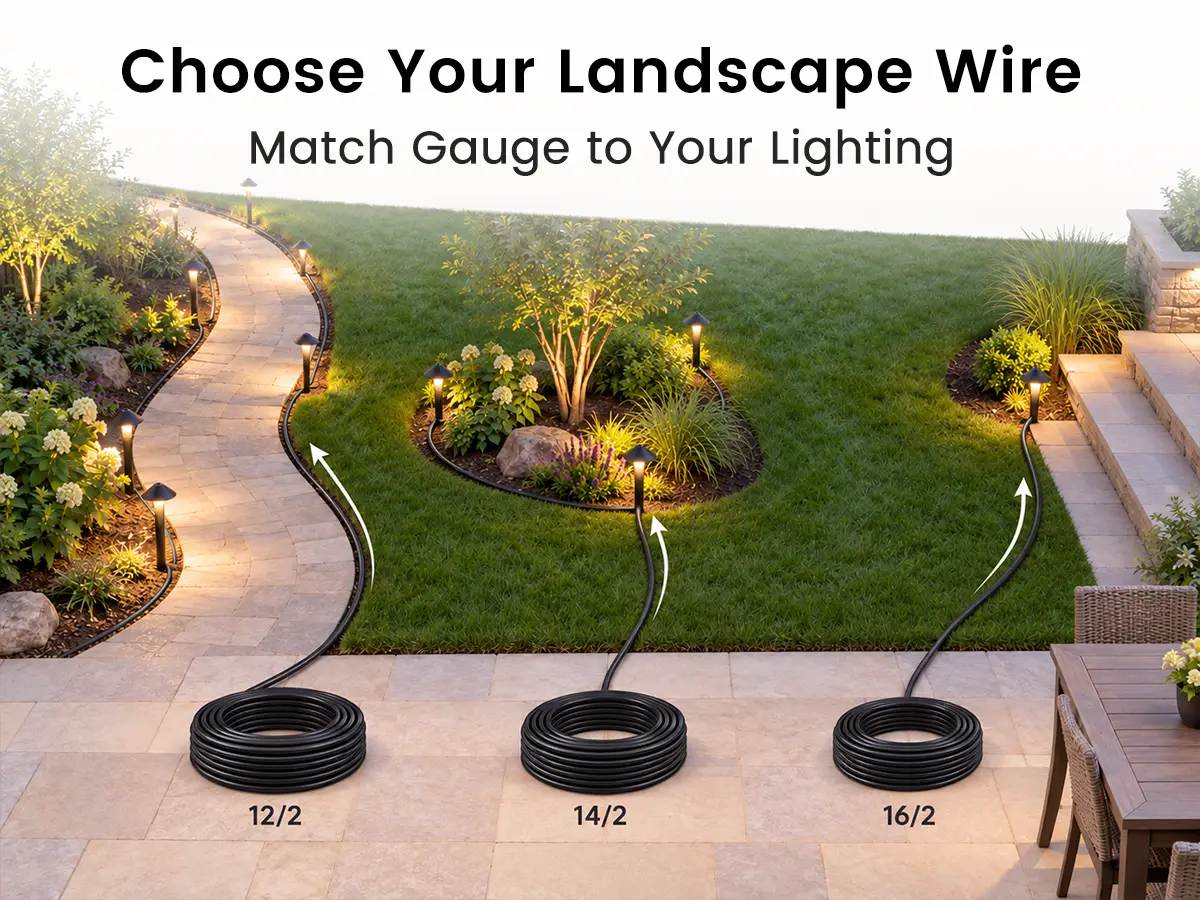
What gauge wire for landscape lighting should you choose? For most low-voltage projects, the practical options are 16/2 for shorter, lighter runs, 14/2 when 16/2 creates too much voltage drop, and 12/2 for longer or more heavily loaded runs. The right choice depends on the total wattage on one cable run, the measured route from the transformer to the last fixture, and the allowable voltage drop—not yard size alone.
This guide compares 12/2, 14/2 and 16/2 landscape wire, explains when each size is worth buying, and gives you a direct way to confirm the choice before installation. In these labels, 12, 14 and 16 identify the AWG size; “2” means the cable has two conductors.
What Gauge Wire for Landscape Lighting? Quick Answer
For a compact lighting zone with a short cable route and a few low-wattage fixtures, start by checking 16/2. Choose 14/2 for a main run serving more fixtures or extending across a larger planting bed. Use 12/2 for the longest run, the most heavily loaded branch or a remote group of lights where voltage drop is the main concern. Confirm the final choice with the total fixture wattage and the measured cable route.
Remember that a lower AWG number means a thicker conductor. Therefore, 12/2 is thicker than 14/2, and 14/2 is thicker than 16/2.
Landscape Lighting Wire Size Chart: 12/2 vs 14/2 vs 16/2
This chart separates the three options by electrical difference, typical layout and installation tradeoff. The examples describe where each size is commonly worth considering; the final gauge still depends on the completed run.
| Wire size | Approx. copper resistance | Typical landscape-lighting layout | Installation and buying tradeoff |
|---|---|---|---|
| 16/2 | 4.0 ohms per 1,000 ft | A compact zone with a few LED path lights and a short route from the transformer | Thinner and easier to route; buy it when the layout does not need the lower resistance of 14/2 |
| 14/2 | 2.5 ohms per 1,000 ft | A main run feeding several path or accent lights across one larger zone | Reduces resistance by about 37% versus 16/2 without the additional thickness of 12/2 |
| 12/2 | 1.68 ohms per 1,000 ft | A long feeder, a remote lighting zone or the branch carrying the highest total wattage | Lowest resistance of these three, but uses more material and is less flexible to route |
These percentages come from the approximate copper-wire resistance values in the NIST Copper Wire Tables: 16 AWG at about 4 ohms per 1,000 feet, 14 AWG at about 2.5, and 12 AWG at about 1.68. Actual voltage drop also depends on current and total circuit length, so resistance alone does not determine the final wire size.
14 vs 16 Gauge Landscape Wire: Which Should You Buy?
The useful difference between 14 and 16 gauge landscape wire appears at the far end of the run. With the same route and fixture load, 14/2 has about 37% less conductor resistance, so it delivers more of the transformer voltage to the last fixtures.
Buy 16/2 for a Small, Fixed Lighting Zone
Consider 16/2 for a transformer located near a compact bed or walkway, with only a few low-wattage path lights on that branch. It is also the practical choice when the route is final, no additional fixtures are planned and the voltage-drop calculation confirms that 16/2 is sufficient. The first light being close to the transformer is not enough reason to buy 16/2. Measure through to the last light and include every fixture on the branch. A short lead followed by a long row of lights is not a short run.
Buy 14/2 for a Larger Zone or a Longer Row of Fixtures
Consider 14/2 when one cable continues across a larger planting bed, feeds several path and accent lights, or ends at a fixture noticeably farther from the transformer than the first group. Its lower resistance is useful on a main run that carries more wattage before individual fixtures branch off. If both gauges meet the target for the completed layout, 16/2 is the more economical purchase. If 16/2 exceeds the target but 14/2 meets it, the lower resistance of 14/2 has a clear purpose.
12 vs 14 Gauge Landscape Wire: When Is 12/2 Worth It?
12/2 is worth buying for the main feeder to a remote lighting zone, the longest branch in the layout or the run carrying the highest combined fixture wattage. Its resistance is about 36% lower than 14/2, which can solve a voltage-drop problem that 14/2 cannot. For a moderate run where 14/2 already delivers the required voltage, the thicker 12/2 adds cost and is less convenient to route without improving the buying decision.
For exact 12/2 distance and load examples, see our 12 Gauge Landscape Wire purchase guide. That dedicated guide handles the detailed 12 AWG calculations so this comparison can stay focused on the purchase decision.
Shop 12/2, 14/2 and 16/2 Landscape Lighting Wire
Not sure which gauge fits? Use the size chart and comparisons above before choosing a product. Select the gauge first, then choose a length that covers the measured route with suitable installation allowance. Shop Vantecable’s pure-copper wire during the Fall Backyard Wire Refresh and save up to 65% on eligible products.

16/2 Pure Copper Landscape Wire
100-200 ft · 16/2 AWG · 99.9% Copper · 12V/24V DC · ETL Listed · Direct burial
From $29.99
View 16/2 Wire
14/2 Pure Copper Landscape Wire
100-200 ft · 14/2 AWG · 99.9% Copper · 12V/24V DC · ETL Listed · Direct burial
From $43.99
View 14/2 Wire
12/2 Pure Copper Landscape Wire, 250 ft
250 ft · 12/2 AWG · 99.9% Copper · 12V/24V DC · ETL Listed · Direct burial
From $49.99
View 12/2 WireYou can also compare available lengths in the Vantecable electrical wire collection.
How to Confirm Your Landscape Lighting Wire Gauge
Before ordering, list every fixture assigned to one run and add their rated wattages. Measure the intended cable path from the transformer to the last fixture, including turns and routing around hardscape. Then calculate voltage drop separately for 16/2, 14/2 and 12/2 until you find the smallest size that meets your chosen target.
Use the WAC voltage-drop calculator to compare the three gauges before ordering. Its guidance also recommends checking the actual voltage at each fixture before the wire is buried and the installation is finalized.
After selecting the gauge, confirm that the transformer, fixtures and connectors are compatible with the wire size and installation environment. A correct conductor size does not compensate for a loose, corroded or mismatched connection.
If no single run meets the target even with 12/2, revise the layout instead of treating thicker wire as the only answer. Dividing the fixtures into two shorter runs reduces the load and route length each cable must carry. Recalculate both runs before buying wire.
Landscape Lighting Wire Gauge FAQ
Can I Mix 12/2 and 14/2 Landscape Wire on One System?
Different wire gauges can serve separate runs from the same compatible transformer, provided each run is calculated and connected correctly. Avoid changing gauge partway through a run simply to use leftover cable. It complicates planning and does not remove the need to size the entire circuit for its load, route and connections. For buried splices, see the guide to landscape wire connectors.
Do I Need 12 Gauge Wire for Landscape Lighting?
Not automatically. You need 12/2 when a calculation shows that 14/2 would create more voltage drop than your project allows and 12/2 meets the target. For a shorter, lighter run, 14/2 or 16/2 may be the more economical purchase.
Does Thicker Landscape Wire Let Me Add More Lights?
Thicker wire can reduce voltage drop, but it does not increase the transformer’s rated capacity. Add future fixtures to the planned wattage total, confirm the transformer has capacity, and recalculate the run before choosing the wire gauge.
Conclusion: Choose the Best Gauge Wire for Landscape Lighting
To decide what gauge wire for landscape lighting to buy, calculate the finished load and measured route first. Choose 16/2 when it meets the target, 14/2 when 16/2 fails but 14/2 passes, and 12/2 when 14/2 fails but 12/2 passes. If 12/2 still misses the target, split the circuit into shorter runs and calculate again.
This approach keeps the purchase tied to the actual installation. It avoids paying for unnecessary conductor size while reducing the risk of choosing a cable that is too small for the planned run.
Shop Vantecable’s pure-copper wire during the Fall Backyard Wire Refresh and save up to 65% on eligible products.