

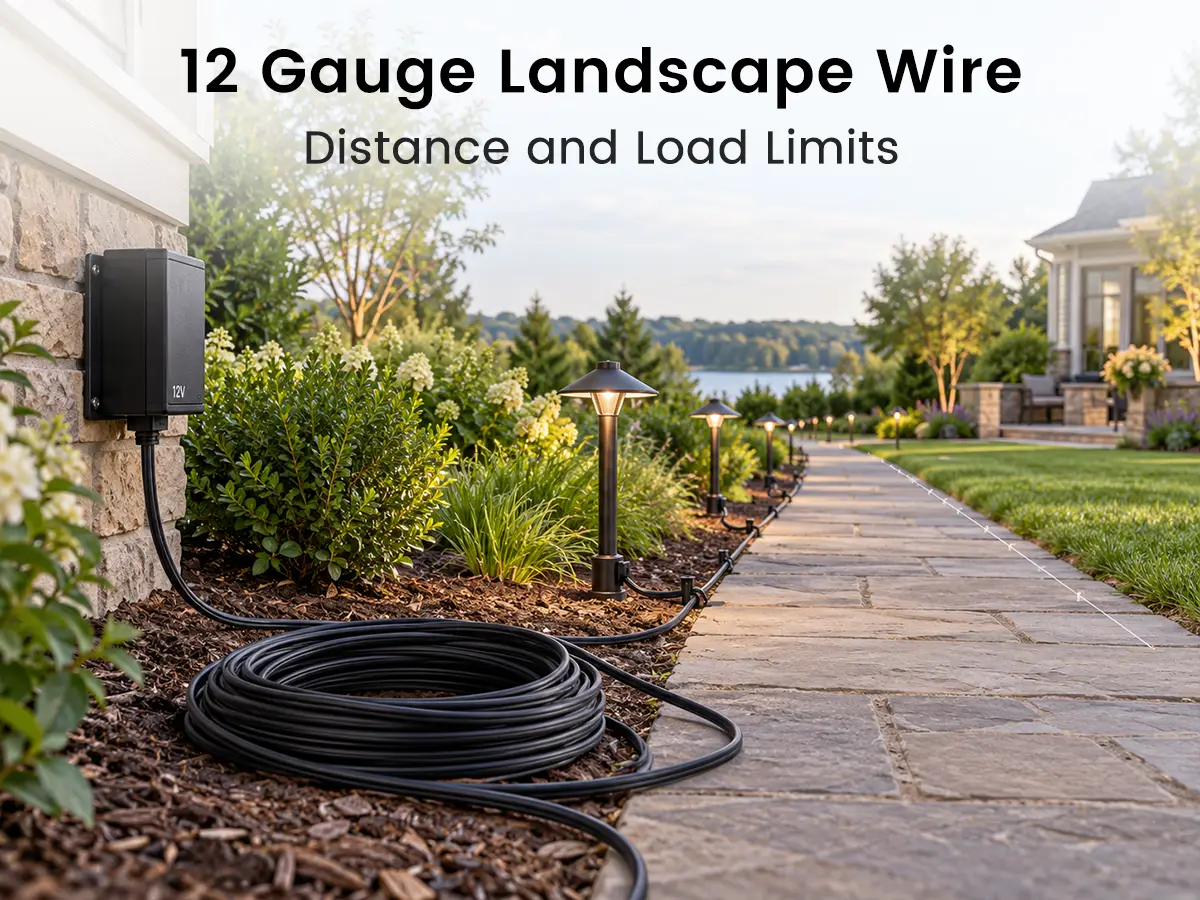
12 gauge landscape wire does not have one fixed distance limit. A small front walkway with six path lights may work easily on a short run, while twenty lights stretching toward a back fence can push the same 12/2 landscape wire beyond a practical voltage-drop range.
The difference is not the wire gauge alone. It is the combination of total fixture wattage and one-way distance. This guide uses 12/2 pure copper wire examples to show how far a run can go, how many lights it can support, and when a layout should be split.
Shop Low Voltage Landscape Wire
Compare Vantecable 12/2, 14/2 and 16/2 pure copper wire for paths, gardens and outdoor accent lighting.
12 Gauge Landscape Wire Distance Chart: Maximum Run by Wattage
The usable distance of 12 gauge low voltage wire changes with load. Every additional foot adds resistance, while a higher-wattage group draws more current through the same conductors.
The table below lists estimated one-way distances for 12/2 landscape wire at common 12V loads. It uses copper conductors, a round-trip resistance of approximately 0.0336 ohm per 10 feet, and the full load at the end of the run. The Syston voltage-drop table provides the underlying 12 AWG resistance data.
| Total load | Current at 12V | Run at 5% drop | Run at 10% drop | 5W fixtures | 10W fixtures* |
|---|---|---|---|---|---|
| 25W | 2.08A | 85 ft | 171 ft | 5 | 2 |
| 50W | 4.17A | 42 ft | 85 ft | 10 | 5 |
| 75W | 6.25A | 28 ft | 57 ft | 15 | 7 |
| 100W | 8.33A | 21 ft | 42 ft | 20 | 10 |
| 150W | 12.50A | 14 ft | 28 ft | 30 | 15 |
| 200W | 16.67A | 10 ft | 21 ft | 40 | 20 |
Calculation note: The 5% and 10% values are voltage-drop planning references, not electrical-code limits or product ratings. Fixture counts are wattage conversions only and do not establish cable or transformer capacity; the 10W column is rounded down. Use the voltage range and installation instructions published by the fixture and transformer manufacturers.
At 25W, the calculated 5% distance is about 85 feet. At 100W, it falls to about 21 feet. The Southwire calculator can also show how voltage, current, conductor size and distance affect a planned circuit. If you still need to choose between 12/2, 14/2 and 16/2, start with our wire gauge guide.
Will 12/2 Landscape Wire Work for Your Yard?
The table below applies the same model to front walkways, side yards, driveways and back-fence lighting.
| Your project | Load and distance | 12/2 answer | Next step |
|---|---|---|---|
| Front walkway | Six 5W path lights, 40 ft | ✅ Works—about 2.8% | Keep it as one direct 30W run |
| Side yard | Eight 5W lights, 60 ft | ⚠️ Near 5%—about 5.6% | Confirm the fixture voltage range before setting the route |
| Driveway edge | Ten 5W lights, 100 ft | ⚠️ High—about 11.7% | Shorten the route or divide the lighting area |
| Backyard trees | Twelve 5W uplights, 100 ft | ❌ Too high—about 14.0% | Use shorter separate runs instead of one long route |
| Back-fence accents | Twenty 5W lights, 100 ft | ❌ Too high—about 23.3% | Redesign the layout before burying the wire |
Six 5W path lights on a 40-foot walkway create a 30W load; twenty 5W lights at the back fence create 100W. More wire on the spool does not make one heavily loaded run perform like a short one.
How to Check Your 12/2 Landscape Wire Run
You only need two numbers before checking a 12/2 landscape wire layout: the total wattage connected to that cable and the one-way distance from the transformer to the farthest fixture.
Add the Total 12/2 Landscape Wire Load
Add the wattage of every fixture connected to the same run. Eight 5W path lights create a 40W load. Four 5W lights plus two 8W spotlights create a 36W load. Use the fixtures connected to that cable rather than the transformer’s full wattage rating. A 200W transformer supplying eight 5W lights still places a 40W fixture load on that individual run.
When one transformer supplies separate front-yard and backyard cables, calculate each run independently because their loads and distances are different.
Measure the One-Way 12 Gauge Wire Distance
Measure the planned route from the transformer to the farthest fixture. The chart already accounts for both conductors in the 12/2 landscape wire, so a 100-foot route remains 100 feet in the calculation.
A 50W load at 50 feet produces about 5.8% calculated drop. At 100 feet, the same load produces about 11.7%. Only the distance changed. For a run-specific estimate, use our gauge calculator.
Why 12V Landscape Lighting Has More Voltage Drop
Low-voltage landscape lighting is more sensitive to distance because the same power requires more current at a lower voltage.
A 100W load draws about 0.83A at 120V but about 8.33A at 12V. The higher current in a 12V system makes the resistance of a long 12 gauge landscape lighting wire run more noticeable, so a greater share of the available voltage can be lost before power reaches the farthest fixture.
This is why a simple yard layout still needs distance planning. When voltage drop becomes too large, the lights at the end are usually the first to appear dimmer.
When to Split a 12/2 Landscape Wire Run
Split a planned run when one cable must cross several distant lighting areas or when its load and distance exceed the selected range in the chart.
Consider a 30W front walkway 40 feet from the transformer and a 40W backyard zone 60 feet away in another direction. They calculate to about 2.8% and 5.6%. Keeping them as separate runs avoids forcing both areas onto one longer route.
For a driveway, ten 5W lights over 100 feet create a 50W load and about 11.7% calculated drop. If the layout permits two 25W runs of about 50 feet, each calculates to roughly 2.9%. The same fixtures remain, but power no longer travels through one loaded 100-foot route.
For back-fence spotlights, 100W at 100 feet calculates to about 23.3%. Dividing the load without shortening the distance still leaves long runs, so moving the transformer closer or using a more central location may be more effective.
Splitting helps when the project contains separate yard zones, one route is much longer than the others, or the end load pushes the result beyond the selected range. The objective is to reduce the load, distance or both on each cable.
Choose 12/2 Landscape Wire for Your Project
Once the run fits the chart, check that the cable itself matches the planned installation. Vantecable’s 12 gauge low voltage landscape wire uses two 12 AWG conductors made from 99.9% copper. It is described for outdoor low-voltage lighting, with an outdoor-resistant jacket, direct-burial approval and an ETL Listed marking.
Shop Vantecable’s pure-copper wire during the Fall Backyard Wire Refresh and save up to 65% on eligible products.

12/2 Pure Copper Landscape Wire, 100ft/250 ft
250 ft · 12/2 AWG · 99.9% Copper · 12V/24V DC · ETL Listed · Direct burial
From $49.99
View 12/2 Landscape WireFor shorter or lighter layouts, compare the 14/2 wire and 16/2 wire, then calculate the selected gauge with the actual load and distance.
12 Gauge Landscape Wire FAQ
How Far Can You Run 12 Gauge Landscape Wire?
There is no single maximum distance for 12 gauge landscape wire. At 12V, the model in this guide gives a 5% planning distance of about 85 feet at 25W, 42 feet at 50W and 21 feet at 100W. The usable distance therefore depends on the fixture load as well as the one-way cable length.
How Many Lights Can I Run on 12/2 Landscape Wire?
Start with the wattage of each light rather than the fixture count alone. Ten 5W lights and five 10W lights both create a 50W load, but whether either group works depends on the distance to the farthest fixture. Under this model, a 50W load reaches about 42 feet at 5% calculated drop or 85 feet at 10%.
Does 12/2 Landscape Wire Mean 12 Amps?
No. In 12/2 landscape wire, “12” identifies the 12 AWG conductor size and “2” identifies the two conductors inside the cable. It does not mean the wire has a 12A rating. The actual current on a 12V lighting run is determined by the connected wattage; for example, a 60W load draws about 5A.
Conclusion: Planning a 12 Gauge Low Voltage Landscape Wire Run
Choosing 12 gauge landscape wire starts with the total fixture wattage on one cable and the one-way distance to its farthest light. Use the chart to check that combination, then shorten or divide a layout when one long run produces too much calculated voltage drop.
After the routes are planned, select enough 12/2 landscape wire to cover the verified runs rather than treating the full spool as one circuit. Final installation decisions must follow the exact wire, transformer and fixture instructions and all applicable local requirements.
Shop Vantecable’s pure-copper wire during the Fall Backyard Wire Refresh and save up to 65% on eligible products.