

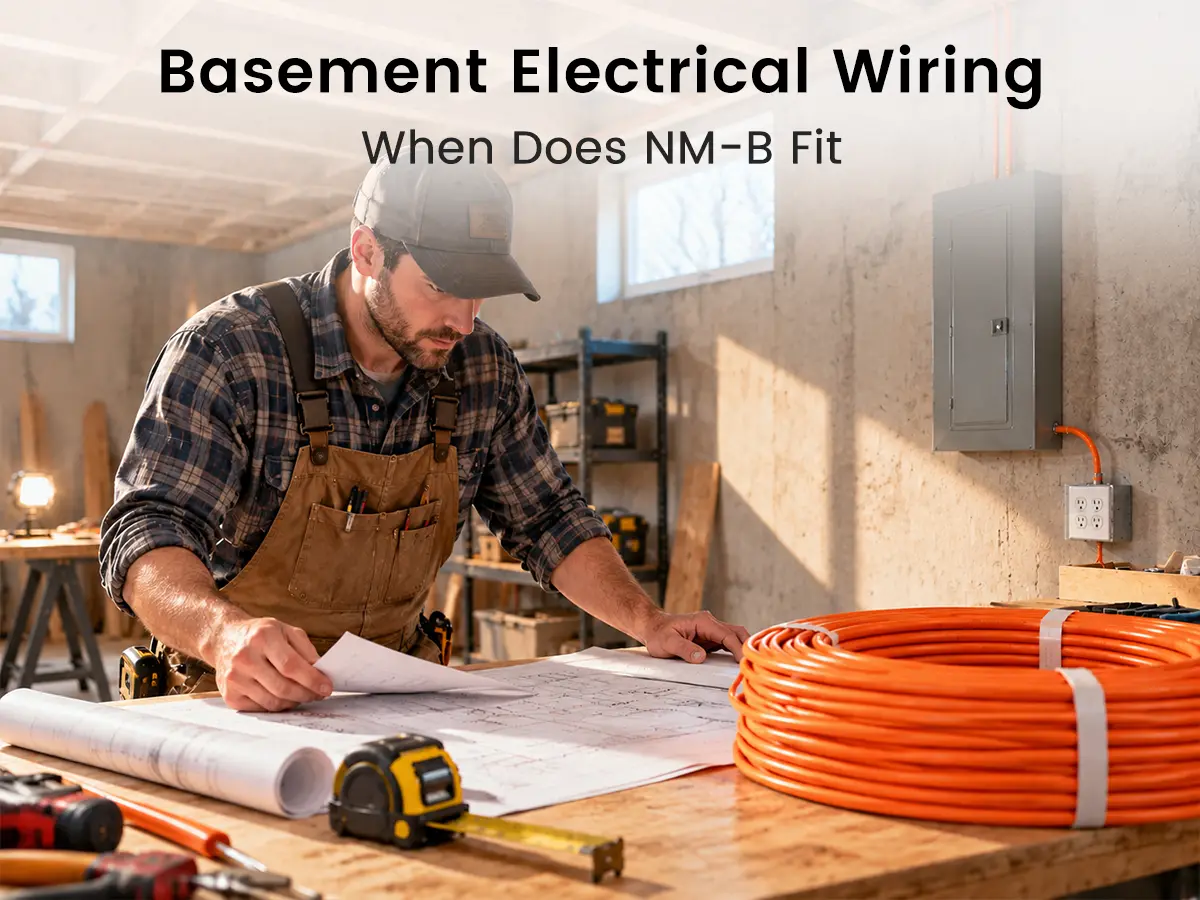
Is Your Basement Dry Enough for NM-B? How to Check Each Zone
A basement is not automatically a dry location — whether NM-B is the right cable depends on which part of the basement you are wiring. For a basement renovation wiring project, check each zone separately before choosing NM-B cable.
Electrical Wire
Shop wire and cable for home wiring, landscape lighting, and equipment connections.
Shop Electrical WireWhat Counts as a Dry, Damp or Wet Location?
The distinction comes down to what the location is normally exposed to, not what it is called on a floor plan.
- A dry location is not normally subject to dampness or wetting.
- A damp location has moderate moisture exposure, such as recurring condensation.
- A wet location is subject to saturation or direct exposure to water.
A finished, conditioned room may qualify as dry, while another part of the same basement has recurring condensation or seepage. The condition along the cable route is what matters.
Check each zone for visible moisture, staining, condensation and a history of water intrusion. These findings call for further assessment; an old stain alone does not establish the location’s present classification. Cable embedded in masonry or concrete in direct contact with earth also has separate installation restrictions.
Evaluate normal and reasonably expected conditions throughout the year, rather than relying on how the basement looks during one dry visit.
Finished Rooms and Unfinished Storage: Usually Fine for NM-B
A finished family room with dry, conditioned walls, or a dry storage area with no unresolved moisture problems, is a typical candidate for NM-B in basement electrical wiring. Dry-looking is not enough on its own — confirm the conditions before selecting the cable.
Before choosing NM-B wire for a finished room or storage area, check the following conditions. These observations help identify moisture concerns; they do not establish that the location is dry on their own.
| Check | What to Verify | Checked |
|---|---|---|
| Floor slab | No visible moisture, recurring condensation or signs of water intrusion | ☐ |
| Walls | No unexplained staining, efflorescence or salt deposits that need further investigation | ☐ |
| Moisture history | No unexplained musty odor or unresolved history of leaks or flooding | ☐ |
| Cable route | The cable will remain in a permitted dry location and will not be embedded in masonry or concrete in direct contact with earth | ☐ |
If a storage corner against a block foundation wall shows a water line, investigate its source and whether the condition recurs before routing NM-B there. The center of the room may remain dry while the wall area needs a different wiring method. Assess the actual cable path rather than assigning one classification to the entire room.
Once you have confirmed a permitted dry route, compare NM-B cable sizes for the circuit you plan to install.
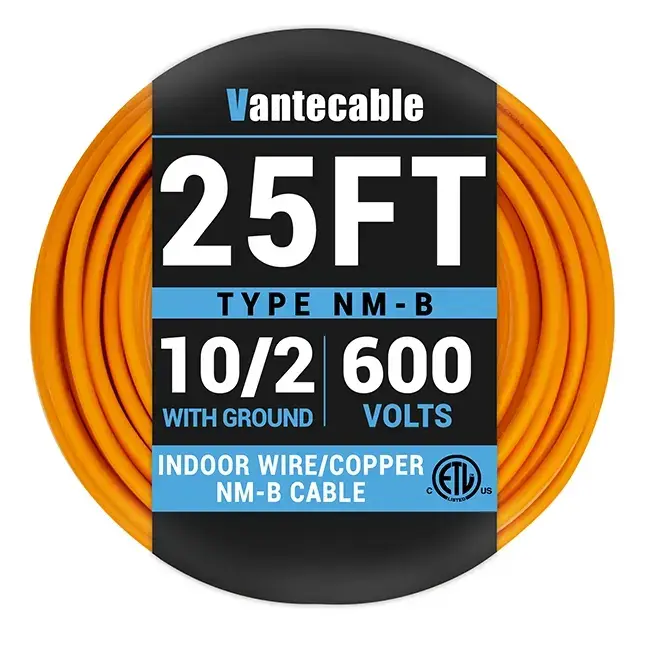
Vantecable NM-B 10/2 Wire with Ground
- Wire Gauge
- 10 AWG
- Voltage Rating
- 600V
- Available Lengths
- 25 / 50 / 100 Ft
- Material
- Copper
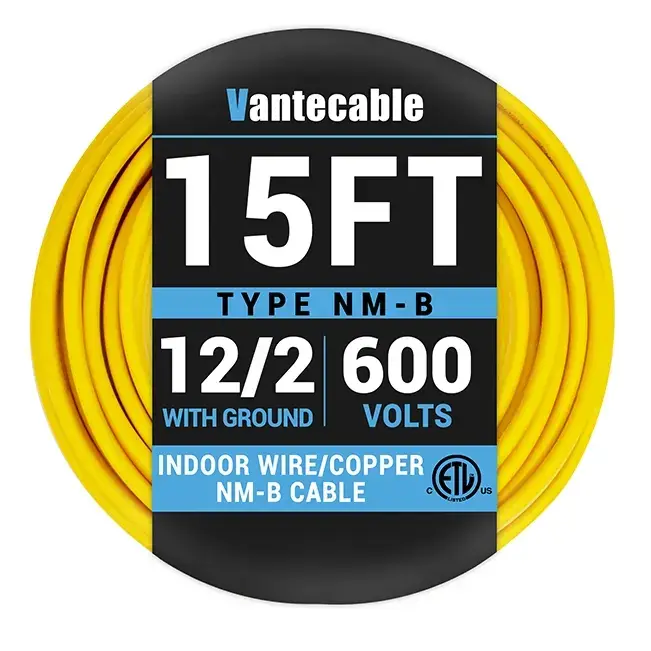
Vantecable NM-B 12/2 Wire with Ground
- Wire Gauge
- 12 AWG
- Voltage Rating
- 600V
- Available Lengths
- 15 / 25 / 50 / 100 Ft
- Material
- Copper
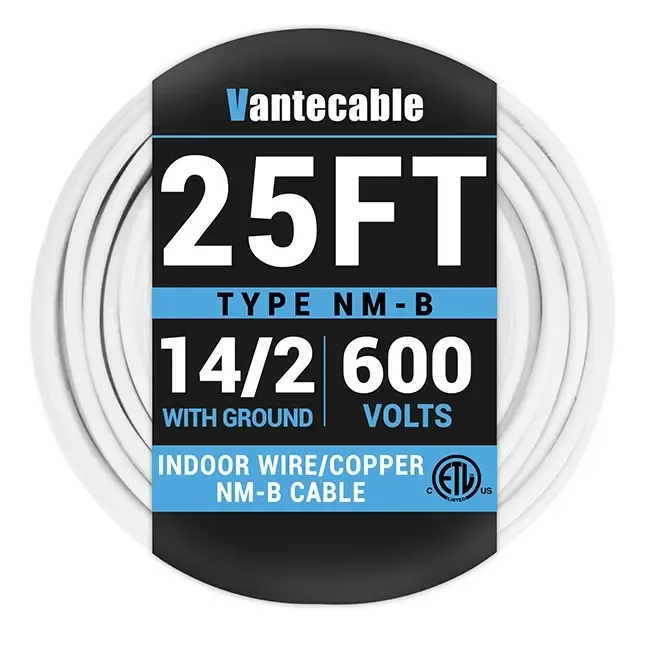
Vantecable NM-B 14/2 Wire with Ground
- Wire Gauge
- 14 AWG
- Voltage Rating
- 600V
- Available Lengths
- 25 / 50 / 100 / 250 Ft
- Material
- Copper
Mechanical Rooms and Foundation Walls: When Condensation Rules NM-B Out
A mechanical room is not automatically damp. Check for recurring condensation on nearby pipes, equipment or walls, along with leaks and foundation seepage. If those conditions make the proposed cable location damp or wet, NM-B is not suitable there.
The table below identifies locations where NM-B wire is not suitable. Putting it inside conduit does not make it acceptable in a damp, wet or underground location.
| Location or Installation Condition | Can You Use NM-B? |
|---|---|
| Damp or wet locations | No |
| Underground runs, including underground conduit | No |
| Outdoor runs exposed to weather or wet interiors of exterior raceways | No |
| Embedded in masonry or concrete that is in direct contact with earth | No |
If a circuit from the panel to fixed equipment must pass through a damp location, mark that segment on your sketch and plan an approved alternative wiring method. A dry equipment location does not make every part of the supply route dry.
If a zone is doubtful or conditions shift seasonally, have a licensed electrician or your local Authority Having Jurisdiction (AHJ) assess it before assigning NM-B to the route.
How Should You Route NM-B and Protect It From Physical Damage in a Basement?
Once a zone qualifies as dry, check whether the cable will be concealed or exposed. Both arrangements need proper routing and support; exposed cable may also need protection from impact, snagging or crushing.
Concealed vs. Exposed Runs: What Changes?
Cable inside wall cavities or above a finished ceiling has some protection from the surrounding construction. It still needs the required clearance from framing edges or suitable protection where nails and screws could reach it.
Exposed runs along joists, studs or walls face different hazards. Tools, stored lumber, ladders and shifting boxes can snag or crush the jacket. Secure the cable at the intervals required for the installation, and keep pulling force away from boxes and connections.
For smaller NM-B cables crossing joists in unfinished basements, use permitted routes through bored holes or on running boards rather than assuming the cable can be fastened across joist bottoms. Runs along framing must also follow the applicable support and protection requirements.
The ICC wiring requirements describe routing and protection provisions for exposed NM cable in unfinished basements.
Does Exposed NM-B Need Protection Below a Certain Height?
There is no universal 7–8-foot basement threshold that makes every exposed NM-B run acceptable above it or requires conduit everywhere below it. The route must satisfy the applicable wiring rules and be protected where it is subject to physical damage.
Consider what happens beside the cable. A storage wall used for ladders, a narrow passage where lumber is carried, or an area behind movable equipment can expose wiring to damage. Height alone does not answer the question.
Before finalizing an exposed route, ask your local inspector which protection methods are acceptable for that installation. Depending on the location, the solution may involve changing the route, using framing protection or installing an approved raceway.
If NM-B is installed in conduit on a basement wall, the location must still qualify as dry. Conduit protects against certain physical hazards; it does not change the cable’s permitted moisture exposure.
How Do You Size Basement Circuits and Plan Outlets Around NM-B?
Confirm the circuit requirements and allowable cable ampacity, then lay out receptacles for the finished and unfinished areas. Wire size, receptacle spacing and GFCI protection are separate checks.
Why the 90°C Marking Doesn’t Raise Your Ampacity
For NM-B wire, allowable ampacity is limited to the 60°C column. The 90°C conductor rating may be used for adjustment and correction calculations, but the final allowable ampacity cannot exceed the applicable 60°C limit.
A higher insulation temperature marking therefore does not authorize a larger breaker or a heavier connected load. Match the cable and overcurrent protection to the complete circuit design.
How Far Apart Should Basement Outlets Be, and Which Need GFCI Protection?
In finished basement living areas, receptacles are generally spaced no more than 12 feet apart, with no point along qualifying wall space more than 6 feet from one. Under the 2020 NEC, GFCI protection applies to basement receptacles in both finished and unfinished areas.
Wall spaces 2 feet or wider generally count toward the spacing requirement, and doorways interrupt the measurement. Each separate unfinished basement portion generally needs at least one receptacle in addition to outlets required for specific equipment.
IAEI’s basement GFCI guidance explains the expansion to finished areas. Before rough-in, confirm the locally adopted code edition and amendments, then mark receptacle locations and protection on your floor plan.
What Should You Use Where NM-B Doesn’t Fit, and When Should You Call an Electrician?
When a zone fails the dry-location check, match the wiring method to the actual condition rather than forcing NM-B into a location it is not rated for.
When Can UF-B Replace NM-B in a Basement Wiring Plan?
Where a basement route is damp or wet, use a wiring method approved for that location. UF-B may be an option when its installation requirements fit the project; our UF-B buying guide explains its permitted uses.
For a route that needs individual conductors in conduit, have the electrician specify the conductor type and protection for each segment. A raceway’s location and conditions determine the required conductor rating.
When Should an Electrician Check Your Basement Wiring Plan?
Have a licensed electrician assess areas with unresolved moisture, an unknown water history or cable routes that cross different location conditions. Panel work and new equipment circuits also need the appropriate design checks. Arrange the required rough electrical inspection before closing walls so routing, protection, grounding and boxes remain accessible.
Basement NM-B Wiring FAQ
How Many Outlets Can You Run Off the Same Breaker?
The NEC does not set a fixed maximum number of standard receptacles on an ordinary residential general-use circuit. The permitted load and circuit requirements determine how many the circuit can serve.
More outlets do not increase the breaker’s capacity. Plan for the equipment that will use them, meet required receptacle spacing, and provide dedicated circuits where required. Our home electrical wiring guide explains how circuit requirements affect cable selection.
Does Basement Wiring Have to Be in Conduit?
No. Basement wiring does not always need conduit. NM-B wire is commonly permitted in dry basement locations when properly routed, supported and protected from physical damage.
Concealed runs through dry framing may not need conduit, while exposed runs may need conduit or another approved protection method. The route and local requirements determine the protection needed. Conduit does not make NM-B suitable for damp, wet or underground locations.
Conclusion: Decide Zone by Zone, Then Pick Your Cable
Walk the basement one zone at a time and let each zone’s moisture condition, cable path and circuit requirements determine the wiring method. NM-B fits permitted dry-location runs with the required routing, support and protection, and with ampacity kept within its applicable 60°C limit.
If you cannot establish whether a route is dry or what protection it needs, have an electrician assess it before buying cable. Complete the required rough inspection before the wiring is concealed.
Once you have a list of confirmed dry runs, compare cable by gauge and length. Vantecable sells NM-B building wire, so match the specification and listing on the exact product to the circuit design before ordering. For help understanding the certification marks on the cable packaging, see our ETL vs. UL guide.
Electrical Wire
Shop wire and cable for home wiring, landscape lighting, and equipment connections.
Shop Electrical Wire