

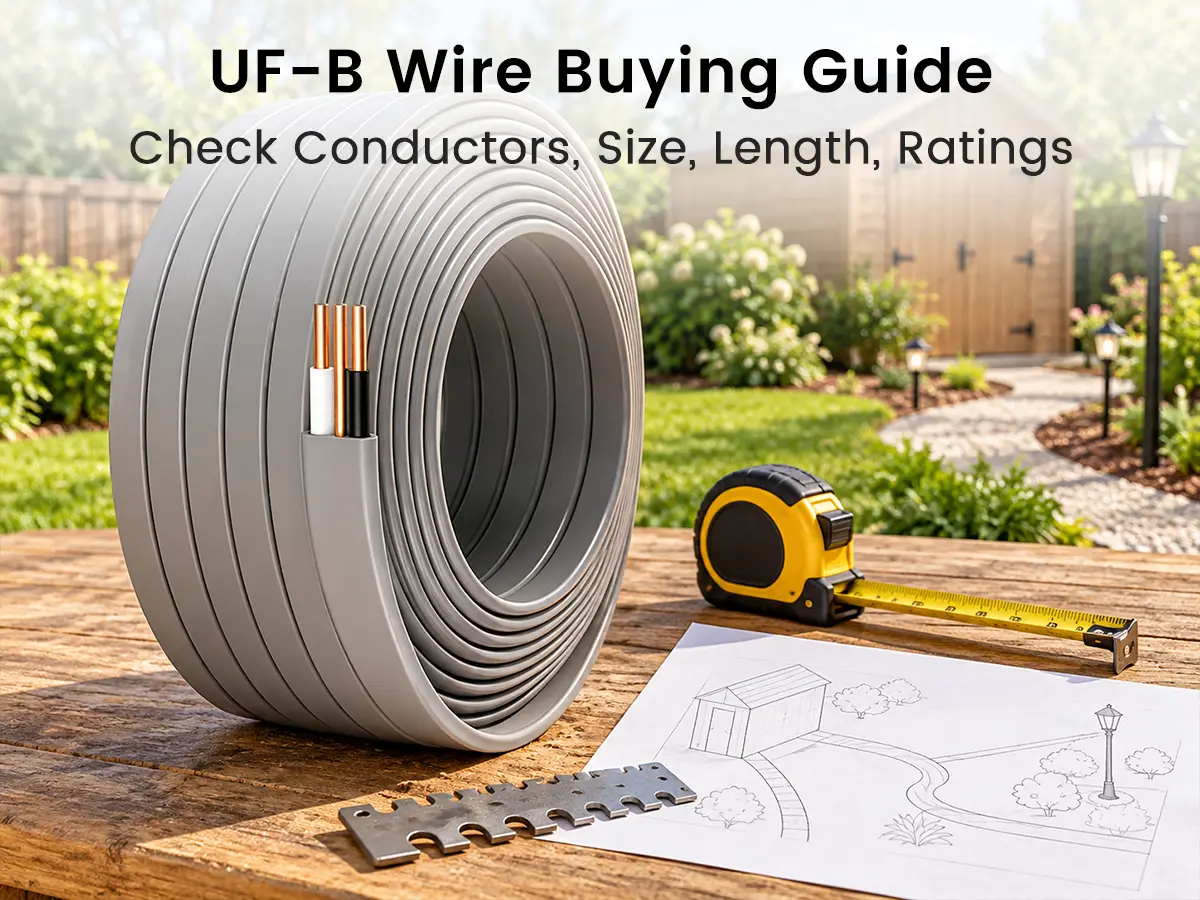
Choose UF-B wire by four checks: the conductor count, the wire size for your load and distance, a length that covers the whole route, and the ratings on the cable. A 10/2 UF-B cable has two insulated 10 AWG conductors plus a ground, which suits two-wire 120V or 240V circuits such as a post light or a pump. This guide walks through each check.
Shop Electrical Wire
UF-B, NM-B and landscape wire for outdoor projects.
Which Outdoor Electrical Wire Should You Choose for Your Project?
Pick outdoor electrical wire by where it will run before you compare gauge or price. The three cards below compare the cable types most often confused when planning an outdoor circuit.
10/2 UF-B
Where it runs: Permanent building circuits that leave the building and continue underground.
Underground / wet: Yes — including direct burial where the code allows.
10/2 NM-B
Where it runs: Permanent wiring inside walls and other normally dry interior spaces.
Underground / wet: No
12/2 Copper Wire
Where it runs: The low voltage side of a landscape lighting system, from transformer to fixtures.
Underground / wet: Yes — when marked for direct burial.
UF-B and NM-B look alike, but only UF-B is made for wet and underground locations. If the cable leaves the building and goes into the ground, NM-B is not an option.
Landscape wire belongs to a different category. It carries the transformer’s low voltage output, not the 120V supply, so it does not replace UF-B. Our low voltage landscape wire guide covers that side of the system.
What Does 10/2 UF-B Wire Mean, and Which Conductor Count Do You Need?
In 10/2 UF-B wire, the first number is the AWG size and the second is the number of insulated conductors. A 10/2 cable with ground has two insulated 10 AWG conductors and one bare ground wire. With no third insulated conductor, it has no separate neutral beyond those two.
The table shows how the circuit determines the conductor count.
| Circuit | Conductors needed |
|---|---|
| 120V load such as a post light or a small pump | Two insulated conductors (hot and neutral) plus ground |
| 240V load that needs no neutral | Two insulated conductors (two hots) plus ground |
| 120/240V circuit that needs a neutral, such as a feed to a shed subpanel | More than two insulated conductors plus ground |
Check the equipment label or manual for its voltage and whether it needs a neutral. Confirm this before buying, because a 10/2 cable cannot be changed later to carry a third insulated conductor.
How Far Can 10/2 UF-B Wire Run Before Voltage Drop Becomes a Problem?
Distance is the main reason a wire that works on a short run can fail on a long one. Voltage drop rises with both the current and the length of the circuit, so the equipment at the far end receives less than the supply voltage.
Use the equipment’s current requirement and the one-way distance from the source to the load to check the drop for your run — our voltage drop calculator and formula guide walks through the math. A thicker conductor (a lower AWG number) reduces the loss. If 10 AWG does not hold up at your distance, move to a lower AWG number instead of ordering more of the same cable, because a longer coil does not make a long run work.
How Much UF-B Wire Should You Buy for Your Route?
Buy by the length of the whole path, not by the straight-line distance between the two points. Measure from the connection point inside the source building, through the wall or foundation, along the trench, and up to the equipment or the building it feeds. Include every turn and every vertical section, and measure to the actual entry point rather than the nearest wall.
Allow extra length for the connections at both ends. Keep this separate from the voltage drop check: the check uses the one-way distance to the load, while the purchase length is the full path plus that allowance.
Our 10/2 UF-B wire comes in 50 ft, 75 ft, 100 ft, 150 ft and 250 ft coils. Choose the shortest coil that covers the measured route plus the allowance, because every splice underground adds another connection to protect. If the route changes before installation, measure again before you cut.
Which Ratings Should You Check on Direct Burial UF-B Cable?
Read the product page and the markings on the jacket together, because a general phrase like “outdoor wire” does not confirm an installation rating. For direct burial UF-B cable, check the items in the table.
| Check | What to look for |
|---|---|
| Conductor material | Copper, as stated in the product specifications |
| Voltage rating | 600V describes the cable’s insulation rating, not the voltage of your circuit |
| Direct burial | The cable must be identified for direct burial |
| Certification | A listing mark that applies to the exact model you are buying |
Direct burial suitability does not set the burial depth, the protection, or the building entry. Those come from the National Electrical Code and your local authority, and a permit and inspection are still your responsibility — our guide to running underground wire to a shed or detached garage covers the installation sequence. A UL Listed mark identifies UL product certification, which is separate from approval of the installed circuit.
What Does Vantecable 10/2 UF-B Wire Offer?

Vantecable 10/2 UF-B Wire
10/2 AWG with ground · Pure copper · 600V · Direct burial · UL Listed · 50–250 ft
From $72.99
Shop the UF-B CoilVantecable’s 10/2 UF-B wire is an underground feeder cable with a ground conductor, sold for outdoor lighting, pumps, and power to sheds and garages. The specifications from the product page are in the table.
Shop the 250 ft 10/2 UF-B wire for $20 off during Vantecable’s Fall Backyard Wire Refresh.
| Specification | Vantecable 10/2 UF-B wire |
|---|---|
| Size | 10/2 AWG with ground |
| Voltage rating | 600V |
| Conductors | Pure copper |
| Jacket | Flame-retardant, easy-strip design |
| Installation | Direct burial |
| Certification | UL Listed |
| Lengths | 50 ft, 75 ft, 100 ft, 150 ft, 250 ft |
Match these specifications to your circuit and route before choosing a coil.
UF-B Wire Buying FAQs
Can UF-B Wire Be Used for Both Feeders and Branch Circuits?
Yes. UF stands for underground feeder and branch-circuit cable. Whether a particular cable fits your circuit still depends on its conductor count, wire size, and the installation conditions.
Does 600V UF-B Wire Have to Be Used on a 600V Circuit?
No. The 600V rating is the insulation’s voltage rating, and the cable can be used on lower-voltage circuits such as 120V or 240V. It does not tell you how much current the cable may carry.
What Ampacity Applies to 10/2 UF-B Wire?
Ampacity depends on the wire size and the conditions listed in the code’s ampacity tables. Look up the 10 AWG figure for UF cable in the National Electrical Code edition your local authority has adopted, then compare it with the equipment’s current requirement to check the circuit.
Conclusion: Choosing UF-B Wire for Your Outdoor Project
Match the cable type to where the wire will run, confirm the conductor count for your circuit, check voltage drop for your distance, and buy a length that covers the full route. If your project fits these checks, Vantecable’s 10/2 UF-B wire is available in five coil lengths.
Shop the 250 ft 10/2 UF-B wire for $20 off during Vantecable’s Fall Backyard Wire Refresh.
Safety note: Wire size, burial depth, protection, and permit requirements come from the National Electrical Code and the authority that has jurisdiction in your area. Confirm the requirements for your specific project before you buy or install.