

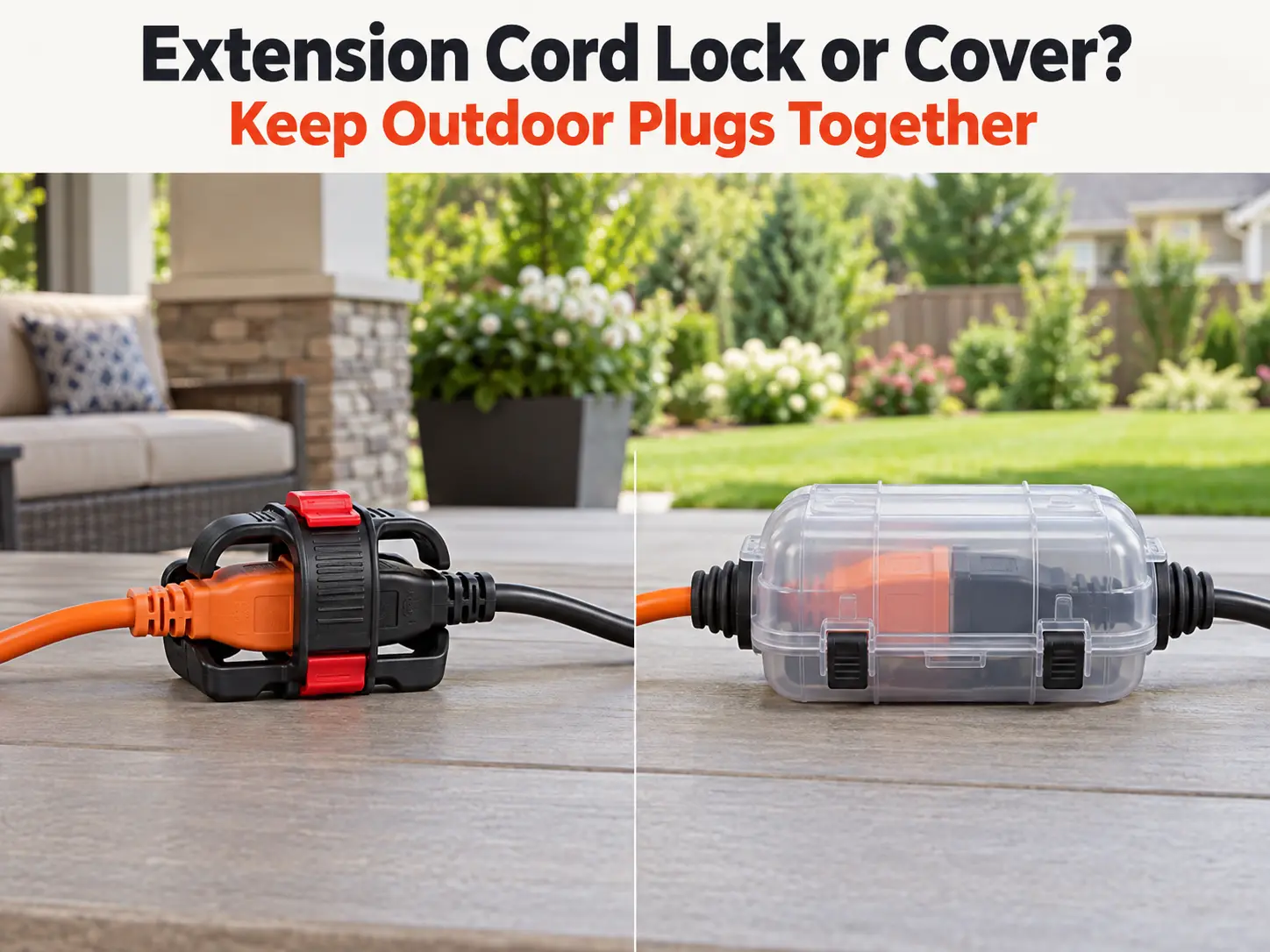
An extension cord lock helps prevent compatible plugs from separating accidentally. A plug connection cover encloses the joint and may also help keep it together when its design includes retention features. For an outdoor setup, choose according to the connection you have, the movement it faces and the protection it needs.
Before adding either accessory, check whether the plugs fit securely without cable tension. A connection that is pulled apart by a moving cable needs better positioning and suitable retention. A plug that slips out even when nothing is pulling on it needs inspection.
Vantecable Outdoor Extension Cords
Compare cord lengths and outlet layouts for your temporary outdoor setup.
Extension Cord Lock or Plug Connection Cover: What Does Your Connection Need?
A lock mechanically retains compatible connected plugs, while a cover encloses a joint that is already connected. Retention and weather protection are separate functions, so check a product’s stated purpose rather than assuming that a closed cover prevents unplugging or that a lock keeps out moisture. Our outdoor plug protection guide covers weather protection in detail.
The table below matches each option to the connection it suits.
| Option | What it does | Where it fits |
|---|---|---|
| Twist-lock connection (for example, the Vantecable RV Locking Cord) | Locks the mated connectors with a twist mechanism | Matching twist-lock connectors in RV or generator setups |
| Plug connection cover | Encloses the joint and uses a snap-lock closure | An intact, compatible plug connection outdoors |
| Standard cord without a locking feature | Relies on the plug fit alone | Setups where slack and support keep the plugs from being pulled |
Why Does Your Extension Cord Connector Keep Pulling Apart?
An extension cord connector can separate when the cable is stretched tight, the joint carries unsupported weight or equipment movement pulls on the plug. A loose fit can produce a similar result even when the cable is properly positioned.
Look at when the separation happens. If the connection comes apart after a tool or decoration moves, inspect the nearby cable route. If the plug slides out while the setup stays still and the cable has slack, inspect the plug and receptacle. The table below shows what to check; disconnect power before inspecting.
| What you see | What to check | What to do |
|---|---|---|
| Cable is straight and taut at the connection | Insufficient reach or a route that pulls the cable tight | Reposition the setup or choose a length and gauge permitted by the equipment manufacturer |
| Joint hangs with cable below it | Unsupported cable or enclosure weight | Arrange suitable support so the connection does not carry that weight |
| Plug slides out with no pull on the cable | Plug fit, worn contacts or damage | Stop using that connection; see the repair or replace guide |
| Plug or socket shows discoloration or becomes unusually warm | Possible contact, load or damage issues | Stop using the setup and investigate before reconnecting |
| Plug works loose after the device moves | Cable repositioned under tension | Re-route the cable with slack and recheck |
Can a Plug Connection Cover Help Keep the Joint Together?
Yes. A compatible plug connection cover with retention features can help reduce accidental separation around an intact connection. It should fit the joined plugs and close as designed without pressing them together or forcing the cable into position.
The Vantecable outdoor connection cover uses a snap-lock closure, and its product page describes protection against accidental disconnection. This makes it worth considering for a compatible outdoor joint that needs an enclosure. It does not provide a published pulling-force limit, so do not treat it as a support for hanging cable or equipment.
Check that the cover closes around the fully seated connection without squeezing the plugs or cable. Use our connection box fit guide for dimensions and unusual plug shapes. Confirm the fit separately before using a triple-tap outlet head.
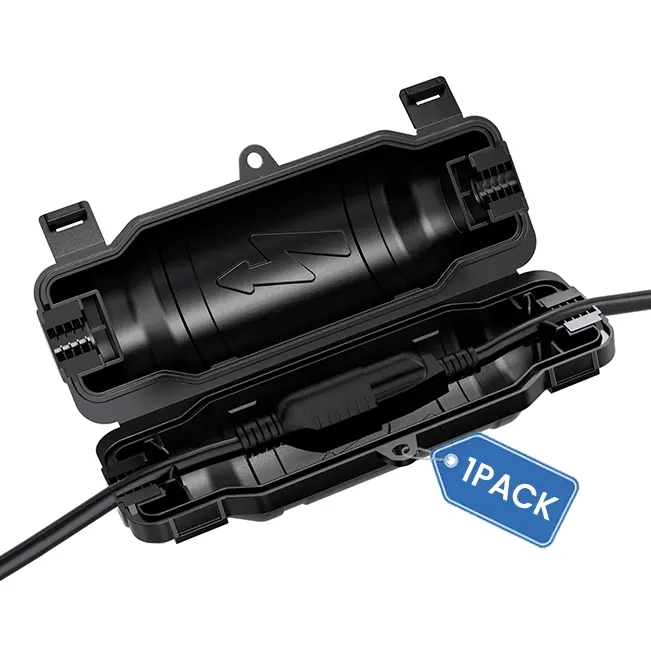
Vantecable Outdoor Extension Cord Safety Cover
Snap-lock enclosure for compatible outdoor plug connections.
Snap-lock closure · Product page lists compatibility with 12/14/16 AWG cords
From $9.99
View Cover SpecificationsHow to Keep Extension Cords Connected Without Pulling on the Plugs
To keep extension cords connected, leave enough cable reach and support its weight near the joint. A lock or cover should not be used to hold a stretched cable in place.
Disconnect power before positioning or moving the device. Free the cable from anything that could catch it, then arrange it so it reaches without stretching. Keep the extra cable clear of walking and equipment paths, and recheck for tension after each move.
If the current cord cannot reach without tension, reposition the device or choose a longer cord that meets the equipment manufacturer’s gauge and length requirements. A longer cord of the same gauge is not automatically suitable for every load, so follow the equipment’s instructions.
Keep the connection from carrying the weight of hanging cable. If mounting is needed, use only attachment points and methods allowed by the product instructions. Do not nail or staple through the cable or use the plug housing to hang equipment, and keep the joint away from standing water.
When disconnecting, grip the plug rather than pulling the cable. OSHA cord handling guidance explains why tension should be kept away from joints and terminals.
Triple-Tap or Three-Way Splitter: Which Layout Fits Your Devices?
Choose a triple-tap extension cord when devices sit together near one connection point, and a three-way splitter extension cord when they are spread across different positions. Neither locks the device plugs in place, so check that each lead or branch reaches its device with slack. Compare the two cords below by gauge and distance rather than by assumed capacity, and check the combined load against each cord’s rating.

Vantecable 12/3 Lighted Triple-Tap Extension Cord
Three nearby outlets for grouped equipment, with an LED indicator at the triple-tap end.
12/3 AWG · SJTW · Three outlets · 15A / 125V / 1875W total · ETL Listed (Intertek)
From $17.63
View Triple-Tap Cord
Vantecable 1-to-3/4 Extension Cord Splitter
Separate branches for devices in different positions.
16/3 AWG · SJTW · 1-to-3/4 splitter · 25–46 ft total · ETL Listed
From $21.05
View Splitter CordWhen Should You Stop Using a Loose Cord Connector?
Stop using the connection if the plug will not stay seated after cable tension and unsupported weight have been removed. A lock or cover should retain an intact connection, not conceal one that has lost its normal fit.
Do not use tape, shims or knots to force a loose plug to stay connected, and do not bend the plug blades to make them grip. These changes hide the underlying problem or damage the assembly. CPSC extension cord guidance advises replacing damaged cords and warns against taping up damaged insulation or altering plug blades.
Inspect both sides of the connection; a worn wall receptacle needs attention to the receptacle, rather than an accessory around the plug.
Extension Cord Lock FAQ
What Can I Use Instead of an Extension Cord Lock?
A compatible plug connection cover with retention features may help keep an intact connection together. Check that it fits the joined plugs and is designed to reduce accidental separation.
How Does a Locking Extension Cord Work?
A locking extension cord uses a retention mechanism to resist accidental separation. For example, the Vantecable RV Locking Cord has a twist-lock SS2-50R female connector and a straight-blade 14-50P male plug. It requires matching connections and is intended for compatible RV or generator setups. A standard triple-tap cord should not be assumed to include the same locking feature.
Can I Make a Homemade Extension Cord Lock?
Do not use a homemade lock to force a loose plug to stay connected. Check the connection’s condition and use compatible retention equipment according to its instructions.
Conclusion: Choose an Extension Cord Lock or Cover for the Connection You Have
An extension cord lock addresses mechanical retention, and a connection cover encloses the joint. Remove cable tension before adding either one. A compatible Vantecable cover may suit an intact outdoor joint, a triple-tap or three-way splitter cord can match the layout of your devices, and any connection that stays loose after tension is removed should be replaced.
Safety note: This article describes general inspection and retention practice, not a substitute for the equipment manufacturer’s instructions or local electrical codes. Never tape, shim, knot or bend plug blades to force a loose connection to hold. If a plug or socket is discolored or warm, stop using it and have the connection checked by a qualified electrician.