

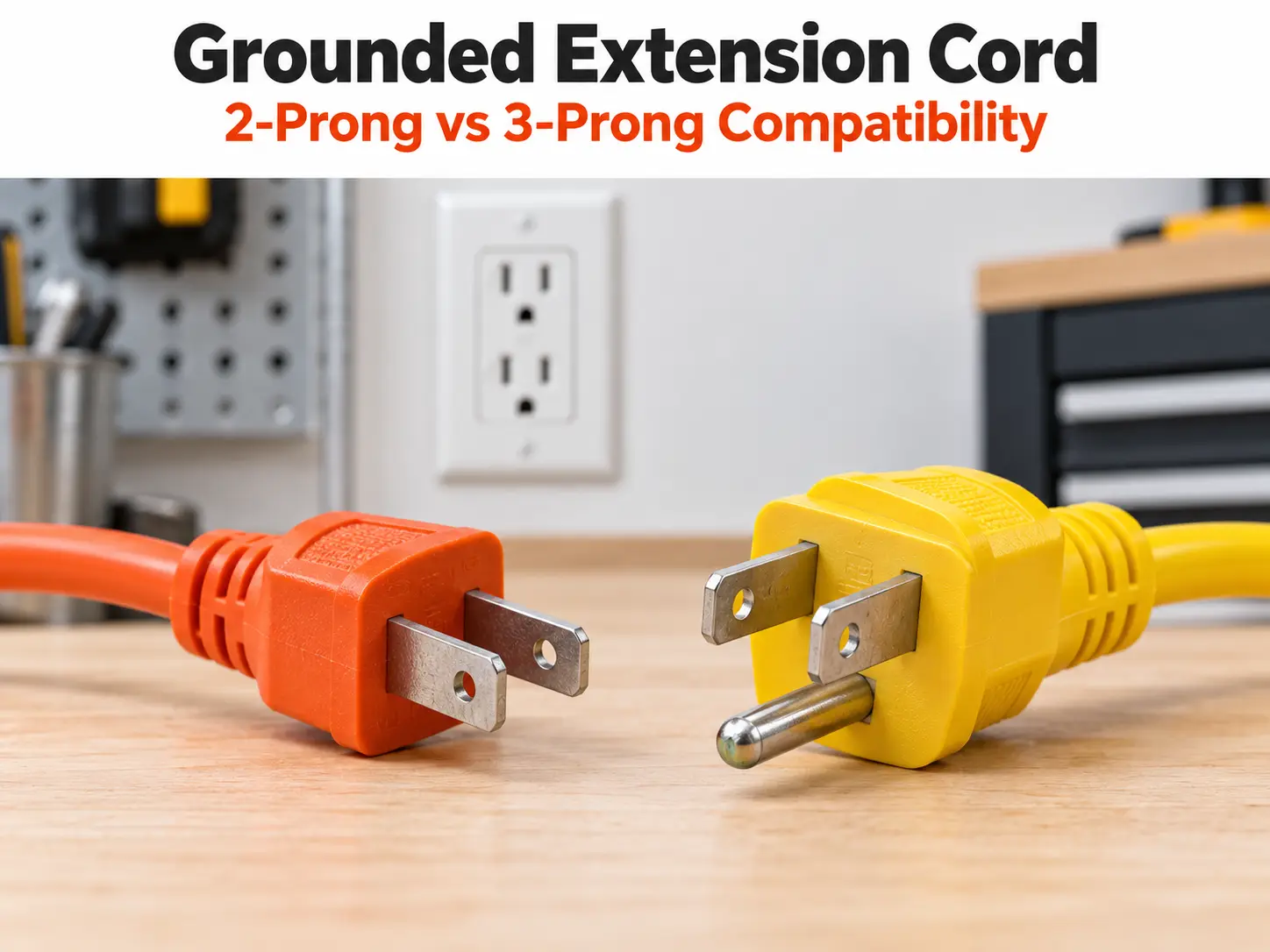
A grounded extension cord has a third wire and a third prong that connect a device’s metal housing to the ground wire behind the outlet. If a fault makes that housing live, this path lets fault current return to the source, which helps the breaker or other protective device shut off power.
A three-prong device needs this connection to stay unbroken through the cord. A two-prong plug has no ground prong, so it can use a grounded cord only if the plug fits and the manual allows extension cords; the cord does not add a ground to it.
This matters when a three-prong tool meets a two-hole cord, or when one cord must serve both kinds of device. A plug that goes in is only the first check. The device requirements, the ground connection and the cord’s ratings must also match.
Outdoor Extension Cords
Compare cord lengths and outlet configurations for your setup.
What Does the Ground Prong on a Grounded Extension Cord Do?
How Does a Grounded Plug Preserve the Equipment Grounding Path?
The ground prong on a grounded plug is not intended to carry normal load current. It works only as a fault path. If a live conductor touches a tool’s metal housing, an intact equipment-grounding path allows fault current to return to the source so the circuit’s protective device can operate. If that path is broken, the housing may stay energized and expose anyone who touches it to electric shock.
The third wire inside a three-conductor cord is the ground conductor. Its size and the cord’s jacket code are covered in our guide to 12/3 cord markings, so this article stays on how the plug, the cord and the outlet work together.
Does a Ground Prong Provide Surge or Overload Protection?
No. The ground prong is not a surge suppressor, and it does not shut off power when a cord is overloaded. A cord can power a device normally with a broken ground connection, so normal operation is not evidence that grounding is intact. Eaton’s explainer on power and extension cords covers grounded cord basics if you want a second source.
2 Prong vs 3 Prong: Which Device Plugs Fit a Grounded Extension Cord?
Can a Two-Prong Device Use a Three Prong Extension Cord?
Usually yes, as long as three conditions are met: the device’s plug is intact, its blades match the cord’s receptacle, and the manual allows use with an extension cord. A standard three prong extension cord receptacle is built to accept a two-prong plug, so the fit itself is normal. The device is still a two-prong device, and the cord does not add a ground to it.
Whether a two-prong device needs a ground at all depends on how it was built, not on its wattage. Check the label and the manual instead of judging from the plug shape.
When Does a Three-Prong Device Require a Grounded Plug Connection?
Whenever the device is built with a ground prong, the grounding connection must stay unbroken from the device to the outlet. The cord needs a ground contact at each end, the receptacle must accept all three prongs, and the supply outlet must provide a ground. Two-slot cords, cut ground prongs and adapters that break the ground path are not acceptable substitutes, and forcing a plug into a receptacle that does not match is never a fix.
OSHA’s workplace rules for electrical equipment follow the same principle: the equipment grounding requirements call for matching plug and receptacle configurations and prohibit adapters that interrupt grounding continuity. Those rules apply to workplaces, but the reasoning carries over to home and job-site use.
The table below compares device plugs, cord receptacles and supply outlets so you can see where the grounding connection holds or breaks.
| Device plug | Extension-cord connection | Supply outlet | Decision |
|---|---|---|---|
| Intact two-prong plug | Matching grounding-type receptacle | Properly wired outlet | May fit if the device permits cord use; adds no grounding inside the device |
| Intact polarized two-prong plug | Receptacle accepts the wider blade | Properly wired outlet | Keep polarity; never force or alter a blade |
| Intact three-prong plug | Grounding-type cord, intact ground path | Properly grounded outlet | Compatible in principle; also check ratings and device instructions |
| Three-prong device | Two-slot cord, or a plug with the ground prong removed | Any outlet | Do not use; the equipment ground is broken |
| Three-prong plug | Grounding-type cord | Outlet marked “No Equipment Ground” or uncertain | Ground path not established; get qualified guidance first |
This table checks grounding conditions only. It does not confirm the load, length, environment or whether the device allows extension-cord use.
Is a Three-Slot Outlet Always Grounded When a Grounded Plug Fits?
No. A three-slot outlet can still be an ungrounded outlet: the third slot only gives the ground prong somewhere to go, and says nothing about whether a ground wire is connected behind it. If the outlet has no ground, a grounded extension cord cannot fix that, because the cord only carries on the ground connection it receives from the outlet. Some outlets were wired without a ground or swapped for three-slot receptacles in older buildings, and a device that plugs in and runs proves nothing either way, since most devices operate the same with or without the ground.
Some three-slot outlets carry a label reading “No Equipment Ground,” which means the receptacle is not connected to an equipment-grounding conductor. If a device requires grounding and the outlet carries that label, or you cannot tell whether the ground is connected, do not run the device from it. Testing outlet wiring takes proper equipment and training, so a licensed electrician should check the outlet and recommend a compliant supply. Replacing receptacles or wiring a ground is electrician work and is not covered here.
How Can You Check Grounding Continuity and Ground Prong Damage?
Stop using any cord whose ground prong is missing, bent or loose, or whose connector shows cracks or a loose grounding contact. A damaged ground contact means the cord can no longer promise a complete path, even if the device powers on. A cord that looks undamaged can still have a broken grounding wire inside, so a visual check is a minimum, not proof of grounding continuity. For broader checks on jackets, water exposure and routing, see our guide to extension cord safety.
The power indicator on a lighted connector shows that the cord is energized. It does not verify grounding continuity. Confirming continuity takes proper test equipment and training, so a cord with any doubt about its ground should be taken out of service instead of probed or opened at home.
When Is a Grounded Triple-Tap Cord the Right Three Prong Extension Cord?
Which Grounded Plug Details Should You Check on a Triple-Tap Cord?
Check three things: the supply-end plug, the three receptacles and the model markings. A grounded triple-tap extension cord suits a job when the device allows extension-cord use, the supply outlet has a matching ground, and you need three connection points in one place instead of three separate cords. Confirm that the supply-end plug has all three prongs, that each receptacle has a ground slot, and that the model marking matches the product you bought. The same check applies to the 10/3 triple-tap cord.
ETL Listed (Intertek) is a certification of the specific product. It does not mean the cord monitors grounding while in use, and it does not make the cord suitable for every device.

Vantecable 12/3 Lighted Triple-Tap Extension Cord
Three grounded outlets with a lighted end so you can see the run has power.
12 AWG · SJTW · Three outlets · Power indicator · 15A / 125V / 1875W total · ETL Listed
From $17.63
Shop the 12/3 Cord
Vantecable 10/3 Lighted Triple-Tap Extension Cord
Lower voltage drop over longer runs, with the same three grounded outlets and lighted end.
10 AWG · SJTW · Three outlets · Power indicator · 15A / 125V / 1875W total · ETL Listed
From $27.99
Shop the 10/3 CordDo 10/3 and 16/3 Three Prong Extension Cords Change Grounding Compatibility?
No. Wire gauge alone does not determine a finished cord’s amp rating or its grounding compatibility. Check the complete product rating, the matching connectors and an intact grounding path, whichever gauge you choose. A black 16/3 triple-tap cord is available with the same three-outlet layout. Its ratings differ from the 12/3, so use the numbers on its own product page.

Vantecable 16/3 Lighted Triple-Tap Extension Cord
A lighter black cord for lower-draw devices, same three-outlet layout.
16 AWG · SJTW · Three outlets · Power indicator · 13A / 125V / 1625W total · ETL Listed
From $16.25
Shop the 16/3 CordFAQ: Grounded Extension Cord Compatibility
Is a Two-Prong Device on a Three Prong Extension Cord Always Double-Insulated?
No. A two-prong plug alone does not show double insulation. A double-insulated device is marked as such on its label or described in its manual, and only that marking or statement should be relied on. If neither says so, contact the manufacturer before assuming it. This is also why a plug that fits a cord does not settle whether the device needs a ground.
Does a Polarized Plug Provide the Same Connection as a Grounded Plug?
No. A polarized plug has one wide blade so it fits the receptacle only one way and keeps the hot and neutral conductors on their intended sides. A grounded plug adds a separate ground prong that connects the device’s metal parts to the grounding conductor. A polarized two-prong plug has polarity but no ground, and neither feature substitutes for the other.
Does a Ground Prong Increase an Extension Cord’s Amp Rating?
No. The ground prong is not intended to carry normal load current. A cord’s amp rating comes from its conductor size, its construction and the rating on its label, so a third prong does not allow more load. The total load must still stay within the rating of both the cord and the circuit it plugs into.
Conclusion: Match the Grounded Plug from Device to Outlet
A grounded extension cord does its job only when the grounding path holds at three points: the device plug, the cord and the supply outlet. Match the plug and receptacle configuration, confirm that the device allows extension-cord use, and keep the ground contact intact from the cord through to a properly grounded outlet. Once those are settled, a triple-tap cord is a practical way to get three connection points in one place without running three separate cords. If any one of them is uncertain, stop and have the outlet or device checked before use.
Safety note: This article describes general grounding concepts and inspection practice, not a substitute for the equipment manufacturer’s instructions or local electrical codes. Never remove a ground prong, use a grounding adapter, or work on outlet wiring yourself. If you are unsure whether an outlet is properly grounded, have it checked by a licensed electrician.