

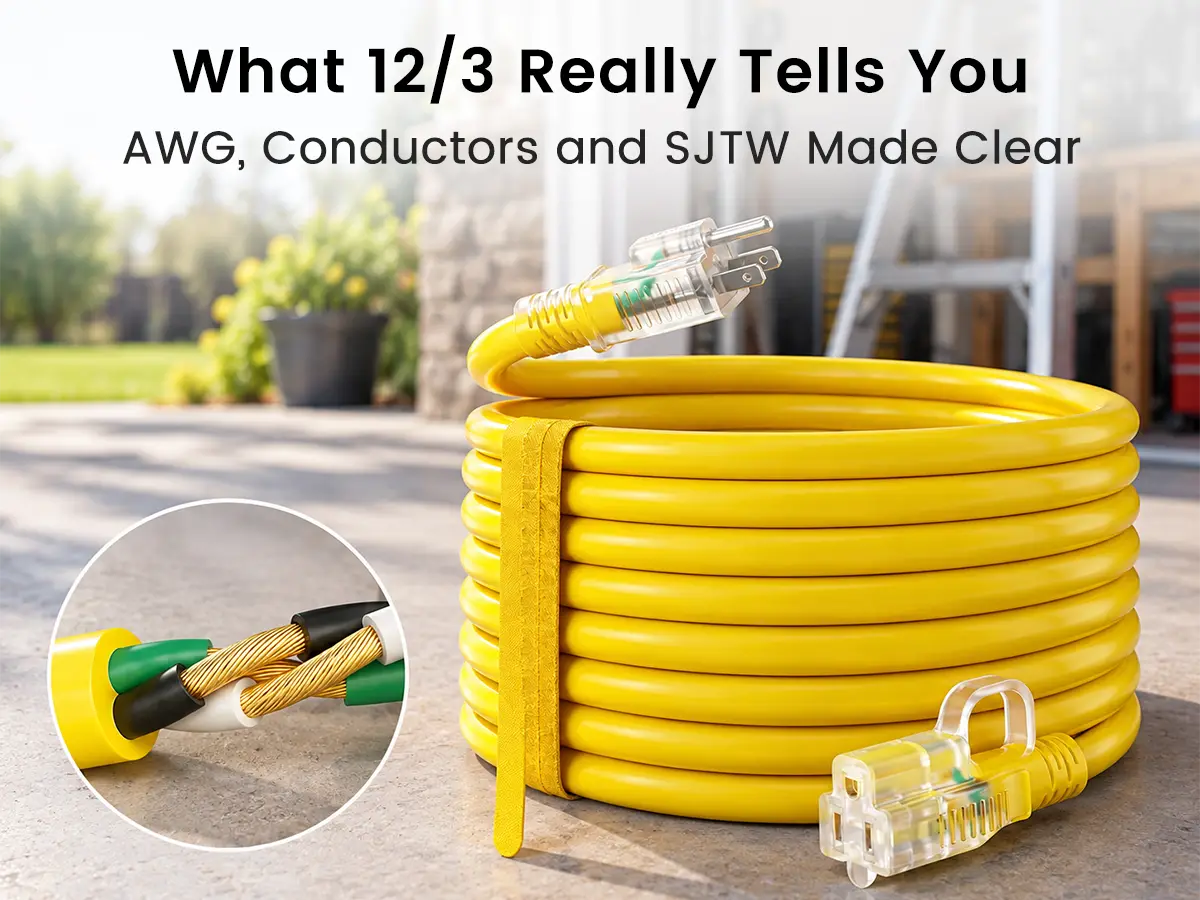
When shoppers ask what does 12/3 mean on an extension cord, the short answer is that “12” identifies the American Wire Gauge size of each conductor and “3” identifies the total number of conductors inside the cord, including the equipment-grounding conductor. On a typical grounded 120V extension cord, those three conductors serve as hot, neutral and ground.
The 12/3 marking describes the cord’s internal conductor construction. It does not replace the electrical rating printed on the cord label. To select a cord correctly, read 12/3 together with the plug configuration, amperage, voltage, wattage, jacket designation, length and certification mark. You can browse Vantecable’s extension cords to compare complete cord specifications rather than judging a product by gauge alone.
12/3 Extension Cord Explained Through Its Two Numbers
A 12/3 extension cord explained accurately starts with two separate questions: how large is each conductor, and how many conductors are inside the jacket? The first number answers the gauge question. The second answers the conductor-count question.
This distinction matters because gauge and conductor count describe different parts of the construction. A cord may use 12 AWG conductors but have a different number of conductors for another wiring configuration. Likewise, two three-conductor cords can use different gauges. Reading the numbers separately prevents the common mistake of treating “12/3” as an amperage, voltage or plug designation.
The table below lists what each part of the marking communicates, with the emphasis on separating construction details from the finished cord’s operating limits.
| Marking | What it identifies | What to verify elsewhere |
|---|---|---|
| 12 | The AWG size of each conductor | Finished cord amperage and wattage |
| /3 | Three total conductors, normally hot, neutral and equipment ground in a grounded 120V cord | Plug pattern and wiring configuration |
| SJTW | Flexible-cord construction and outdoor-use designation | Product-specific temperature, oil and weather-resistance claims |
| 15A / 125V / 1,875W | Maximum product rating stated for the featured cord | Connected equipment load and outlet capacity |
| NEMA 5-15P to 5-15R | Standard grounded plug and connector configuration | Compatibility with the outlet and equipment plug |
12 Gauge Extension Cord Meaning in the AWG System
In the American Wire Gauge system, a lower gauge number identifies a larger conductor diameter. A 12 AWG conductor is therefore larger than a 14 AWG conductor, while a 10 AWG conductor is larger than a 12 AWG conductor.
The practical value of a larger conductor is lower resistance for the same conductor material and length. That can help limit voltage drop when current travels over distance. However, conductor size is only one part of an assembled extension cord. The usable limit comes from the rating assigned to the complete cord set, not from AWG alone.
12 Gauge 3 Conductor Cord: Hot, Neutral and Ground
In a standard grounded 12 gauge 3 conductor cord fitted with NEMA 5-15 connectors, one conductor carries power from the source to the load, one provides the normal return path, and the equipment-grounding conductor provides a fault-current path when the connected system is working as designed. The grounding conductor is a safety component; it is not intended to carry normal operating current.
The “3” means three conductors in total. It does not normally mean three current-carrying conductors plus a separate ground. This is a useful distinction when reading product listings, because phrases such as “12/3 with ground” are commonly associated with building cable conventions and should not automatically be transferred to a portable cord set without checking its construction.
OSHA’s flexible-cord requirements address grounding continuity and strain relief in workplace applications. In practical use, the grounding pin, plug body, connector and jacket must remain intact. Never remove the grounding pin to fit an ungrounded receptacle.
SJTW Extension Cord Meaning on a 12/3 Cord
The SJTW extension cord meaning concerns the flexible-cord construction rather than the conductor count. On the featured Vantecable product, SJTW identifies a 300V-class thermoplastic cord intended for outdoor use. A complete explanation of the letters and related jacket designations is available in the SJTW meaning guide.
This keeps the markings separate: 12/3 describes conductor size and count, while SJTW describes the cord type and jacket system. Product-specific temperature, oil-resistance and other performance claims should be confirmed from the product specifications.
12/3 Extension Cord Ratings Come From the Complete Cord Set
The featured Vantecable 12/3 extension cord is rated 15A at 125V, or 1,875W, and uses a NEMA 5-15P plug with a NEMA 5-15R connector. Its working limit is therefore 15A and 1,875W, even though 12 AWG conductors may also appear in other products with different connectors and ratings.
The 1,875W figure comes from multiplying the product’s stated voltage by its stated current: 125V × 15A = 1,875W. For a fuller explanation of that rating, see the 15 amp rating guide. Keeping the calculation in that dedicated article prevents this 12/3 guide from duplicating the same wattage discussion.
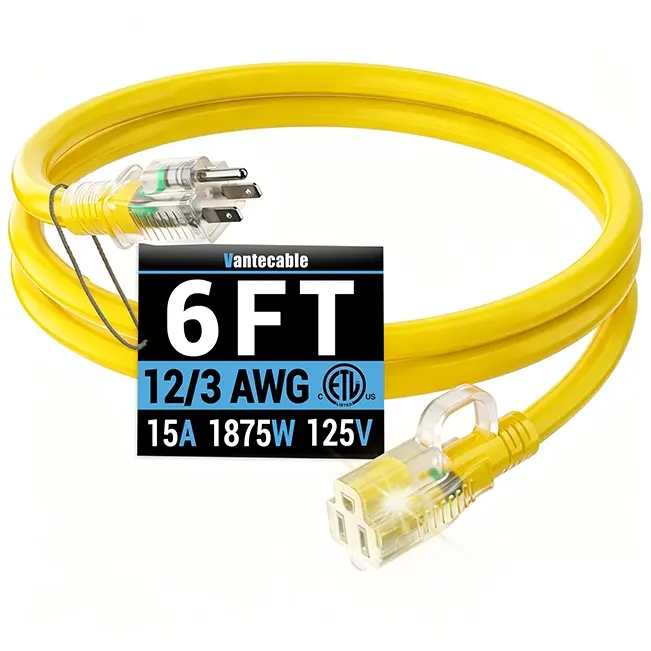
Vantecable 12/3 AWG Yellow Outdoor Extension Cord
- 12/3 AWG construction
- SJTW outdoor jacket
- NEMA 5-15P to NEMA 5-15R connector
- 15A / 125V / 1,875W rating
- LED lighted connector
- Temperature range -40°C to +70°C
- ETL Listed (Intertek)
- Available lengths: 6 ft, 10 ft, 15 ft, 25 ft, 50 ft, 75 ft, 100 ft, 150 ft, 200 ft and 500 ft
Choosing a 12 Gauge 3 Conductor Cord for Real Loads
A 12 gauge 3 conductor cord may be appropriate for compatible 120V tools and equipment when its complete rating meets the load. Begin with the equipment nameplate: confirm its voltage, current or input wattage, then compare those values with the cord label and the supplying circuit. Equipment categories alone are not enough because similar-looking tools may have different input ratings and manufacturer instructions.
Motor-driven tools, pumps and air compressors may draw more current during startup than during steady operation. Use the shortest practical cord that satisfies the equipment manufacturer’s guidance, because excessive length can make voltage drop more noticeable during starting. Stop using the setup if the plug or connector becomes unusually warm.
Heating appliances can place a sustained load on a circuit, and some manufacturers prohibit extension-cord use. Their instructions take priority. For outdoor tools, also confirm an outdoor-use jacket designation, keep connectors dry, use GFCI protection where required and inspect the full cord for damaged blades, cuts, crushed areas or exposed conductors before use.
How Cord Length Affects a 12/3 Extension Cord
Changing the length does not change the meaning of 12/3, but it changes the total resistance of the current path. As the cord becomes longer, voltage drop becomes more relevant, especially with higher-current loads and motor startup.
Select the shortest length that safely reaches the work area without stretching the cord or placing connectors where they can be damaged. Do not join multiple cords to create the required distance. Exact voltage drop depends on current, length, conductor resistance, connection condition and operating temperature, so follow the equipment manufacturer’s instructions instead of relying on one universal distance limit.
12/3 vs 10/3 Extension Cord: When to Move Up a Gauge
A 12/3 extension cord and a 10/3 cord both contain three conductors, but 10 AWG conductors are larger than 12 AWG conductors. The heavier construction may be useful where distance and voltage drop are more demanding, provided the cord’s plug configuration and complete electrical rating remain compatible with the source and equipment.
The table below compares the decision factors, with the emphasis on choosing from the product label and application rather than assuming that a lower AWG number automatically provides a higher usable amperage.
| Decision factor | 12/3 cord | 10/3 cord |
|---|---|---|
| Conductor size | Smaller than 10 AWG | Larger than 12 AWG |
| Weight and handling | Generally easier to carry and coil at the same length | Generally heavier and less compact at the same length |
| Distance consideration | Suitable when its labeled rating and voltage-drop performance meet the load | Worth considering when a longer run makes voltage drop more significant |
| Finished rating | Determined by the complete cord label | Also determined by the complete cord label, not gauge alone |
| Best comparison method | Match load, length, plug and rating | Match the same four factors before buying |
Moving to 10/3 does not automatically change a NEMA 5-15 cord into a higher-amperage product. If both cords carry a 15A rating, both must remain within that limit. The larger conductor can reduce resistance over distance, but it does not override the connector or product rating.
Use this comparison alongside the equipment's actual load and the cord's marked rating, not gauge alone, when deciding whether to move up to 10/3.
What Does 12/3 Mean on an Extension Cord FAQ
Does 12/3 Mean Three 12-Gauge Wires Plus a Ground?
No. On a typical grounded portable extension cord, 12/3 means three 12 AWG conductors in total: hot, neutral and equipment ground. It does not normally describe three conductors plus a fourth grounding conductor.
Does a Longer 12/3 Extension Cord Have a Lower Amp Rating?
The printed product rating does not automatically change because one offered length is longer, but voltage drop increases as the current path becomes longer. Confirm the manufacturer’s rating for the exact length and use the shortest practical cord for the load.
Does a Lighted Connector Prove the 12/3 Cord Is Properly Grounded?
No. A standard lighted connector normally indicates that power has reached the connector. It does not by itself verify grounding continuity, correct polarity, voltage quality, available amperage or the condition of the connected equipment.
Can a Standard 12/3 Extension Cord Replace a Generator Cord?
Only use a cord whose connectors, voltage, amperage and intended application match the generator outlet and the equipment being supplied. A standard NEMA 5-15 extension cord is not a substitute for a dedicated generator inlet cord or higher-amperage locking cord.
Conclusion: Read the Complete 12/3 Extension Cord Label
The answer to what does 12/3 mean on an extension cord is specific: 12 identifies the AWG conductor size, and 3 identifies the total number of conductors. In a grounded 120V cord, those conductors normally serve as hot, neutral and equipment ground. SJTW then describes the flexible-cord construction and outdoor-use designation.
Those markings help explain how the cord is built, but the final selection should come from the complete label. Confirm amperage, voltage, wattage, plug type, jacket designation, length and certification for the exact product. For the featured Vantecable cord, the controlling product rating is 15A at 125V, or 1,875W, with NEMA 5-15 connectors and an ETL Listed configuration. Intertek provides more information about the ETL Listed Mark and its role in product certification.