

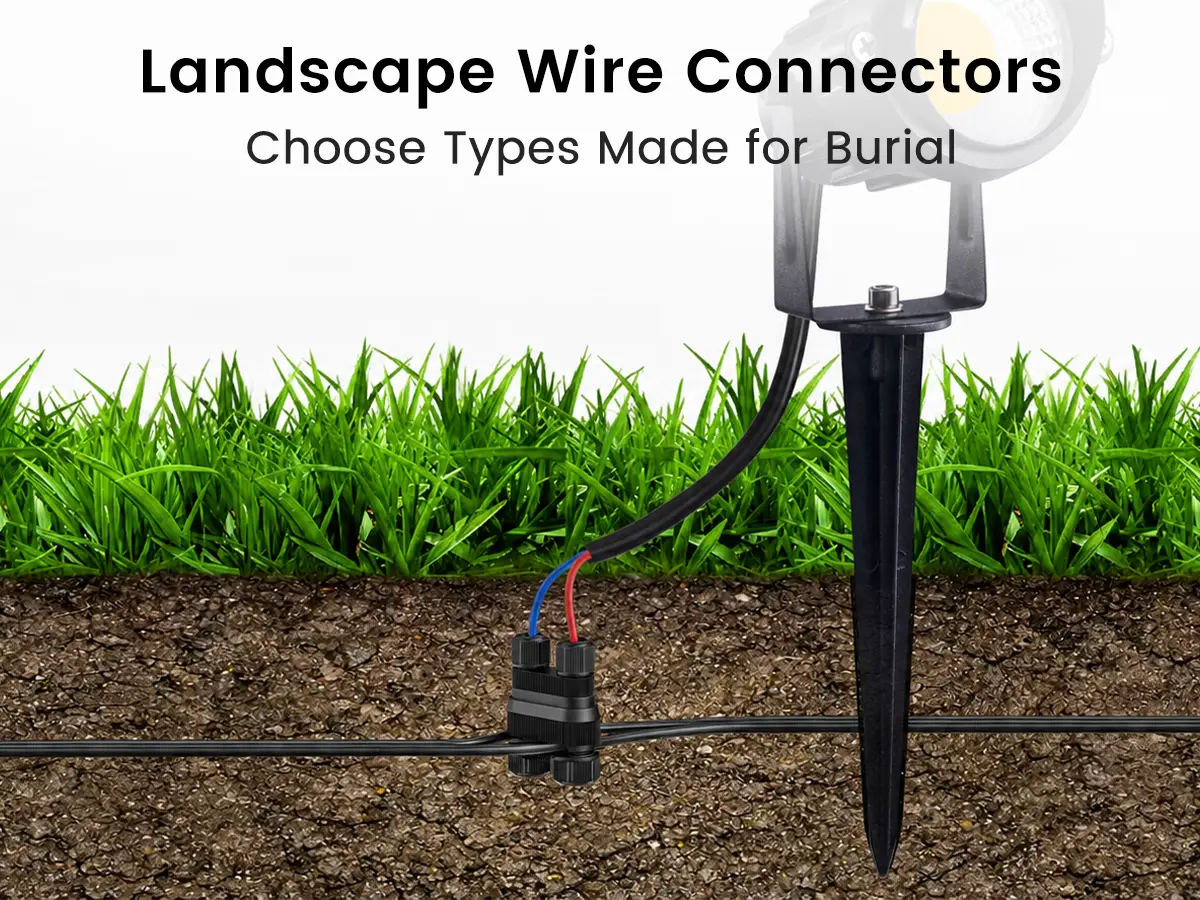
Landscape wire connectors should be selected by the rating of the complete connection, not by names such as “waterproof wire nut” or “outdoor connector.” A connector that works above ground is not automatically suitable for a wet or direct-burial location.
Vantecable does not sell connector accessories, but connector issues are often connected to the cable system itself. This guide explains how to choose direct burial wire connectors, compare connector types, understand why underground splices fail, and determine whether the real problem is the connector or the landscape wire.
Shop Low Voltage Landscape Wire
For a new low-voltage lighting project, the cable layout matters as much as the connection method. Explore Vantecable’s landscape wire collection when planning your outdoor lighting system.
How to Choose Direct Burial Wire Connectors
Choosing direct burial wire connectors starts with the installation environment, not the connector name. Terms such as “waterproof,” “outdoor,” or “weather-resistant” describe features, but they do not automatically confirm that the complete connection is suitable for underground use.
A reliable underground splice depends on three factors: where the connector is approved to be installed, what type of wire it supports, and how the complete connection is assembled.
| Check | What it means |
|---|---|
| Installation rating | The connector is identified for wet locations or direct burial use |
| Wire compatibility | The connector supports the wire gauge, conductor material and wire combination |
| Complete connection | The connector and installation method are suitable as one system |
Weather-resistant is not the same as direct-burial rated. A direct burial wire connector applies to the complete assembled connection, including the connector, the wire and the installation method.
The same principle applies to wire compatibility. A connector that physically fits a cable does not automatically mean it is suitable for that cable combination. The wire gauge, conductor material and number of conductors all affect whether the connection is appropriate.
For low-voltage landscape lighting, the connector should support the cable that is actually being used. A properly selected connector protects the splice, but it cannot compensate for a cable run that is too long, overloaded or unsuitable for the lighting layout.
Landscape Wire Connector Types Compared
Different landscape wire connectors are designed for different connection situations. The best option depends on the installation environment and the cable being connected.
The table below compares common connector categories and the type of problem they are intended to prevent.
| Connector type | Common use | What to verify | Helps prevent |
|---|---|---|---|
| Pre-filled moisture-resistant connector | Underground low-voltage splices | Direct-burial rating and supported wire combination | Moisture reaching conductors |
| Heat-shrink connection system | Inline cable repairs | Correct sleeve size and installation method | Corrosion around the splice |
| Clamp-style connector | Branch and fixture connections | Supported wire range and conductor count | Loose mechanical connections |
| Standard twist-on connector | General electrical connections | Approved installation environment | Incorrect use in wet locations |
No connector type is automatically correct for every landscape lighting system. A connection that performs well above ground may not be appropriate below ground.
The most common mistake is choosing based only on appearance. A connector may look sealed, but long-term performance depends on whether the complete connection is designed for the environment where it will be installed.
Why Direct Burial Wire Connectors Fail Underground
Underground splice failures often follow the same pattern: moisture reaches the connection, the conductor begins to corrode, resistance increases, and lighting performance becomes inconsistent.
A connector can fail when the wire is not fully inserted, the connection does not match the supported wire combination, or the sealing method is not completed correctly. Over time, corrosion can increase resistance at the splice and reduce the voltage reaching fixtures farther down the run.
This does not always appear as an immediate failure. Sometimes the lights continue working but become dimmer, less stable or more sensitive to movement around the connection.
If one fixture or one section after a splice stops working, the connector is a logical place to inspect. If the entire run gradually becomes dimmer toward the end, the issue may involve the wire size, cable length or total lighting load instead.
For more information about end-of-run lighting issues, review our landscape lighting guide.
Can You Splice Landscape Wire for Direct Burial?
Yes, you can splice landscape wire underground when the connector is suitable for the installation location, supports the wire combination and is installed according to its instructions.
A good splice starts with the cable itself. Damaged sections should be removed before making a new connection, and the splice should use clean conductors prepared according to the connector requirements.
The connection should be treated as a complete system. The connector, the wire and the installation environment all affect whether the splice remains reliable over time.
Before any underground work, use the appropriate underground utility locating service such as 811 Before You Dig.
After the connection is completed, inspect the splice area before covering it. A connection that is easy to access during testing is much easier to correct than one that fails after burial.
Can You Daisy Chain Landscape Wire Connections?
Yes, daisy-chain landscape wiring can work when the wire size, lighting load and run length match the project requirements.
Daisy-chain layouts are common because landscape fixtures are often placed along the same walkway, garden border or planting area. The main consideration is that the first section of wire carries power for every fixture farther down the route. As more lights are added, that section carries a larger portion of the total load.
Connection points also become more important because each splice creates another place where resistance or moisture issues can affect the system. A problem near the beginning of the chain may affect every fixture after that point, while a problem near the end may only affect the remaining lights.
A reliable daisy-chain layout depends on the relationship between the cable, the lighting load, the distance and the quality of each connection. A good connector can protect a splice, but it cannot correct a run that is already too long or carrying too much load.
When Dim Landscape Lights Are Not a Connector Problem
A connector is often the first thing homeowners check when landscape lights become dim. Sometimes that is the correct place to look, but the connection is only one part of the lighting system.
If one section becomes dark immediately after a splice point, the connector deserves attention. A loose connection, damaged splice or moisture issue may interrupt power beyond that point.
If brightness gradually decreases from the transformer toward the farthest fixtures, the cause may be related to the wire run instead. Longer distances, higher loads and unsuitable cable selection can create voltage drop that replacing a connector cannot solve.
Before replacing multiple connectors, evaluate the complete lighting layout. The fixture load, cable distance and wire size all affect how much voltage reaches the end of the run.
If the issue is related to cable selection rather than the splice, review the landscape wire guides.
A connector is often the first thing homeowners check when landscape lights become dim. Sometimes that is the correct place to look, but the connection is only one part of the lighting system.
If one section becomes dark immediately after a splice point, the connector deserves attention. A loose connection, damaged splice or moisture issue may interrupt power beyond that point.
If brightness gradually decreases from the transformer toward the farthest fixtures, the cause may be related to the wire run instead. Longer distances, higher loads and unsuitable cable selection can create voltage drop that replacing a connector cannot solve.
Before replacing multiple connectors, evaluate the complete lighting layout. The fixture load, cable distance and wire size all affect how much voltage reaches the end of the run.
If the issue is related to cable selection rather than the splice, use our wire gauge calculator to compare wire size, run length and lighting load.
When the Problem Is the Landscape Wire, Not the Connector
Replacing a connector only fixes the connection point. It does not solve a cable problem caused by excessive distance, damaged insulation or a lighting layout that exceeds what the wire can support.
A new wire run may be the better solution when the cable jacket is damaged, corrosion has spread beyond the splice area, or the existing cable no longer matches the lighting load and installation requirements.
For a new or replacement low-voltage lighting system, choose the wire based on the actual layout rather than replacing a failed connection with the same setup.
Choose Vantecable Landscape Wire for Your Project
Shop Vantecable’s pure-copper wire during the Fall Backyard Wire Refresh and save up to 65% on eligible products.

12/2 Pure Copper Landscape Wire
100-250 ft · 12/2 AWG · 99.9% Copper · 12V/24V DC · ETL Listed · Direct burial
From $49.99
View 12/2 Landscape Wire
14/2 Pure Copper Landscape Wire
100-200 ft · 14/2 AWG · 99.9% Copper · 12V/24V DC · ETL Listed · Direct burial
From $43.99
View 14/2 Landscape Wire
16/2 Pure Copper Landscape Wire
100-200 ft · 16/2 AWG · 99.9% Copper · 12V/24V DC · ETL Listed · Direct burial
From $29.99
View 16/2 Landscape WireLandscape Wire Connectors FAQ
Can You Splice Landscape Wire Underground?
Yes, underground splicing is possible when the connector is designed for the installation environment and supports the wire being connected. The connector rating, wire compatibility and installation method all affect the reliability of the splice. A connector should not be selected only because it is described as waterproof or outdoor-rated.
Can You Connect 12/2 and 14/2 Landscape Wire?
It may be possible when the connector supports both wire sizes and the complete lighting run is evaluated correctly. Connecting different wire sizes does not make the entire circuit perform like the larger conductor. The final result still depends on the lighting load, cable distance and overall system layout.
What Landscape Wire Should I Use After Replacing a Failed Splice?
Choose the wire based on the lighting layout rather than simply replacing the damaged connection. The right choice depends on the total fixture load, cable distance and installation environment. Vantecable offers 12/2, 14/2 and 16/2 landscape wire options for different low-voltage lighting applications.
Conclusion: Choosing Landscape Wire Connectors for Direct Burial
Reliable landscape wire connectors start with the complete connection, not just the connector itself. The installation rating, cable compatibility and environment all affect whether an underground splice remains dependable over time.
When a splice fails, inspect the connection. When an entire lighting run performs poorly, review the wire size, distance and load before replacing connectors repeatedly.
For a new outdoor lighting project, start with the cable layout and choose connectors that match the installation requirements. Explore Vantecable’s low voltage landscape wire collection when planning your next landscape lighting system.
Always follow the instructions provided with the wire, lighting equipment and connection products, along with applicable local requirements. The NFPA 70 National Electrical Code provides the framework used for many electrical installations in the United States.
Shop Vantecable’s pure-copper wire during the Fall Backyard Wire Refresh and save up to 65% on eligible products.