

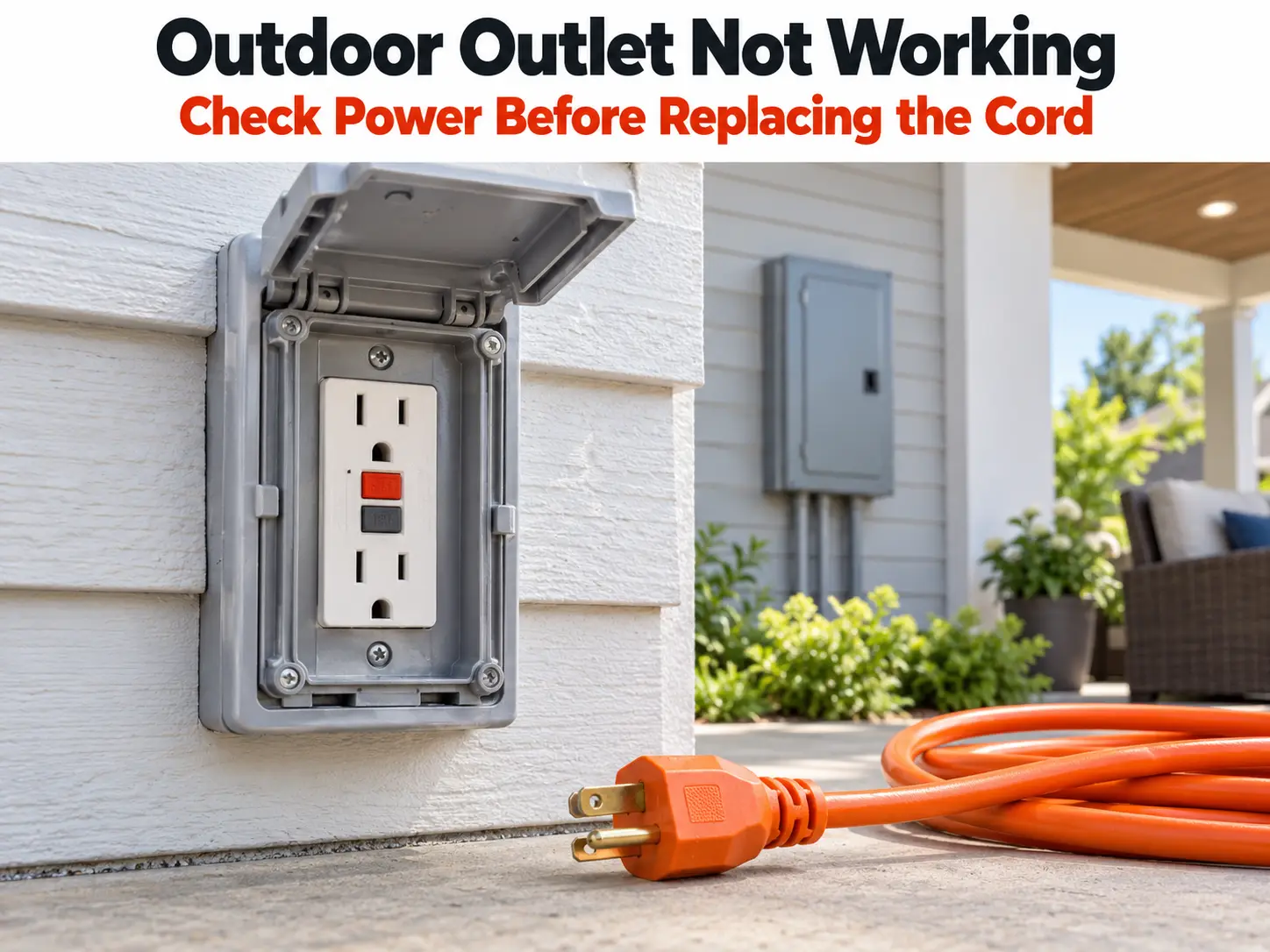
An outdoor outlet not working may be affected by an upstream GFCI, a tripped breaker, a supply control or a connection fault. A device that does not start does not prove the wall outlet is dead, so confirm the affected part before replacing the extension cord.
Stop checking and keep away from the outlet if you see moisture, standing water, a burning smell, unusual heat or visible damage, and turn off the upstream power from a dry, safe location first. This guide covers only checks you can make safely from the outside: how the outlet behaves, the protective devices you already know about and the controls you already know about. It does not cover opening an outlet, a panel or any wiring.
Vantecable Outdoor Extension Cords
Compare lengths and outlet layouts for temporary outdoor power.
Outside Outlet Not Working: Have You Confirmed the Wall Outlet Has No Power?
Use a known-working small outdoor-rated device to check the outlet under the safe conditions below. If it runs, the outlet supplies power; check the cord and equipment next. If it does not run, check the outlet, its supply and its controls. An outside outlet not working can look the same as a failed cord, a switched-off tool or a timer that has reset, so check the outlet first.
Can a Known-Working Device Help Check a Dead Outdoor Outlet?
Yes. A known-working small outdoor-rated device can help show whether the outlet supplies usable power. If it runs, the outlet supplies power to that device. If it does not, check the outlet, its supply and its controls.
Use it only when the outlet and surrounding area are dry, undamaged and free of unusual heat or repeated tripping. This check does not verify grounding, wiring condition or capacity for the intended load. Do not use suspect equipment to reproduce a fault.
What Does No Power Outside Affect: One Outlet or Several?
No power outside can affect one outlet or several. Check how many outlets have lost power before choosing where to look next.
If several are affected, start with shared protection or controls. If only one is affected, start with its protection, controls and connection.
Could an Upstream GFCI Explain an Outside Outlet Not Working?
Yes, an outdoor outlet without TEST and RESET buttons can still be protected by a GFCI installed somewhere else. An upstream GFCI may sit in a garage, in another indoor location or in a separate outdoor protective device, and when it trips, every outlet it protects can lose power at once. Where a GFCI is located only tells you where to look. The actual protection depends on how the circuit was wired, so do not assume the nearest outlet protects the others.
Start with locations you already know to be related and with any circuit labels that exist. Do not reset every GFCI you find. The Electrical Safety Foundation’s guidance on how to use and test GFCIs lists damaged cords, faulty equipment and the condition of the GFCI itself among the things to rule out, and says to contact an electrician when the cause is unclear or the tripping continues.
GFCI Not Resetting: Is the Supply Missing or Is a Fault Still Present?
GFCI not resetting may involve missing supply, a persistent fault in connected equipment or wiring, or a problem with the GFCI itself. It does not identify the extension cord as the cause, so check the upstream supply and connected setup.
Can No Power to the GFCI Prevent It from Resetting?
Yes, some models will not reset when they receive no supply from upstream. No power to the GFCI can come from a tripped breaker, a supply control that is switched off or a loose connection upstream, so check the controls and circuit status you can reach safely. Do not take live measurements and do not open anything to look at connections.
Manufacturer GFCI reset guidance names missing power, a ground fault that is still present, incorrect wiring and a damaged unit as the main reasons a GFCI will not reset. The exact behavior depends on the model.
Resetting an Upstream GFCI: What to Check First and When to Call an Electrician
Check for moisture, damaged equipment, unusual heat and repeated tripping before any reset, and stop if any of them is present. If none is present and it is safe to do so, disconnect the loads on that circuit and then use the external controls as the device’s instructions describe. Follow the manual for the specific model, because indicator lights, waiting times and reset behavior differ between models. Do not press RESET repeatedly to force power back.
Call a qualified electrician when the cause stays unclear, the GFCI will not recover, it trips again, the problem began after a recent installation or replacement, or it will not reset even with nothing connected. Any change to the wiring at the GFCI, including the line and load connections, belongs to the electrician.
Can a Tripped Breaker or Switched-Off Control Cause No Power Outside?
Yes. A tripped breaker or a switched-off control cuts power to the outlet, and either one can leave an outdoor outlet dead while the rest of the house still has power.
What Can the Circuit Breaker’s External Status Tell You?
The handle and any model-specific indicator show the breaker’s reported status. On many models, a middle position indicates a trip; OFF may mean the breaker was switched off manually. A handle fully at ON does not confirm power at the outlet, so check the upstream GFCI and known controls next. Look only at the handle and the circuit label, and follow the circuit breaker model’s instructions for interpreting its status indicator.
When the cause is unclear, or when there is moisture, heat or a burning smell, resetting is not the default action. Do not open the panel cover, touch internal wiring or replace a breaker with a larger one.
Could a Wall Switch or Timer Leave an Outdoor Outlet Without Power?
Yes, a known wall switch or timer setting can cut power to an outdoor outlet, including after a power outage resets the timer. This is a common reason for an outdoor outlet without power that has nothing to do with a fault. Check the controls you already know about and the timer’s settings after any outage. Do not flip every switch in the house hoping one restores power, and remember that the on/off switch on a tool or appliance does not control the outlet.
The table below shows what each observation tells you about the supply, without assuming that every dead outlet has the same cause.
| Observation | What to check next | What You Can Conclude |
|---|---|---|
| A suitable known-working device does not operate at the dry, undamaged outlet | Known supply controls and protective devices | The outlet did not supply usable power to the checked device; the cause remains unidentified |
| Several outlets lose power | Their actual circuit and upstream protection | More than one outlet is affected; a shared supply interruption is possible |
| GFCI will not reset | Supply availability, persistent fault or device condition | The GFCI has not reset; its supply, connected setup or the GFCI itself needs checking |
| Breaker appears on, but the outdoor outlet has no usable power | Upstream GFCI, controls or a connection issue | The handle position alone does not explain the loss of power |
| Wall outlet provides power, but equipment connected through a cord does not run | Cord connections and permitted device controls | Power was available at the wall outlet during the check; the cord and equipment need attention |
Extension Cord Not Working but the Outlet Has Power? What to Check
If the outlet supplies power but equipment connected through the cord does not run, check the cord connections and the equipment’s permitted controls. An apparent extension cord not working may actually involve the device rather than the cord.
With power disconnected, inspect the plug, connector and jacket for damage or heat marks, and check that connections fit securely. Operate only the controls permitted by the equipment instructions.
A lighted connector provides a power-status indication at its location; it does not verify every receptacle, grounding, load capacity or circuit safety.
If any connection is wet, turn the upstream power off from a dry position before touching anything. The steps for a wet cord are in our wet extension cord safety guide. A cord that trips a protective device as soon as it is connected or started is a protective-device event, and the checks should stop there.
When Should You Replace the Cord with a Lighted Triple-Tap Extension Cord?
Once the supply issue is resolved, consider a lighted triple-tap cord if the old cord needs replacement and you need three nearby connection points. Confirm that each device permits extension-cord use and that the cord’s rating meets the setup’s requirements.
The Vantecable 12/3 lighted triple-tap extension cord has three outlets, 12 AWG conductors and an SJTW jacket, and its lighted end shows that power reaches the connector. The lighted cord indicator meaning guide explains what the light does and does not show. Its rating of 15A / 125V / 1875W applies to the cord as a whole, so the combined load on all three outlets must stay within it. It is ETL Listed (Intertek).

Vantecable 12/3 Lighted Triple-Tap Extension Cord
Three outlets and a lighted end that shows power reaching the connector.
12 AWG · SJTW · Three outlets · Power indicator · 15A / 125V / 1875W total rating · ETL Listed (Intertek)
From $17.63
Shop the 12/3 CordFAQ: Outdoor Outlet Not Working
Why Does Only One Half of an Outdoor Outlet Work?
It can be a split-controlled outlet, a wiring arrangement or a failing receptacle, and a single working half does not confirm that the outlet is safe. Some outlets are wired so that a switch controls one half, which is a normal arrangement, but damage or a loose connection can produce the same symptom. Stop using the outlet if you see heat, discoloration or damage, and have a qualified electrician check it. Do not open the outlet to investigate.
What Should You Record Before Calling About an Outside Outlet Not Working?
Record which outlets are affected, when power stopped, what equipment was connected, and any GFCI or breaker indications. Note recent rain, unusual heat or a burning smell. Do not reconnect suspect equipment just to reproduce the problem.
Should You Keep Using an Outdoor Outlet That Lost Power and Came Back On by Itself?
No, unless a known timer or switch explains it. An outlet that lost power and then returned without anyone resetting it still has an unknown cause, such as a loose connection or moisture. Stop using it until the cause is found, and do not wiggle the plug to restore contact.
Conclusion: Find the Cause of an Outdoor Outlet Not Working Before Buying a Cord
Confirm that the outlet has usable power first, then check the known upstream protection and controls, and only then look at the cord or equipment. An outdoor outlet not working is a supply question until the outlet is shown to be live, and replacing a cord does not change that. If the outlet is live and the old cord needs replacing, choose the replacement by the equipment’s rating. Stop and call a qualified electrician when the cause cannot be identified, a protective device keeps operating, or there is any sign of moisture, heat or damage.
Safety note: This article describes general supply-check concepts and inspection practice, not a substitute for the equipment manufacturer’s instructions or local electrical codes. Never open an outlet, a panel or wiring, take live measurements, or reset a protective device that will not hold. If you are unsure whether an outlet is properly supplied or grounded, have it checked by a licensed electrician.