

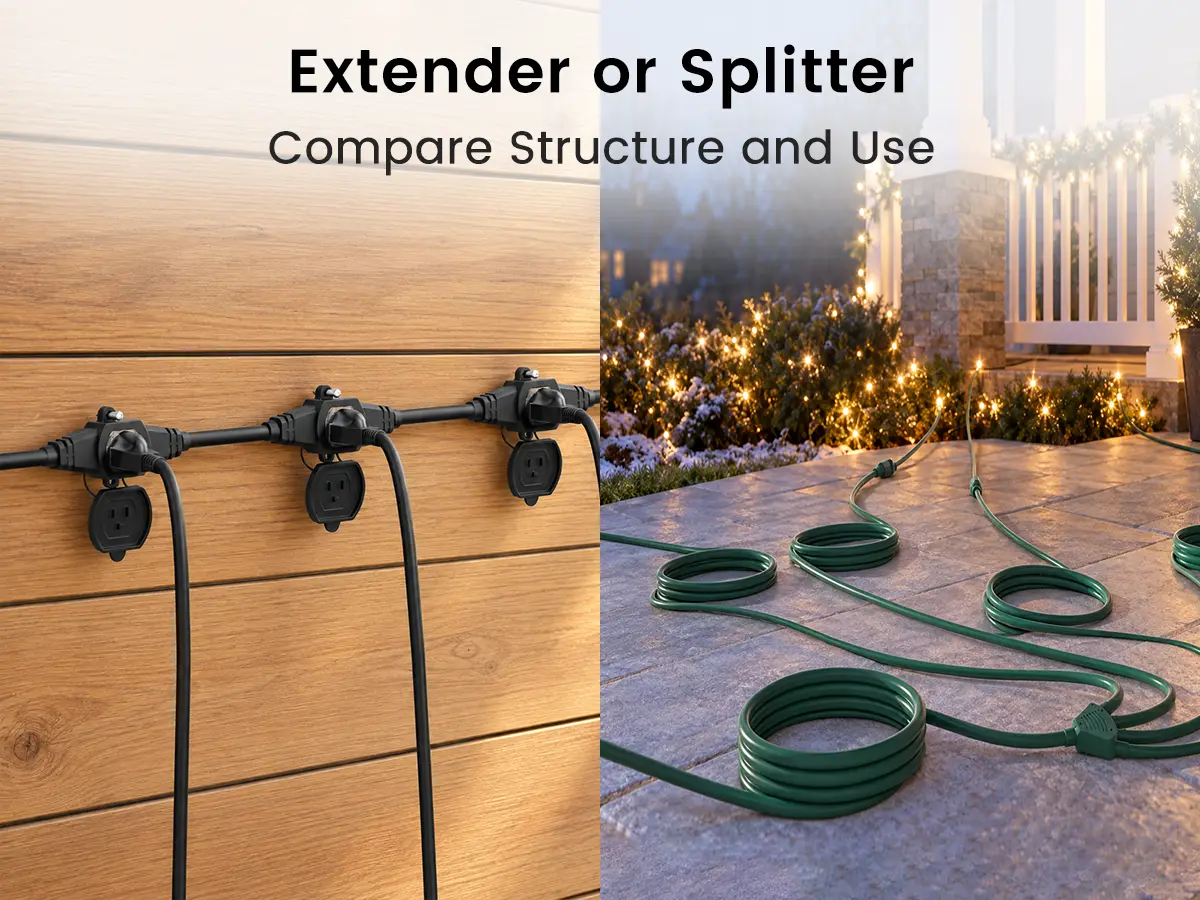
An outlet plug extender keeps several receptacles at the wall, while an extension cord splitter carries those connection points away from the wall. Choose the plug extender for devices grouped beside one receptacle and the cord splitter when temporary equipment sits farther away or in separate locations, such as a patio, garage or yard. Neither adds circuit capacity, so this guide compares only layout and placement.
Shop Outdoor Extension Cords
Cords, splitters and multi-outlet options for your yard.
What Is an Outlet Plug Extender, and Where Does a Multiple Plug Outlet Stay?
An outlet plug extender plugs directly into a wall receptacle and turns one opening into several. Search results also call it a wall tap or wall outlet extender. Because it sits flush against the wall, it adds little or no reach: every connection stays beside the original outlet. A multiple plug outlet of this type suits a workbench, charging corner or row of small appliances, not a device across the room.
Before using one, check plug orientation, whether the body covers the neighboring receptacle, and whether bulky adapters crowd each other. It is not automatically a power strip or surge protector, and its shape doesn’t prove USB ports, surge protection or outdoor suitability. Rely on the product label and manufacturer instructions.
How Does an Outdoor Extension Cord Splitter Move Outlets Away From the Wall?
A flexible cable carries the connection points from the receptacle to where the devices sit, so outlets are distributed near the equipment instead of at the wall. Receptacles may be grouped at the end of the cord or spaced along it, and some listings call the product a power splitter cord. An outdoor extension cord splitter suits patio lights, garden lighting, holiday displays and temporary work lights, where one run replaces several cords from the wall.
Before buying, check the distance from the plug to the first receptacle, the spacing between receptacles, and whether the farthest device reaches its connection point without tension. Outlet count varies by cord length; our multi-outlet cord guide covers choosing a length and layout.

Vantecable 1-to-3/4 Splitter Outdoor Extension Cord
Multiple connection points for temporary outdoor layouts. All outlets share the cord’s total rating.
16/3 SJTW · Green · 3 or 4 outlets by length · 13A / 125V / 1625W total · ETL Listed (Intertek)
From $21.05
Shop the SplitterOutlet Plug Extender vs. Extension Cord Splitter: Which Fits the Device Layout?
Start with the layout. Mark the receptacle you will use and where each device will actually sit. If everything is within arm’s reach of the outlet, the plug extender is simpler. If any device sits across a room, on the far side of a patio or along a path, the connection points have to travel, and that is what a cord is for.
| Decision Point | Outlet Plug Extender | Extension Cord Splitter | Why It Matters |
|---|---|---|---|
| Connection location | At the wall receptacle | At the end of or along a flexible cord | Sets where devices plug in |
| Added reach | Little or none | Carries connections away from the wall | Matters for remote equipment |
| Device layout | Grouped beside the outlet | Grouped remotely or spread along a route | Matches outlet to equipment position |
| Wall clearance | May block a nearby receptacle or crowd bulky adapters | Only the supply plug occupies the wall receptacle | Affects access at the original outlet |
| Outdoor use | Only if specifically marked for the location | Choose a cord specifically rated for outdoor use | Shape alone doesn’t establish suitability |
If you are choosing between three and four connection points rather than between structures, see the outlet count guide.
The extender is the wrong shape when devices are spread out, far from the wall, or use adapters wide enough to cover the second receptacle. If neither structure reaches cleanly because both would mean tugging plugs, crossing a walkway or chaining temporary cords, rearrange the devices or use one cord of the right length. For a spot you use repeatedly, consider a code-compliant permanent solution: the CPSC treats extension cords as temporary power and cautions against overloading and damaged cords in its cord safety guidance.
Where Should Extension Cord Splitter Connections Sit Outdoors?
Run the cord from an outdoor-rated receptacle toward the equipment and keep every connection visible. Check the jacket, plugs and connection points before use, after moving equipment and after bad weather. Keep connections away from puddles and drainage channels, walkway centers and steps, door and window gaps, vehicle routes, cutting equipment, and spots where plugs get stepped on.
Don’t let plugs or connections carry constant strain, and don’t bury a standard extension cord in soil, mulch or gravel. An outdoor rating is not permission to submerge a cord or leave it out permanently; our outdoor rating guide explains what the labels mean.
FAQ About Outlet Plug Extender and Extension Cord Splitter
Can an Outlet Plug Extender Be Used Outdoors?
Only if the exact product is marked and instructed for outdoor use. A wall-mounted shape or a cover alone doesn’t establish it.
Does an Outlet Plug Extender Include Surge Protection?
Not necessarily. Some products do, but call one surge-protective only if its label and specifications say so. If you need surge protection for an RV hookup, a dedicated Vantecable RV surge protector is the better route.
Can a Multiple Plug Outlet Block the Second Receptacle?
Yes, some designs cover the neighboring outlet. Check the body size and plug orientation before buying, especially if you plan to use both receptacles.
Conclusion: Choose an Outlet Plug Extender by Connection Location
If your devices all sit beside the wall receptacle, an outlet plug extender may be all you need. If they sit far away or are spread out, choose a cord splitter suited to the environment. Outlet count decides how many devices you can connect; cord structure decides where those connections are.
Safety note: Extension cords are intended for temporary use. Follow the product label and the manufacturer’s instructions, keep the combined load of all connected devices within the cord’s rating, and check local codes before making any wiring change permanent.