

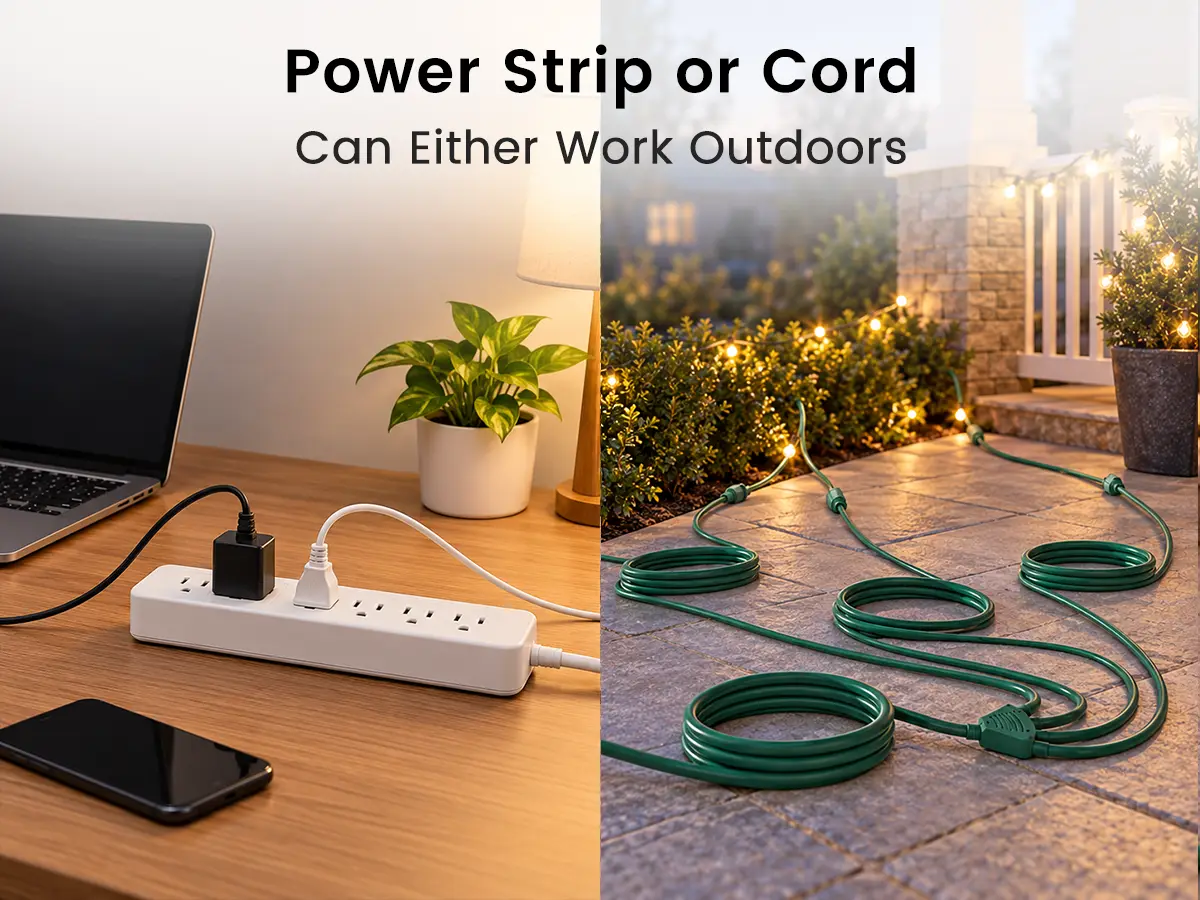
Power strip vs. extension cord is a different question outdoors than it is at a desk, because the first thing to check is whether the product is made for outdoor use at all. A standard indoor power strip should not be used on a patio or porch. An outdoor-rated extension cord, including a model with multiple outlets, can supply temporary outdoor power when the whole assembly is marked for outdoor use and the total load stays within its rating. A few power strips are labeled for outdoor use, so the label decides.
Outdoor Extension Cords
Find outdoor-rated cords when a power strip is not an option.
Power Strip vs. Extension Cord: What Does Each One Actually Do?
A power strip adds outlets near an existing receptacle. Some include a switch, circuit breaker or surge protection, which the label has to confirm. An extension cord adds reach, and some models add several outlets at the same time, either molded into the end or spaced along the cord on branches. The table below compares the two with a focus on outdoor use.
| Comparison Point | Power Strip | Extension Cord |
|---|---|---|
| Main purpose | Add outlets near the source | Extend reach to where the power is needed |
| Outdoor use | No, unless the label says so | Only when the whole cord is marked for outdoor use |
| Outlets | Several, in a bar or block | One, or several on multiple-outlet models |
| Available capacity | Limited by the nameplate rating | Limited by the cord rating, shared by all outlets |
Can You Use a Power Strip Outdoors on a Patio or Porch?
A standard indoor power strip should not be used outdoors, and a porch roof or patio cover does not change that, because a covered patio can still see blowing rain and damp conditions. A power strip should be considered for outdoor use only when its markings and instructions explicitly permit the conditions where you plan to use it. “Outdoor,” “damp location,” and “wet location” should not be treated as interchangeable terms. Surge protection is a separate feature and is not part of an outdoor rating. For protection at a 30A or 50A RV hookup, see our RV surge protector.
Can You Plug a Power Strip Into an Extension Cord Outdoors?
Do not assume you can. Instructions for many power strips require a direct connection to a permanently installed receptacle and rule out extension cords and other power strips, and the OSHA guidance on relocatable power taps describes that requirement for listed power taps.
Chaining a strip to a cord, or daisy-chaining one power strip to another, makes the load hard to judge, lets the lowest-rated part set the limit for everything behind it, and adds connection points that are exposed to weather outdoors. If you need several outlets at a distance, a properly rated extension cord with multiple outlets may eliminate the need to add a separate power strip. The combined load and the manufacturer’s instructions still determine whether the setup is appropriate.
When Does an Extension Cord With Multiple Outlets Make Sense Outdoors?
It suits temporary jobs such as holiday lights along a fence, landscape decorations or several low-wattage devices spread across a yard, because spaced branches let each device plug in where it sits. Confirm that the complete cord assembly, including its plug and outlet ends, is rated for outdoor use under the manufacturer’s labeling and instructions. For choosing length, gauge and layout, see our multiple outlet buying guide.
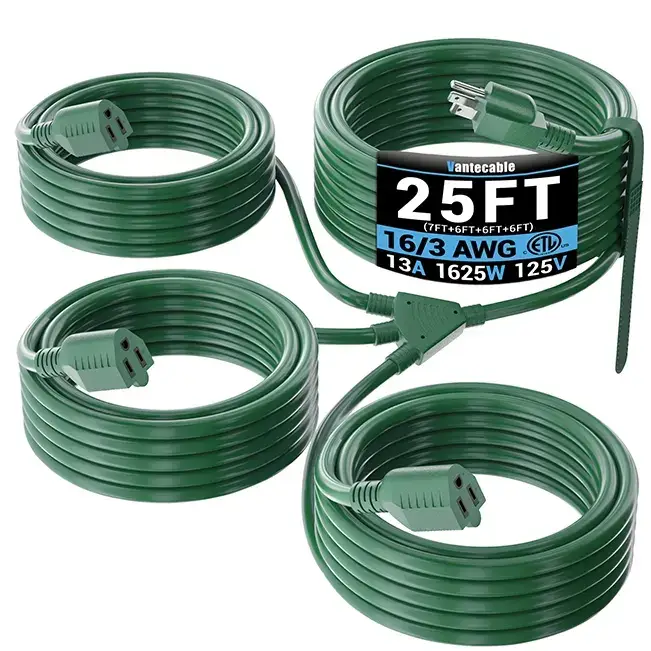
Vantecable 16/3 Outdoor Extension Cord With Multiple Outlets
16/3 SJTW · Green · 25–46 ft · 13A / 125V / 1625W · ETL Listed (Intertek)
From $21.05
View ProductPower Strip vs. Extension Cord: How Much Total Connected Load Can You Plug In?
Add up the nameplate amps or watts of every device you plan to run and compare the total connected load with the rating on the cord or strip. Devices labeled 600W and 1200W add up to 1800W, which is more than a cord rated for 1625W can carry, however many outlets are still empty.
The limit for the whole setup is the lowest rating among the circuit feeding the outlet, the cord or strip, and any adapter between them. A hot plug, a damaged jacket, discoloration, a loose fit or intermittent power means the cord should be taken out of use. Our guide to why an extension cord gets hot covers the warning signs in more detail.
Which Should You Choose: A Power Strip or an Extension Cord?
The table below matches common power needs to the right product category and lists what to check before use.
| Need | Better Fit | What to Verify |
|---|---|---|
| Several devices near one indoor outlet | Power strip | Load rating and device compatibility |
| One outdoor device far from the outlet | Outdoor extension cord | Outdoor marking, gauge, length and load |
| Several compatible outdoor devices | Extension cord with multiple outlets | Total load and the rating of the whole cord |
| Permanent outdoor power | Neither | Wiring by a qualified electrician |
FAQ About Power Strip vs. Extension Cord Outdoors
Which Is Safer, a Power Strip or an Extension Cord?
Neither is safer by category. Safety depends on whether the product is marked for the place it is used, whether the total load stays within its rating, and whether it is undamaged. Indoors, a power strip suits compatible devices grouped near an outlet. When outdoor reach is required, an outdoor-rated extension cord is generally the relevant product category, provided its load rating, construction and instructions match the application. CPSC extension cord safety information explains how cords are regulated and what to look for.
What Should You Never Plug Into a Power Strip or Extension Cord?
Do not connect equipment that exceeds the product’s rating or whose instructions require direct connection to a permanently installed receptacle. Check the equipment nameplate and manual instead of relying only on the number of available outlets.
Is It Okay to Leave a Power Strip or Extension Cord Plugged In Outdoors All the Time?
Follow the manufacturer’s instructions for either product, including limits on outdoor exposure and use. Extension cords are made for temporary power and should not replace permanent wiring. For ongoing power at a fixed outdoor location, have a qualified electrician install a permanent outdoor receptacle.
Conclusion: Choosing a Power Strip vs. Extension Cord Outdoors
Check the environment and the label before you compare outlet counts. A standard indoor power strip does not belong outdoors, and a product marked for outdoor use still has to stay within its load rating. When you need both distance and several temporary outlets, an extension cord with multiple outlets is the closer fit.
Safety note: This guide reflects general U.S. electrical practice and the markings printed on outdoor-rated cords. Always follow the manufacturer’s instructions and your local electrical code. Extension cords are for temporary use and are not a substitute for permanent wiring.