

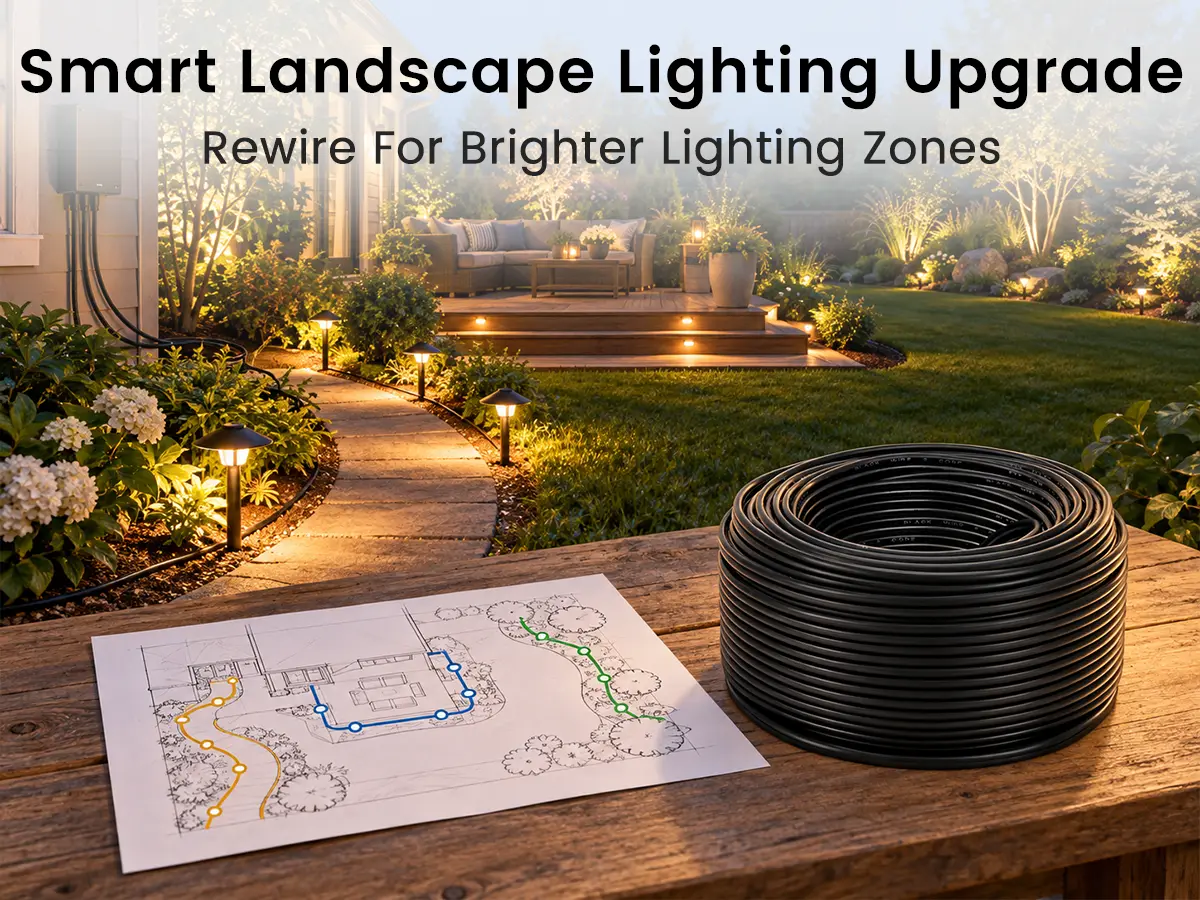
Smart landscape lighting upgrades often expose wiring limits that the old layout hid: the farthest fixtures dim, one long run feeds the whole yard, or a new zone has nowhere to connect. The wire determines whether each lighting area can receive enough low-voltage power. Runs that are undamaged and suited to the new layout can stay, and only damaged, undersized or poorly arranged sections need replacing. For a longer, remote or more heavily loaded branch, 12 AWG pure copper landscape wire may leave more voltage-drop margin when the load, distance and equipment instructions support it.

Vantecable 12/2 Pure Copper Landscape Wire
A wiring foundation for adding remote fixtures, reorganizing existing runs and preparing separate lighting zones.
12/2 AWG · Pure copper · Black · 100 ft or 250 ft · Direct burial · ETL Listed (Intertek)
From $49.99
Shop the 12/2 WireWhy Do Landscape Lights Dim During a Smart Landscape Lighting Upgrade?
Landscape lights may dim during a smart landscape lighting upgrade when new fixtures increase the load, a cable route is extended or an existing run has limited voltage-drop margin. A loose connection, damaged cable, control setting or fixture fault can look similar, so dim lights do not mean every wire must be replaced. Lights that weaken gradually toward the end of one run point to the route, load and wire size. A sudden change after one connection points to that connection or the cable section next to it. For the full diagnosis, see our guide to landscape lights that dim.
Does Your Yard Show These Landscape Lighting Upgrade Signs?
Your yard may need new wire when the existing cable layout prevents separate zones, remote additions or consistent light along a complete run. One symptom alone does not prove the cable must be replaced, but once controls, fixtures and isolated connection faults are ruled out, the affected run is the limit of the upgrade.
The table below lists the yard conditions that limit a zoned upgrade and the wiring change that addresses each one.
| Existing Yard Condition | Smart Upgrade Limitation | Recommended Wiring Change |
|---|---|---|
| All fixtures share one long run | Areas cannot be divided cleanly into separate zones | Add dedicated branches for each control zone |
| A new patio or garden area has no nearby branch | New fixtures would extend an already long route | Run a new copper branch from the distribution point |
| The farthest zone dims when more fixtures are added | Existing run has limited voltage-drop margin | Recalculate the branch and replace it if required |
| Cable routes are undocumented | Repairs and future expansion become harder | Map and label each run during the upgrade |
| Every addition requires another inline splice | The existing layout is difficult to expand | Create planned branch points in accessible locations |
Replacing wire should correct a confirmed wiring limitation. A new 12 AWG copper run will not repair a failed fixture, an incorrect control setting or incompatible equipment. For landscape lighting repair limited to one locatable joint, fix that connection first. Once other causes are ruled out, replacing the limiting run can split an overly long route, add voltage-drop margin and give future zones a clearer starting point.
What Can Smart Landscape Lighting Zones Add to Your Yard?
A zoned layout gives each area of the yard its own low-voltage run: the front entry and walkway, the patio, garden accents and the driveway edge. With compatible controls installed, separate runs let the entry and path follow one schedule while the patio follows another, and they allow a garden addition without extending the original line. When one zone has a fault, the search narrows to that run and its connections instead of the whole yard.
The table below connects common zone goals with the wiring decision behind each one.
| Desired Result | Wiring Decision | What the Wire Supports |
|---|---|---|
| Path and patio on separate schedules | One identifiable run for each area | Delivers low-voltage power to each zone separately |
| Remote garden lights | Check route length and fixture load first | Gives the far area its own path instead of an extension of a long old line |
| Later additions and troubleshooting | Record branches and connection points | Makes new fixtures easier to evaluate and a faulty zone easier to locate |
How Does Low Voltage Landscape Lighting Wiring Support Separate Smart Outdoor Lighting Zones?
Low voltage landscape lighting wiring supports separate zones by giving each zone its own run that carries low-voltage power from the supply to that zone’s fixtures. Compatible controls handle schedules and the fixtures handle light output, so the wire’s job is that continuous power path, kept intact by its connections. Gauge, distance and load together set the voltage left at the last fixture. Adding fixtures, distance or zones can expose a margin the old run barely had, so review the wire before building the new layout.
Where Does 12 AWG Pure Copper Wire Fit in a Zoned Smart Lighting Upgrade?
12/2 pure copper landscape wire fits three situations in a zoned layout: a separate zone far from the supply, the main run feeding a heavily loaded zone, and a run planned for extra fixtures later. A 12 AWG run reaches a remote garden or driveway edge without extending an old line. The lower resistance of a 12 AWG copper conductor gives the busiest branch more voltage-drop margin. Choosing 12 AWG at the start also leaves design margin for lights you add later. Shop Vantecable’s pure-copper wire during the Fall Backyard Wire Refresh and save up to 65% on eligible products.
The 12 AWG pure copper conductor matters most on those runs. The two-conductor 12/2 construction fits low-voltage landscape lighting circuits that need a supply and a return. The 100 ft and 250 ft lengths let you buy by the measured route and avoid adding splices to reach the end. The black jacket suits outdoor routing, and the product page lists the wire as direct burial landscape wire, so underground runs to new zones can use the same cable. It is ETL Listed (Intertek), which gives third-party safety certification; the ETL Listed Mark page explains what the mark covers. The gauge for each run still depends on its actual load, distance, system voltage and equipment requirements.
How Do You Rewire Smart Landscape Lighting Without Rebuilding Everything?
You do not need to replace every run. Keep the ones that are correctly rated, undamaged and suited to the new layout, and replace only the sections that limit the planned zones.
Start by marking every fixture and the area it lights. Record the wire gauge, conductor material and route of each existing run where they are known, then inspect the jacket and connections. Compare each run with the new zone plan, keep what fits, replace what limits it and give any remote or new area its own run. Finish by updating the wiring map.
Which Existing Wire Runs Can Stay During a Smart Landscape Lighting Upgrade?
Keep a run when its jacket and connections are in good condition and it can serve one planned zone on its own. Add a branch when the old run can stay but a new area needs separate control: leave the old run in place and run a new branch from the distribution point instead of extending it. Replace a run when its jacket or conductor is damaged, it cannot carry the planned load, or the layout forces several zones onto one unreasonably long run. UL’s wire markings guide helps confirm whether existing wire of unknown type suits the environment.
How Do You Plan Smart Landscape Lighting for Future Expansion?
Before digging, sketch each zone (walkway, patio, garden bed, driveway edge) and note its fixture count, the distance to the farthest fixture and the planned wire gauge and material. Give a zone you may extend later its own run and leave slack at the end of it. Check each run’s load and distance with a wire gauge calculator before choosing the gauge, and mark the connection points on the sketch so a fault can be traced later. Follow the wire, lighting equipment and control manufacturer instructions along with applicable local requirements, and have a qualified person handle any work on the line-voltage supply where required.
Smart Landscape Lighting FAQs
Can Existing Landscape Lighting Wire Stay When Adding Smart Controls?
Yes, if the existing wire is undamaged, properly sized for its load and distance, and arranged in a way that matches the planned control zones. Adding smart controls does not automatically require replacing every wire run.
Does Every Smart Landscape Lighting Zone Need 12 AWG Pure Copper Wire?
No. Wire size depends on each zone’s load, one-way distance and equipment requirements. Vantecable 12/2 pure copper wire is most relevant where a longer or more demanding branch needs additional voltage-drop margin.
Can You Replace Existing CCA Landscape Wire with Pure Copper Wire?
Yes, but verify the required wire size, connector compatibility and equipment instructions before replacing the run. Replacing CCA with pure copper does not correct an overloaded transformer, damaged fixture or poorly planned zone layout.
Conclusion: Build Smart Landscape Lighting on Reliable Wiring
Before adding zones to your smart landscape lighting, keep the runs that still suit the layout and replace the damaged, undersized or poorly arranged sections. Vantecable 12/2 pure copper landscape wire gives longer, remote or heavily loaded branches the added voltage-drop margin that a 12 AWG conductor can provide. Plan each zone separately and document the routes so later additions are easier to evaluate.
Shop Vantecable’s pure-copper wire during the Fall Backyard Wire Refresh and save up to 65% on eligible products.
Always confirm the conductor size, material, installation rating, system voltage and equipment requirements for the exact landscape lighting system being upgraded.