

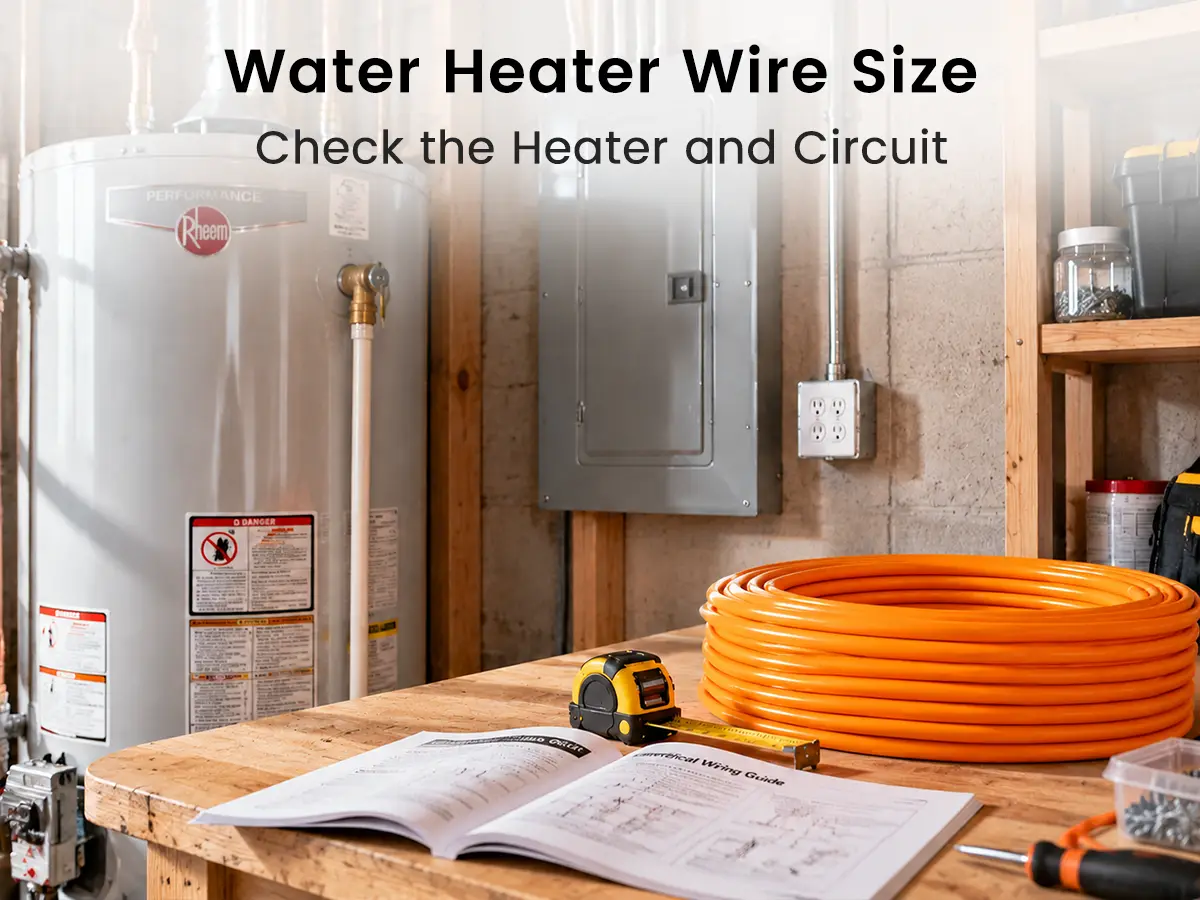
For a standard 240 V single-phase electric storage water heater, water heater wire size follows the nameplate wattage, not a single chart. A 4500 W heater takes 10 AWG copper with a 25 or 30 A double-pole breaker, a 3500 W unit fits 12 AWG with 20 A, and a 6000 W unit needs 8 AWG with 35 A. Read your own nameplate first, then follow the steps below from sizing to installation.
Electrical Wire
Shop wire and cable for home wiring, landscape lighting, and equipment connections.
Shop Electrical WireWater Heater Wire Size Chart: Quick Reference
Find your nameplate wattage in the table, then read across to the minimum ampacity, wire and breaker.
| Nameplate (240 V) | Current | Minimum (× 1.25) | Copper wire | Breaker |
|---|---|---|---|---|
| 3500 W | 14.58 A | 18.23 A | 12 AWG | 20 A |
| 4500 W | 18.75 A | 23.44 A | 10 AWG | 25–30 A |
| 5500 W | 22.92 A | 28.65 A | 10 AWG | 30 A |
| 6000 W | 25.00 A | 31.25 A | 8 AWG | 35 A |
Common 4500 W and 5500 W storage-heater configurations point to 10 AWG copper. On page 8, the Rheem installation manual lists 12 AWG with 20 A overcurrent protection for 3500 W, 10 AWG with 25 A for 4500 W, 10 AWG with 30 A for 5500 W, and 8 AWG with 35 A for 6000 W at 240 V.

Vantecable 10/2 NM-B Wire With Ground
For compatible 4500–5500 W / 240 V storage-heater circuits specifying 10 AWG copper and no neutral.
10/2 AWG with ground · Solid copper · 600 V · 25 / 50 / 100 ft · ETL Listed (Intertek)
Shop 10/2 NM-B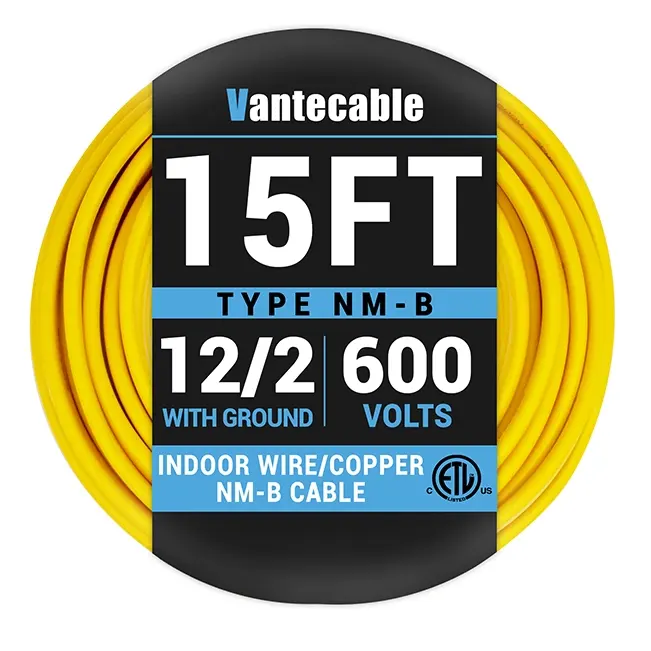
Vantecable 12/2 NM-B Wire With Ground
For compatible 3500 W / 240 V storage-heater circuits specifying 12 AWG copper and no neutral.
12/2 AWG with ground · Solid copper · 600 V · 15 / 25 / 50 / 100 ft · ETL Listed (Intertek)
Shop 12/2 NM-BStep 1: Read the Nameplate and Calculate Minimum Ampacity
Divide the nameplate watts by volts, then multiply by 1.25. NEC 422.13 treats fixed storage heaters of 120 gal or less as continuous loads, so the circuit must be rated for at least 125% of nameplate current. The nameplate is on the tank side or inside the access panel. Record the total input watts, the volts and any wiring notes.
On a dual-element heater, use the label’s total input and wiring configuration. Do not add the upper and lower element wattages unless the manufacturer states they operate at the same time.
For a 4500 W / 240 V heater, 18.75 A × 1.25 = 23.44 A. That requires 10 AWG copper with 30 A ampacity and a double-pole breaker of at least 25 A. A 25 A or 30 A breaker fits when permitted by the manufacturer’s instructions and does not exceed the heater’s marked maximum overcurrent protection.
Under this 125% calculation, a 30 A circuit supports up to 5760 W at 240 V:
30 A ÷ 1.25 × 240 V = 5760 W
Above that, such as 6000 W, move to a larger conductor size; the reference table shows 8 AWG copper.
Step 2: Choose the Cable: 10/2, 10/3 or Conduit
Use 10/2 NM-B when Step 1 calls for 10 AWG, the heater has no neutral terminal and the path allows NM-B.
Does the Heater Need a Neutral?
Follow the wiring diagram on the heater. Most conventional 240 V storage heaters need only two hots and a ground, because the heating elements connect across the two hot legs and do not require a neutral. If the circuit requires 10 AWG and the diagram shows a neutral connection, choose 10/3 NM-B: two hots, neutral and ground.
10/2 NM-B has a black conductor, a white conductor and a bare copper ground. When the white conductor serves as the second hot, permanently re-identify it at each termination and other visible, accessible locations. The identification should encircle the insulation; black marking tape is one suitable example.
The 600 V printed on the jacket is the insulation’s voltage rating, not the circuit’s load capacity.
Is NM-B Allowed on Your Path?
NM-B suits permitted dry indoor runs, including dry basement locations discussed in our NM-B in basements guide. Where the cable is exposed to physical damage, such as a garage wall near vehicles, protect it with conduit or another approved method.
A damp location rules NM-B out. If the design uses individual conductors in conduit, their rating must suit the location, including any wet conditions inside the raceway. Local code amendments may restrict the wiring method further.
Step 3: Check the Run Length
Check voltage drop using the actual cable route and heater current. The NEC informational note recommends keeping branch-circuit voltage drop at 3% or less. The table below estimates the drop at each one-way length with the heater’s nameplate current flowing.
| One-way run | 12 AWG / 3500 W | 10 AWG / 4500 W | 10 AWG / 5500 W |
|---|---|---|---|
| 50 ft | 1.2% | 0.9% | 1.2% |
| 100 ft | 2.3% | 1.9% | 2.3% |
| 150 ft | 3.5% | 2.8% | 3.5% |
Estimates assume a 240 V resistive load and solid, uncoated copper resistance at 75°C: 1.93 Ω per 1000 ft for 12 AWG and 1.21 Ω per 1000 ft for 10 AWG. They exclude upstream voltage drop and connection resistance. This resistance assumption does not change NM-B’s applicable ampacity limit.
The calculated 3% distance is approximately 159 ft for a 4500 W heater on 10 AWG and 130 ft for a 5500 W heater. These are estimates, not guaranteed maximum cable lengths.
If the estimated drop exceeds 3%, choose a larger conductor size and recalculate.
Step 4: Installation Overview
Confirm who may install the circuit before buying cable. Permit and licensing rules vary by locality, and some manufacturers require a qualified electrician: the Rheem manual says the branch circuit must be provided by one. Check your heater’s manual and your local building department.
Installation involves isolating the supply and verifying absence of voltage, routing and supporting the cable, completing the connections according to the manufacturer’s diagram, and checking the installation before energizing it. For typical NM-B installations, secure the cable within 12 in. of enclosure entries and at intervals not exceeding 4.5 ft, subject to the applicable box requirements and code exceptions.
Fill the tank and purge air according to the heater’s instructions before power is restored. Never energize a storage heater that is not full of water.
Planning other circuits in the same project? Our Home Electrical Wiring Guide compares 14/2, 12/2 and 10/2 NM-B.
FAQ: Water Heater Wire Size
Is 10/2 Wire Good for a Water Heater?
Yes, when the heater requires 10 AWG copper, two hot conductors and a ground, and the route permits NM-B. This commonly fits conventional 4500–5500 W / 240 V storage-heater configurations. Confirm the breaker requirement in the manufacturer’s instructions. If a neutral is required, the cable needs an additional insulated conductor.
Can I Use 12/2 Wire or a 20 A Breaker on a 4500 W Heater?
No, for the 4500 W / 240 V storage-heater configuration covered here. Its calculated minimum is 23.44 A, which exceeds the 20 A limit of 12 AWG copper NM-B. Use 10 AWG copper and the manufacturer-permitted 25 A or 30 A double-pole breaker.
A compatible 3500 W / 240 V unit may use 12/2 on a 20 A circuit, as shown in the reference table. For other loads, see our 20 A circuit sizing guide.
What Happens if a Water Heater Is Wired Wrong?
Incorrect wiring can create shock and fire hazards or cause breaker trips. If you suspect a wiring error, switch the breaker off and have an electrician check the circuit.
Pick the Right Wire for Your Heater
Match the heater’s rated input and wiring diagram to the required conductor size, conductor count and breaker. Then confirm the route and purchase length before ordering.
For compatible dry indoor installations, Vantecable’s 10/2 and 12/2 NM-B cables provide solid copper conductors with ground and are ETL Listed (Intertek).
Electrical Wire
Shop wire and cable for home wiring, landscape lighting, and equipment connections.
Shop Electrical Wire