


When the power goes out, the refrigerator is usually the first appliance people worry about — and the first one they reach for an extension cord to solve. A refrigerator extension cord should be selected from the refrigerator’s nameplate load, startup requirement and total route length — not from wire gauge alone. Check the appliance manual first; if temporary extension-cord use is permitted, use a grounded cord rated for the load and keep the run as short as practical.
Can You Use a Refrigerator Cord During an Outage?
Using an extension cord on a refrigerator only makes sense as a temporary measure during a power outage, not as a substitute for a dedicated outlet. Before doing anything else, check the refrigerator’s owner’s manual to confirm the manufacturer actually permits temporary extension-cord use — some do not, and that instruction overrides anything else on this page.
For example, refrigerator manufacturers commonly require that any extension cord used with a refrigeration appliance be a listed three-wire grounding appliance cord rated at least 15A — GE Appliances, for instance, states this directly while noting a dedicated outlet remains its primary recommendation. Check your specific refrigerator's manual for its manufacturer's instructions before using any cord.
If your manual allows it, use a three-prong, grounded cord, and never remove the ground pin to fit a two-prong outlet. Match the cord’s rating to the refrigerator’s load rather than whatever cord happens to be nearby, and keep the run as short as the setup allows — every extra foot adds resistance the compressor has to push through on startup. Treat the cord as a stopgap for the outage, then disconnect it once utility power or permanent wiring is restored.
Check Refrigerator Startup Watts
This is the section that actually decides whether 12/3 or 10/3 is the right call, and it starts with the appliance, not the cord.
Find the Refrigerator Nameplate Amps and Watts
Every refrigerator has a rating plate, usually on the back panel, the lower door frame, or inside the fresh-food compartment wall — check all three locations if it isn’t obvious at first. Look for the rated voltage (almost always 120V for residential units), the rated current in amps as specified by the manufacturer, confirming from the manual how that value should be used, and the input watts, using the value stated on the nameplate or in the manufacturer’s documentation rather than estimating it from voltage and current alone. The plate or manual may also give a startup requirement — model-specific starting-current, surge, or generator-sizing information. A locked-rotor amp (LRA) value may appear on the compressor, but it should not be treated as the refrigerator’s actual startup wattage without manufacturer guidance.
Make sure the numbers you’re reading match the exact model and serial number of your unit, not a similar-looking model in the same product line — compressor sizing can differ between otherwise similar refrigerators.
Compare Startup Watts with Generator Capacity
Once you have the refrigerator’s data from the nameplate and manual, compare it against what the generator can actually deliver. Check the generator’s own spec sheet for both its running (rated) watts and its surge or peak watts — these are two different numbers, and the surge figure is the one that has to cover the refrigerator’s startup demand. The generator has to cover the running load continuously and absorb the startup spike each time the compressor cycles on, not just the running number.
List everything else that might draw power from the same generator at the moment the compressor could start — lights, a sump pump, a phone charger, another appliance — and add those running loads to the refrigerator’s running load before checking headroom. Assume the compressor could start while those other loads are already active, since outages don’t schedule themselves around a fridge’s duty cycle. If the generator is an inverter type running in an eco or idle mode, be aware that it may take a moment to respond to a sudden startup surge; check the manufacturer’s guidance on whether eco mode should be disabled for appliances with a compressor.
Manufacturer “rule of thumb” multipliers for startup demand — a generic 2x or 3x running-watts estimate, for example — are useful only for rough planning, not a substitute for the refrigerator’s actual nameplate and manual data. If the compressor fails to start, the breaker trips repeatedly, or you notice lights or the compressor visibly sag when it cycles on, stop using that setup and re-check the generator’s capacity and the cord before trying again.
Choose 12/3 or 10/3 for a Refrigerator During an Outage
Once the load and startup numbers are confirmed against the generator, the gauge decision comes down to two refrigerator-specific situations — not a general AWG comparison.
When a 12/3 Refrigerator Cord May Fit
A 12/3 cord may be enough when the refrigerator’s manual confirms temporary extension-cord use is permitted, the rated load and startup demand fall within the complete cord set’s rating, and the route from the outlet or generator to the refrigerator is short. Watch for abnormal heat in the cord, repeated tripping, or compressor start difficulty during use — any of these means 12/3 isn’t the right fit for that setup.
For the complete cord-set rating, see our 12 gauge rating guide rather than repeating the general rating explanation here.
When a 10/3 Refrigerator Cord May Be Appropriate
A 10/3 cord may be appropriate when the route from the generator to the refrigerator is longer and you need to further reduce line resistance and startup-phase voltage sag over that distance. The plug type, voltage, and 15A rating of the complete cord set still need to match both the refrigerator’s plug and the generator’s receptacle.
What “10/3” means and how that gauge is built is covered in 10/3 gauge meaning — this article assumes you already know that and focuses on when to reach for it.
| Refrigerator Setup | What to Check |
|---|---|
| Shorter verified route | Whether 12/3 meets the appliance load, startup demand and manufacturer instructions |
| Longer generator-to-refrigerator route | Whether 10/3 is needed to reduce voltage drop |
| Unknown startup requirement | Check the model manual or manufacturer before selecting |
| Multiple appliances on one circuit | Add running and startup loads before connecting |
Connect a Refrigerator to a Generator’s 120V Receptacle
This step is scoped to the refrigerator connection only, not to generator setup in general. Confirm the generator provides a compatible, grounded 120V receptacle, and that circuit can carry both the refrigerator’s startup and running load, factoring in anything else already drawn from the same generator. Use an extension cord for refrigerator backup power that matches the refrigerator’s NEMA 5-15 plug and the generator’s compatible grounded 120V receptacle. Do not force or directly connect a refrigerator’s NEMA 5-15 plug to an L5-30, L14-30, or 50A receptacle; if power is supplied from one of these generator outlets, use properly rated distribution equipment that provides a compatible grounded 120V receptacle and appropriate overcurrent protection. And never use a male-to-male power cord to back-feed a generator into a home’s wiring — there is no safe way to do this with a standard extension cord, and it puts both people and equipment at risk.
If you’re setting up a generator connection beyond just the refrigerator — full house or panel-level backup, or a proper 30A/50A generator cord — that’s covered in Generator Extension Cords: The Professional Guide.
Refrigerator Power Cord Options During an Outage
Once the refrigerator load, startup requirement and route length have been confirmed, select the cord that fits that specific setup.
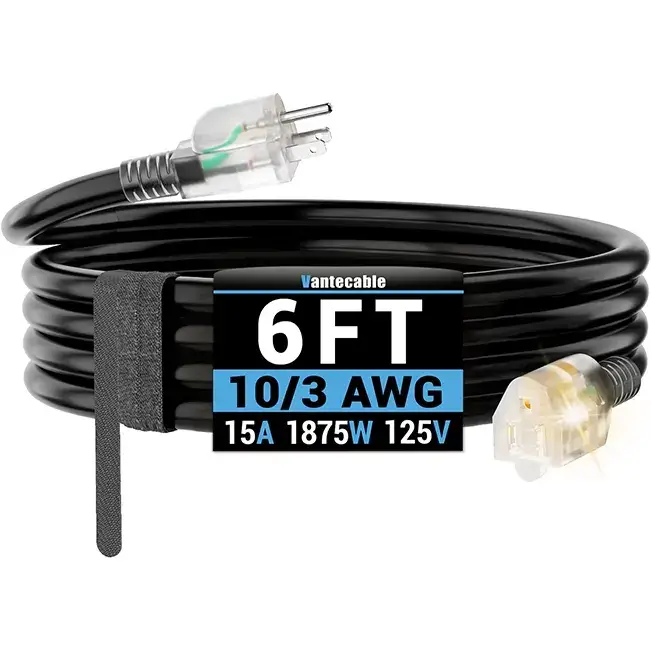
10/3 SJTW Extension Cord, Black, Lighted Indicator
25 ft · 10/3 AWG · SJTW · 15A / 125V / 1,875W · ETL Listed · Lighted indicator
From $14.99
Shop Now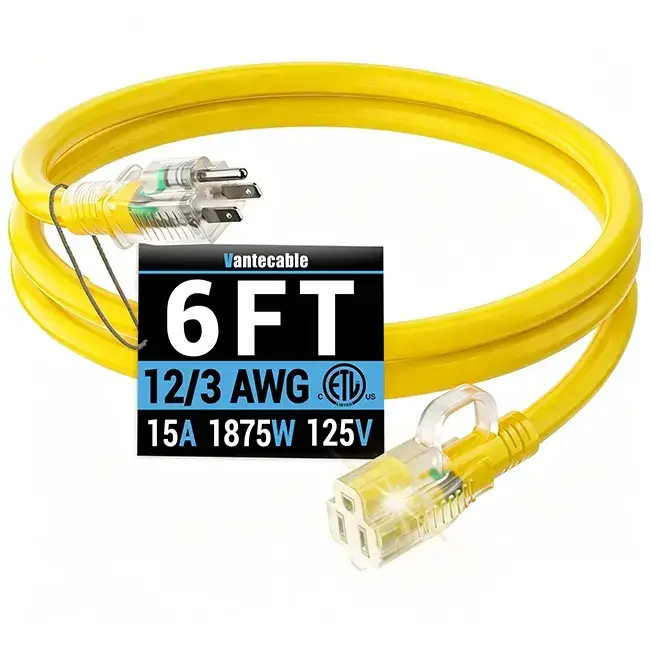
12/3 Heavy Duty Lighted Extension Cord
12/3 AWG · SJTW · 15A / 125V / 1,875W · Lighted plug · ETL Listed · Not for submerged use
From $19.99
Shop NowRefrigerator Extension Cord Checklist
Before you plug a refrigerator into anything during an outage, confirm:
- Refrigerator manual — does it permit temporary extension-cord use at all?
- Nameplate voltage and current
- Startup requirement (from the manual or manufacturer, not calculated from LRA alone)
- Generator running and surge capacity
- A compatible, grounded 120V receptacle
- Total route length from source to refrigerator
- The exact rating of the complete cord set — plug type, voltage, amperage
- Any other loads sharing the same generator circuit
A cord that’s damaged, wet, or missing its ground pin defeats all of the above regardless of gauge — OSHA’s guidance on flexible cords covers the condition-related risks worth inspecting for before each use.
FAQ
Can I plug a refrigerator directly into a generator?
Yes, but only through a compatible, grounded 120V receptacle with sufficient running and starting capacity. Do not force a NEMA 5-15 refrigerator plug into an incompatible generator outlet or use a male-to-male cord.
How do I find my refrigerator’s startup watts?
Check the owner’s manual or ask the manufacturer for model-specific starting-current, surge, or generator-sizing information. Do not calculate actual startup watts directly from the compressor’s LRA value.
Can a refrigerator and freezer share one generator circuit?
Only if the generator’s running and surge capacity cover both units’ running loads plus either one starting up while the other is already running. Add the loads together before connecting, rather than assuming there’s headroom.
Conclusion
Check the refrigerator manual and nameplate, account for startup demand, confirm the generator’s compatible 120V output, and then select the shortest grounded cord that meets the complete setup. For the cords sized to do that, see the Emergency Power Cords collection.