

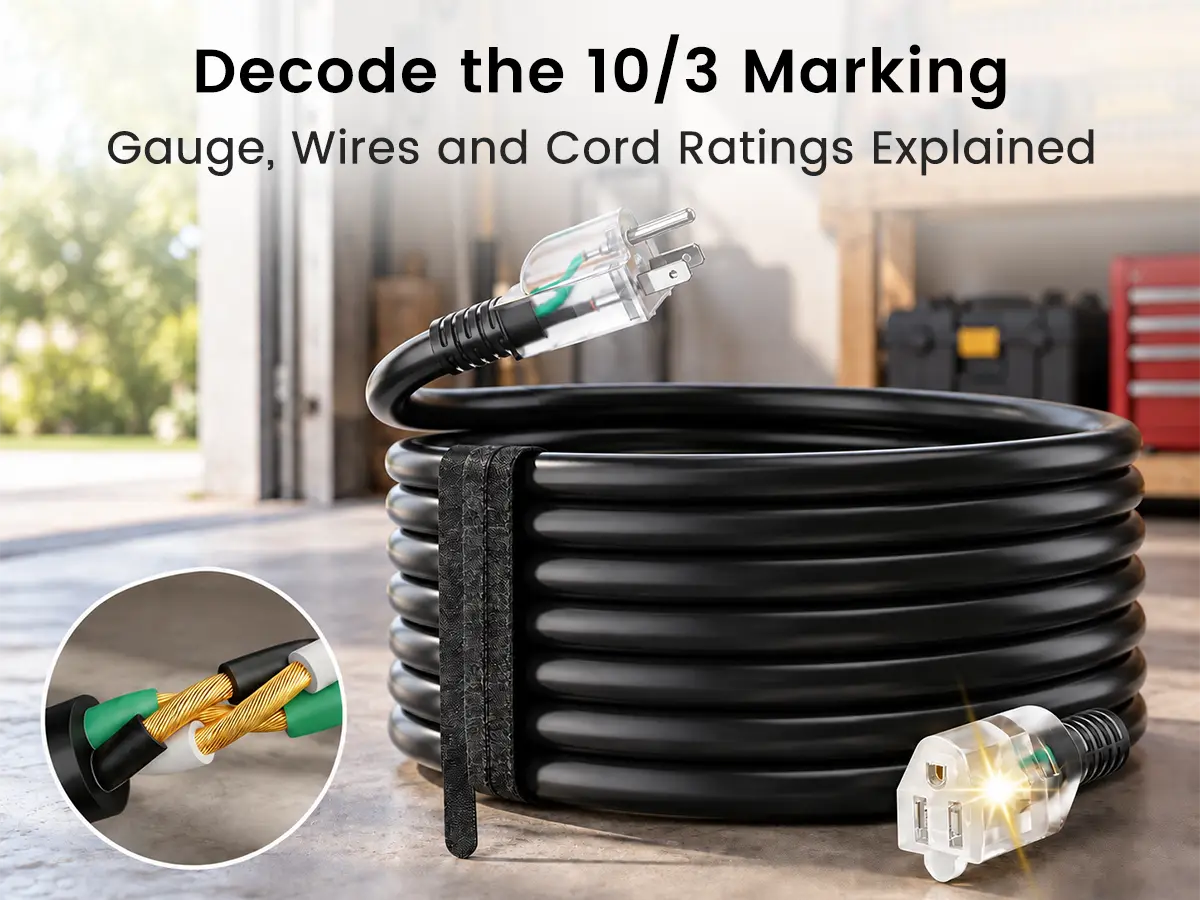
Seeing “10/3” printed beside a 15A rating can be confusing. Some buyers associate 10 AWG conductors with higher-current wiring and assume that a 10/3 extension cord must carry 30 amps. A portable cord, however, is rated as a complete assembly rather than by conductor size alone.
The 10/3 gauge extension cord meaning is three 10 AWG conductors inside the cord. The marking describes conductor size and count; it does not mean 10 amps, and it does not automatically make the finished cord a 30A product. A cord fitted with NEMA 5-15 connectors and labeled 15A must remain within that 15A rating.
This guide explains how to read 10/3 together with the cord’s SJTW jacket, plug configuration, length and product label. You can also browse Vantecable’s extension cords to compare available gauges and connector configurations.
What Does 10/3 Mean on an Extension Cord?
When someone asks what does 10/3 mean, the simplest answer is “10-gauge, three-conductor cord.” The two numbers describe related but separate parts of the cord’s construction.
The first number identifies conductor size under the American Wire Gauge system. The second number tells you how many conductors are contained within the cable assembly. Neither number directly states how much current the finished extension cord is approved to carry.
This notation helps describe the cable, but it is only one part of the information needed to select an extension cord.
What the 10 Gauge Extension Cord Marking Means
A 10 AWG conductor is larger than a 12 AWG conductor under the American Wire Gauge system. When conductor material, current and cord length are otherwise comparable, the larger conductor has lower resistance and can help reduce voltage drop over distance. This is one reason 10/3 cords are often considered for longer runs or equipment with more demanding starting loads.
However, choosing 10/3 does not automatically provide a higher usable amperage. The complete cord-set rating still depends on the plug, connector, insulation, jacket and certified product configuration. A 10/3 cord equipped with NEMA 5-15 connectors and marked 15A must still be used within its 15A rating.
If you are comparing the heavier 10 AWG construction with a 12 AWG option, our guide to the 12/3 cord marking explains how 12 AWG conductors, the three-conductor configuration and the finished cord rating work together.
What the Three Conductor Extension Cord Marking Means
The “3” in a 10 gauge 3 conductor extension cord means that three separate conductors run through the cable.
In a conventional grounded 120V extension cord with a standard three-prong configuration, one conductor carries the energized line, one provides the neutral return path and one provides the equipment-grounding path.
The exact conductor function must still be confirmed from the finished cord’s wiring and connector configuration. The “3” only reports the number of conductors; it does not independently prove which electrical system the cord was designed to serve.
This is why 10/3 extension cord explained correctly means more than identifying three wires. The connector, voltage marking and product label are needed to determine how those conductors are used.
10/3 Extension Cord Explained: What the Marking Does Not Tell You
The 10/3 gauge extension cord meaning is often misunderstood because buyers try to use the notation as a complete electrical rating. It is not.
A 10/3 marking does not independently identify the finished cord’s maximum current, operating voltage, wattage, plug configuration, approved environment, jacket material, temperature range or safety certification.
These details should appear elsewhere on the cord jacket, attached label, plug, packaging, specification sheet or certification record.
Why a 10 Gauge Cord Rating Is Not Determined by AWG Alone
A conductor size and a cord-set rating are related, but they are not interchangeable.
Conductor ampacity describes how much current a conductor may carry under specified conditions. Those conditions can include insulation type, ambient temperature, conductor arrangement, permitted application and the standard or code table being applied.
A cord-set rating applies to the complete assembled product. It accounts for more than the conductor inside the jacket. The plug, female connector, terminals, insulation, strain relief and overall tested configuration are also part of the finished product.
This explains why a 10 gauge extension cord can be equipped with a 15-amp plug and carry a 15-amp finished-product rating. The larger conductor does not change the rating of a 15-amp plug or receptacle. The cord must be used according to the lowest applicable rating in the complete assembly.
Consumers sometimes associate 10 AWG building wire with a 30-amp circuit and assume that every 10 AWG extension cord is therefore a 30-amp cord. That conclusion is not reliable. Fixed-building wiring and portable cord sets are different products, and the permitted current depends on the complete application and listed configuration.
Never substitute a gauge-based estimate for the marked rating on the finished cord.
How the 10/3 Cord Label Defines the Usable Rating
The product label should be the primary reference when deciding whether a cord is appropriate for a tool or appliance. Look for amperage, voltage and wattage information in addition to the gauge.
The plug configuration provides another important limit. A 10 AWG cable assembled with a 15-amp straight-blade plug does not become a 30-amp cord simply because its conductors are thicker than those in many general-purpose cords.
The equipment must also remain within the cord’s marked rating. If a tool lists current in amps, compare that number with the cord label. If it lists input watts, compare its rated wattage with the cord’s marked capacity. Motor-driven equipment may also have starting-current requirements, so the equipment manufacturer’s instructions remain important.
The table below lists the main markings commonly found on a cord, with the emphasis on separating conductor information from complete-product ratings.
| Marking | What it identifies | What it does not prove by itself |
|---|---|---|
| 10 AWG | Conductor gauge | Finished cord amperage |
| /3 | Three conductors | Conductor functions or circuit voltage |
| SJTW | Flexible-cord construction and outdoor-use designation | Exact plug type or load capacity |
| Amp rating | Maximum marked current for the product | Suitability for every appliance |
| Voltage rating | Maximum marked operating voltage | Connector compatibility |
| Watt rating | Marked power limit at the specified voltage | Starting requirements of motor loads |
| Plug configuration | Physical and electrical connection type | Jacket rating or conductor size |
| ETL Listed | Certification through Intertek’s ETL program | Suitability beyond the marked application |
How SJTW Completes the 10/3 Extension Cord Marking
A cord marked 10/3 SJTW combines conductor information with a flexible-cord designation. The 10/3 portion identifies gauge and conductor count, while SJTW describes a 300V-class thermoplastic flexible cord intended for outdoor use. Our SJTW meaning guide provides the complete letter-by-letter explanation and comparisons with related jacket designations.
The jacket code does not replace the complete product specifications. Keep outdoor connections dry and protected, and confirm product-specific temperature, oil-resistance, UV and other environmental claims from the cord label or supporting documentation rather than assuming that SJTW covers every condition.
10/3 With Ground vs a 10 Gauge 3 Conductor Extension Cord
The terms 10/3 with ground and 10 gauge 3 conductor extension cord are sometimes used as though they mean the same thing. In common North American product labeling, they may describe different conductor counts.
On a flexible three-prong extension cord, “10/3” generally refers to three conductors in total. In the usual 120V configuration, those three conductors serve line, neutral and equipment ground.
On some fixed-building cable, “10/3 with ground” commonly refers to three insulated circuit conductors plus a separate equipment-grounding conductor. That construction contains four conductors in total, even though “10/3” appears in the description.
This difference matters because building cable is not an extension cord. The products have different jackets, conductor construction, installation requirements and intended uses. Fixed-building cable should not be fitted with portable cord ends and treated as an extension cord, and flexible extension cord should not be used as a substitute for permanent wiring.
When reading a listing, first identify the product category. Then check whether the stated conductor count includes the grounding conductor.
10/3 Gauge Extension Cord Meaning for Length and Voltage Drop
Gauge does not change as a cord gets longer, but electrical resistance accumulates with conductor length. As the distance between the source and the equipment increases, voltage drop becomes more important.
A 10 gauge extension cord generally offers lower conductor resistance than a comparable 12 gauge cord of the same material and length. That can be useful for longer runs or equipment with higher current demand. It does not eliminate voltage drop, and it does not permit the cord to exceed the marked rating of its plug or connector.
Voltage drop deserves closer attention when the cord is long, the connected equipment operates near the cord’s rating, or the load includes a motor, pump or compressor. Connection quality also matters. A worn receptacle, loose plug or contaminated contact can introduce additional resistance at a localized point.
The shortest practical cord is normally the better choice. Excess length adds resistance, weight and storage requirements without improving the electrical connection.
For a direct comparison of the two heavy-duty gauges, see our 10 vs 12 guide. This article does not repeat that comparison because the purpose here is to explain the 10/3 marking rather than rank different wire sizes.
How to Read a 10/3 Extension Cord Rating Label
A buyer evaluating a 10/3 extension cord should read the entire label in a consistent order.
Start with the conductor marking to confirm gauge and conductor count. Next, check the jacket designation to determine whether the cord is marked for the intended environment. Then identify the amperage, voltage and wattage ratings. Finally, confirm the plug configuration, certification mark and permitted applications.
The table below compares what can be learned from “10/3” with the information that must be checked elsewhere, helping prevent gauge from being mistaken for a complete rating.
| Question | Answered by 10/3? | Where to verify it |
|---|---|---|
| What is the conductor gauge? | Yes | Cord jacket or product label |
| How many conductors are present? | Yes | Cord jacket or product label |
| Is a ground included? | Not conclusively | Plug configuration and wiring documentation |
| What is the amp rating? | No | Finished cord-set label |
| What is the voltage rating? | No | Product label and specifications |
| What is the wattage limit? | No | Product label or rated volts × rated amps |
| Is it suitable for outdoor use? | No | Jacket designation, such as W |
| What plug does it use? | No | Product images, label and connector designation |
| Is it independently certified? | No | Certification mark and listing record |
Do not rely on jacket color to answer these questions. Black, yellow and orange jackets can improve visibility or suit different environments, but color is not a standardized substitute for electrical markings.
A lighted connector is also separate from the 10/3 gauge extension cord meaning. On a conventional lighted-end cord, the indicator normally shows that power has reached the connector. It does not independently verify correct polarity, grounding continuity, available amperage, voltage quality or the condition of the connected equipment.
Choosing a 10 Gauge 3 Conductor Extension Cord
A 10 gauge 3 conductor extension cord may be appropriate when a grounded piece of equipment requires a heavy-duty connection, particularly where cord length makes resistance and voltage drop relevant. Gauge alone, however, should never be the only selection criterion.
Before using the cord, confirm the equipment’s input voltage, rated current or wattage, required plug configuration, distance from the power source and operating environment. The cord’s label and certification must also apply to the intended use.
For equipment with a motor, check the manufacturer’s cord recommendations. Starting demand, operating conditions and permitted cord length may affect the required size even when the normal running current appears to be within the cord’s rating. For a broader review of wire size, length and equipment load, use our gauge chart.
The Electrical Safety Foundation International recommends using a cord rated for the connected product, avoiding damaged or unusually warm cords, and not using extension cords as permanent wiring. It also advises against removing the grounding pin or forcing an incompatible plug into an outlet.
Vantecable 10/3 AWG Black Outdoor Extension Cord
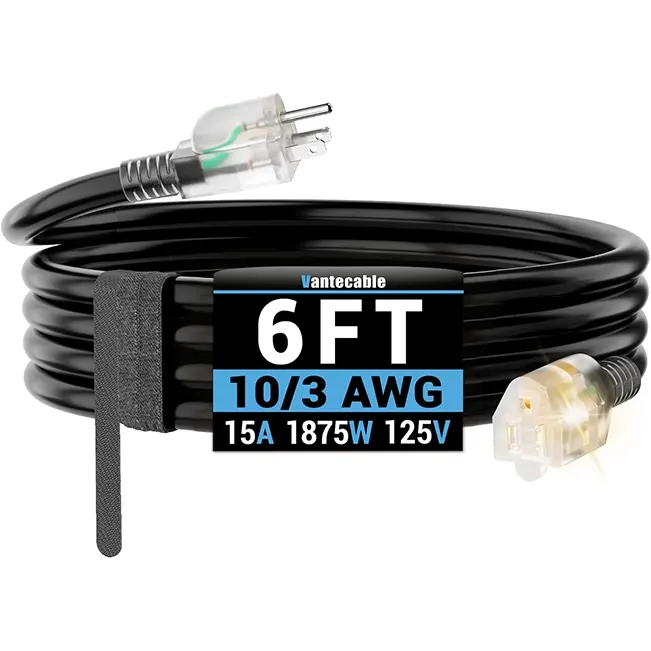
Vantecable 10/3 Gauge Outdoor Extension Cord
- 10/3 AWG construction
- Black SJTW jacket
- LED lighted end
- Available in multiple lengths from 6 ft to 200 ft
- ETL Listed
- Designed for outdoor extension-cord applications
This Vantecable cord combines 10 AWG conductors with a three-conductor SJTW construction. The lighted connector provides a visible indication when power reaches the female end, while the black jacket gives the cord a low-profile appearance in workshops, yards and jobsite environments.
The ETL Listed mark indicates that the product has been evaluated through Intertek’s certification program to applicable safety requirements. Intertek’s ETL Listed Mark guidance explains the mark and provides access to its product directory. Intertek, rather than the ETL mark itself, is the OSHA-recognized Nationally Recognized Testing Laboratory.
Always select the required length before purchase and confirm the electrical rating and connector configuration on the product label. Do not infer those specifications from 10/3 AWG alone.
10/3 Gauge Extension Cord Meaning FAQ
Is 10/3 the same as 10/3 with ground?
Not always. On a typical three-prong flexible extension cord, 10/3 generally means three conductors in total, commonly line, neutral and equipment ground. In fixed-building cable terminology, 10/3 with ground may mean three insulated conductors plus a separate grounding conductor. Always identify the cable type before interpreting the conductor count.
Can a 10/3 extension cord have a 15-amp plug?
Yes. A 10/3 extension cord can be assembled with a 15-amp plug and connector. In that case, the cord must be used according to its finished 15-amp cord-set rating. The larger 10 AWG conductors do not raise the rating of a 15-amp connector.
Does 10/3 mean the extension cord is rated for 30 amps?
No. Although 10 AWG conductors are commonly associated with some 30-amp wiring applications, 10/3 alone does not establish a 30-amp extension-cord rating. The finished cord’s amperage depends on its connectors, insulation, construction and certified product rating.
Can a 10/3 cord be used for both 120V and 240V equipment?
The 10/3 marking alone cannot answer that question. It identifies gauge and conductor count, not the operating voltage or circuit configuration. Use the cord only when its voltage rating, connector type and manufacturer instructions match the equipment and power source.
Does a black jacket mean a 10/3 extension cord is outdoor-rated?
No. Jacket color does not determine whether a cord is approved for outdoor use. Look for the applicable jacket designation, such as the W in SJTW, and confirm the product’s stated application.
Does the LED Lighted End Mean a 10/3 Cord Is Handling the Load Safely?
No. The LED indicator only confirms that voltage is present at the female end when the cord is plugged in and energized. It does not indicate whether the connected equipment is operating within the cord’s rated capacity, whether the grounding path is intact, or whether the plug and connector are running warm from a sustained heavy-duty load. On longer runs or higher-demand equipment, periodically check the plug and connector by hand instead of relying on the light alone.
10/3 Extension Cord Explained: Conclusion
The 10/3 gauge extension cord meaning is straightforward once the two numbers are separated: “10” identifies the 10 AWG conductor size, and “3” identifies three conductors inside the cord. The marking describes construction, but it does not provide a complete electrical rating.
To choose a cord correctly, read beyond 10/3. Confirm the jacket designation, amperage, voltage, wattage, connector configuration, cord length and certification mark. If the cord uses a 15-amp plug, follow the complete cord-set rating even though the 10 AWG conductors are larger than those used in many general-purpose extension cords.
A properly selected cord should match the connected equipment, the available receptacle and the operating environment. Browse Vantecable’s extension cords to compare available gauges, lengths and outdoor configurations.