


For the products compared in this guide, power cable types fall into three practical forms: finished cord sets connect equipment to a power source, bulk portable cord is used in compatible flexible assemblies, and building wire or cable forms part of a fixed wiring system. This guide explains how to tell these forms apart and identify the category that fits your project.
Electrical Wire
Shop wire and cable for home wiring, landscape lighting, and equipment connections.
Shop Electrical WireWhat Are the Three Main Power Cable Types?
Finished cord sets, bulk portable cord and building wire differ by how they are supplied and where they are allowed to be used.
| Power cable type | Supplied form | Primary use | Vantecable examples |
|---|---|---|---|
| Finished cord set | Plug and connector attached | Temporary or movable equipment power | Extension, generator and RV cords |
| Bulk portable cord | Flexible cord without finished ends | Compatible custom flexible assemblies | SOOW and SJOOW |
| Building wire or cable | Installed and terminated as part of a wiring system | Permanent circuits | NM-B and UF-B |
Which Finished Cord Set Fits Your Equipment?
Choose a finished cord set by what it connects: an extension cord runs from a receptacle to equipment, a generator cord runs from a generator outlet to equipment or an inlet, and an RV cord runs from a campsite pedestal to the RV inlet. Each is built for a different connector pair and load, and each is limited by the lowest rating among its cable, plug and connector, so read the label on the complete product. For gauge and rating details, see 10/3 Gauge Extension Cord Meaning.
When Does a Standard Extension Cord Fit?
Use a standard extension cord when compatible plug-in equipment only needs more distance from a matching receptacle, such as a work light in the yard, a power tool in the garage or a temporary fixture. Compare the equipment nameplate with the complete cord rating, length, connector configuration and indoor or outdoor marking.
When Do You Need a Generator Cord?
Use a generator cord when the generator has a locking or higher-amperage outlet that must connect to compatible equipment, a distribution device or a properly installed power inlet. Match the exact outlet and inlet configurations, voltage and amperage. Common examples include NEMA L5-30, L14-30, 14-50 and SS2-50 configurations, but the generator and connected equipment determine the required cord.
When Do You Need an RV Power Cord?
Use an RV power cord when connecting an RV to a compatible campsite pedestal or home supply for 30A or 50A service. Common configurations include TT-30 for 30A and 14-50 for 50A, so match the plug and connector ends to the supply outlet and the RV inlet or shore-power cord. A standard NEMA 5-15 extension cord cannot replace a specified 30A or 50A RV cord.
When Does Bulk Portable Cord Fit a Power Cable Project?
Use bulk portable cord when movable equipment requires a flexible cord in a specific length or connector configuration and the equipment instructions permit that wiring method. Bulk cord is supplied without finished ends, so compatible plugs, connectors and strain relief must be selected, installed and checked by a qualified person before use. If you are unsure, choose a finished cord set instead.
Bulk portable cord fits these situations:
- Replacing an approved flexible equipment lead when the manufacturer permits replacement
- Creating a compatible cord assembly in a required length or connector configuration
- Connecting movable equipment where the applicable instructions permit flexible cord
It does not fit these situations:
- Fixed wiring inside walls or underground: use building wire or cable (see the next section)
- A ready-to-plug cord for tools or appliances when you do not plan to install ends: use a finished cord set
Once compatible ends and strain relief are installed, the result is a field-assembled cord set. It should not be described as carrying the listing of a factory-finished cord set unless the completed assembly has been evaluated and marked accordingly.
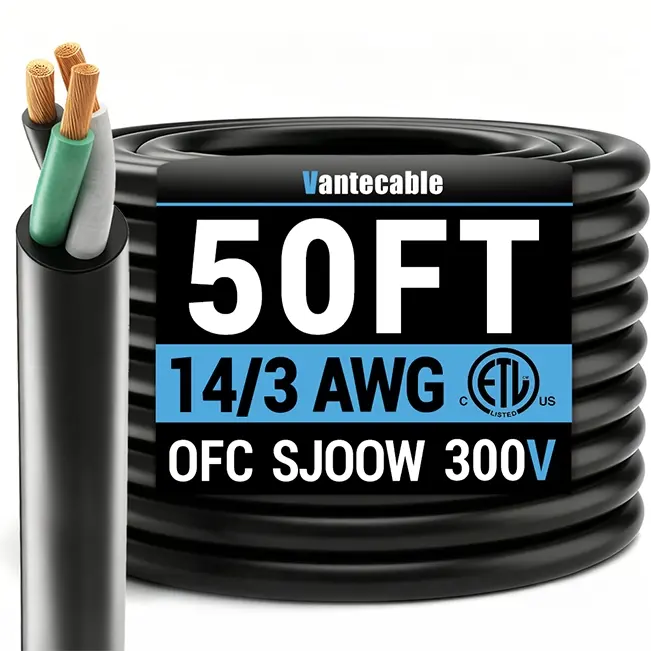
The two bulk families differ mainly by voltage class: SOOW is a 600V portable cord, and SJOOW is a 300V junior-service portable cord. To choose between them, read SOOW vs. SJOOW.

When Does a Power Cable Project Require Building Wire?
Building wire belongs in permanent electrical installations. NM-B is used for permitted dry indoor routes, while UF-B may fit wet or underground fixed routes when the exact cable is marked for that use. Neither should be fitted with portable cord ends and used as an extension cord, and flexible portable cord is not a substitute for an approved permanent wiring method. For project-specific selection, use the Home Electrical Wiring Guide.
Which Markings Matter for Each Power Cable Type?
Start by identifying the product form, because a finished cord set, bulk portable cord and building cable use their markings differently.
| Product form | Where to look | Markings that matter most |
|---|---|---|
| Finished cord set | Complete-product label and attached ends | Voltage, current or wattage, length, connector configuration, environment and listing mark |
| Bulk portable cord | Repeating jacket legend | Cord type, AWG, conductor count, voltage class, temperature information and listing mark |
| Building wire or cable | Cable jacket or sheath legend | Cable type, conductor size and count, voltage rating, permitted location and listing mark |
For a finished cord set, follow the rating of the complete assembled product rather than estimating capacity from AWG alone. On bulk portable cord, the jacket identifies the cable but does not establish the rating or listing of a completed field-assembled cord set. Building-cable markings identify the wiring method, while the circuit design and installation requirements determine where that cable may be used; for wet and underground routes, see the UF-B Buying Guide.
For jacket letters, bulk cord sizes or length and gauge limits, use the related guides below.
Power Cable Types FAQ
Is a Power Cord the Same as an Extension Cord?
No. A power cord connects equipment to a power source, while an extension cord adds distance between a receptacle and compatible equipment. Both may be finished cord assemblies, but they serve different connection needs.
Which Cable Is Considered a Power Cable?
A power cable is generally a cable designed to deliver electrical power rather than primarily carry data or communication signals. Finished extension cords, bulk SOOW cord and NM-B building cable can all fall within that broad term, but they belong to different product categories and are not interchangeable.
Is SOOW a Power Cord or a Cable?
SOOW is a flexible portable-cord designation. It is often sold as bulk cable without attached ends, but the SOOW marking identifies the flexible cord itself. Depending on how it is terminated, it may become an equipment power lead or part of a field-assembled cord set.
Conclusion: Choose the Product Form Before the Cable Size
Identify the product form first, then compare voltage, current, conductor count, length, connectors and operating environment. This order keeps a similar gauge or jacket appearance from leading you to the wrong category.
Electrical Wire
Shop wire and cable for home wiring, landscape lighting, and equipment connections.
Shop Electrical Wire